This manual is for SOC FPX 1150 Assessment 2, start to submission. A middle assessment in this course usually turns to collaboration, which students underestimate because it looks like the easy part of the title. The assessment usually asks you to explain why a group is failing to produce something everybody wants, and to propose a response that changes an incentive rather than an attitude. Delegation is available, and a premium original sample locating where benefit and effort come apart returns inside 24 to 48 hours, with revision included until it scores. Capella's catalog lists the course as SOC-FPX1150, and some courserooms print SOC1150; both point to this same Assessment 2.
One honesty note before the manual: Capella revises courses and scoring guides over time, so always write to the exact scoring guide attached to your assessment in the courseroom. The course identity above is verified on capella.edu; the method and structure below are our tutors' approach to it, not Capella's official rubric text.
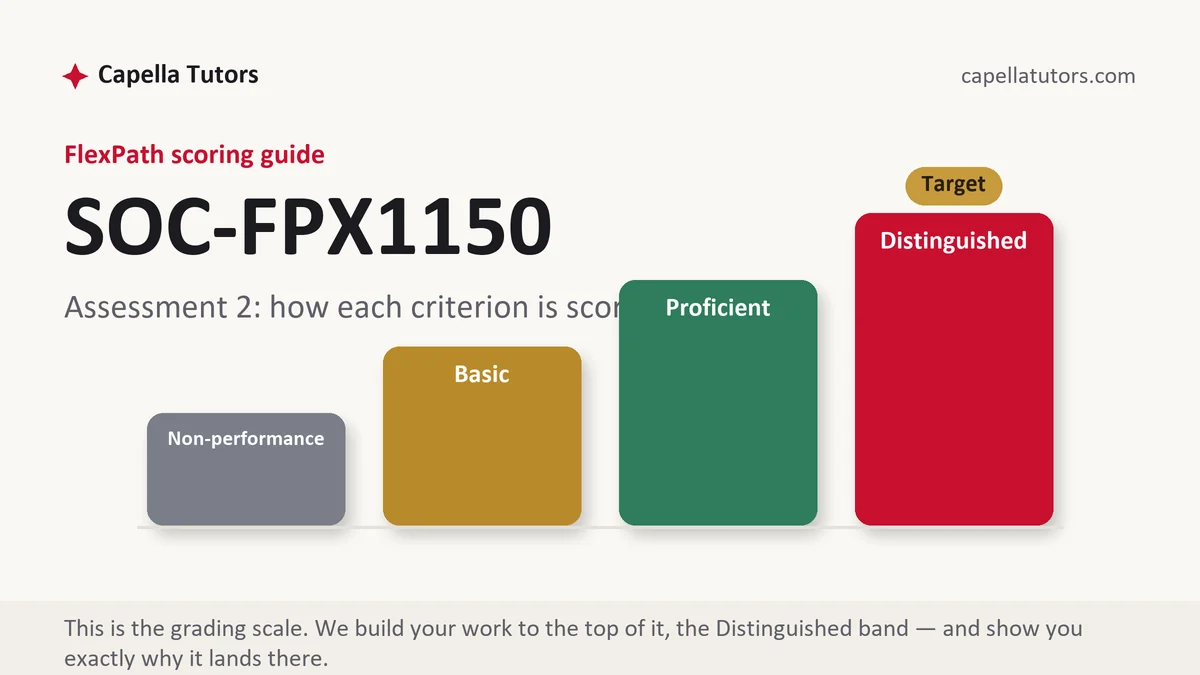
How SOC FPX 1150 Assessment 2 is scored
Rows are read separately against four levels, and that wording is the specification you build to:
| Level | What it means on a collaboration and problem-solving analysis |
|---|---|
| Distinguished | The free-rider logic addressed rather than assumed away, the proposal given a named owner, and the incentive it changes identified explicitly. |
| Proficient | The group problem explained with a concept and a workable response proposed. |
| Basic | A call for better communication and more commitment. The classic middle-column proposal here. |
| Non-performance | A required element absent, most often the response or the owner. |
Shared goods attract free riding whenever the benefit reaches everybody and the effort does not, which is the logic Olson set out in 1965. It explains why a volunteer rota collapses in month three while everybody still supports the cause, and a proposal that ignores it is proposing goodwill.
The SOC FPX 1150 Assessment 2 method, step by step
-
Map the criteria and state what the group is failing to produce
Name the good, say who receives it, and say who currently supplies the effort. A problem described as low morale cannot be analyzed, and a problem described as a shortfall in a specific output can be.
-
Check the size of the group
Groups behave differently by size. A pair holds together only while both members stay, and a third member creates the possibility of a majority and of a mediator. Beyond a certain size anonymity makes informal sanction nearly impossible, which is usually the mechanism doing the damage.
-
Separate the benefit from the effort
Write down who gains when the work is done and who pays when it is. Where those two sets differ, you have found the mechanism, and the analysis criterion is satisfied by saying so rather than by describing the mood of the people involved.
-
Predict where the problem should be worst
If your account is right, the failure should concentrate somewhere: among newer members, in the shifts nobody watches, in the parts of the work with no visible output. Stating that prediction is what shows the concept is doing explanatory work.
-
Change an incentive, and give it an owner
A proposal that asks people to care more has changed nothing. Assign a named responsibility, make the contribution visible, reduce the group to a size where sanction works, or attach a benefit to the effort. Then say who owns each change, because an unowned proposal is not implementable.
-
Attribute and check, then self-score
Cite the concept to the person who developed it, cite data to the agency rather than to the article that mentioned it, and reconcile every figure with its source. Then mark your own level on each row and keep the review window free.
A structure that maps to the criteria
Planning targets our tutors use for a collaboration deliverable, not Capella requirements; your scoring guide decides where the length sits.
| Section | What it must do | Guide |
|---|---|---|
| The shortfall | The good the group is failing to produce, who receives it, and who supplies the effort now. | ~160 words |
| Group size and structure | How many people, how visible each contribution is, and what sanction is available. | ~230 words |
| The mechanism | Where the benefit and the effort come apart, stated as a logic rather than as a mood. | ~280 words |
| Evidence | Data or published research on comparable settings, with year, geography and population. | ~250 words |
| The proposal | The incentive or norm that changes, who owns each part, and what would show it worked. | ~250 words |
| References | Concepts attributed to their originators, data cited to the agency, current APA both ways. | as needed |
Annotated sample excerpt
A model excerpt from our team showing a proposal that changes an incentive rather than an attitude. Study the logic, then rebuild it around the group your prompt names.
The good is coverage: someone has to be reachable for the 40 to 60 calls a year that arrive between 7 a.m. and 5 p.m., and the benefit of that coverage reaches all 1,900 residents of the township while the cost falls on whichever of the 22 members can leave a paid job.1 That gap is the mechanism, and it predicts exactly where the roster should fail, which is on weekday daytime shifts rather than at night, among the members who joined most recently and hold the least seniority to negotiate with an employer, and in the tasks with no visible output such as equipment checks.2 So the proposal is not a recruitment drive, it is four changes to the incentive: a posted daytime roster naming one primary and one backup by date, a per-call stipend funded from the existing township line, a written arrangement with the two largest local employers, and a monthly log of completed equipment checks posted at the station, with the assistant chief owning the roster and the treasurer owning the stipend.3
- 1Quantifies the good, the beneficiaries and the contributors in one sentence, which is what lets the mechanism be named rather than asserted.
- 2States the prediction the logic implies and locates it in three specific places. A concept that predicts is a concept being used.
- 3Replaces exhortation with four incentive changes and attaches a named owner to two of them. An owner is what makes a proposal gradeable as a response.
The full premium sample for your exact assessment, written fresh to your scoring guide and issue, is free to request. Study it, revise it into your own voice, and submit work you understand.
The five mistakes that cost Distinguished
- A proposal that asks people to care more. Goodwill is not an incentive, and a response built on it changes nothing the analysis identified.
- Free riding assumed away. Wherever the benefit is shared and the effort is not, the logic applies, and ignoring it is the standard failure of this row.
- Group size left out. Anonymity and the availability of sanction depend on how many people are involved, and the number belongs in the analysis.
- No owner named. An unowned change cannot be implemented, and the criterion asking for a response reads it as a wish.
- Society written about as though it were a person. Society decided nothing, and naming the township, the employer or the department is always the stronger sentence.
Pre-submission checklist
- The shortfall is a specific output with beneficiaries and contributors named
- Group size and the available sanction are stated
- The mechanism is written as a logic, not as a mood
- The account predicts where the failure should concentrate
- Every proposed change has an owner and an incentive it alters
- Concepts credited to the people who built them, data cited to the producing agency, APA reconciled in both directions
Collaboration section due and the proposal keeps sounding like a pep talk?
Send the criteria and the group, organization or setting you were assigned. The draft names the good, locates where benefit and effort come apart, predicts where the failure sits and proposes changes with owners attached. Back inside 24 to 48 hours, with free rework until nothing on the guide is left short.