This manual is for SOC FPX 1150 Assessment 1, start to submission. An opening assessment in a sociology course usually asks for a change of altitude: something you have watched happen to one person, shown to be patterned, then brought back down to what the pattern does to that person. The assessment usually asks for public data rather than opinion, with the geography, the year and the population attached. Or hand it across: a premium original sample with every figure sourced to a named public dataset comes back inside 24 to 48 hours, revised until the rows clear. Capella's catalog lists the course as SOC-FPX1150, and some courserooms print SOC1150; both point to this same Assessment 1. In current courserooms this assessment typically appears as "Learning to Use Your Sociological Imagination".
One honesty note before the manual: Capella revises courses and scoring guides over time, so always write to the exact scoring guide attached to your assessment in the courseroom. The course identity above is verified on capella.edu; the method and structure below are our tutors' approach to it, not Capella's official rubric text.
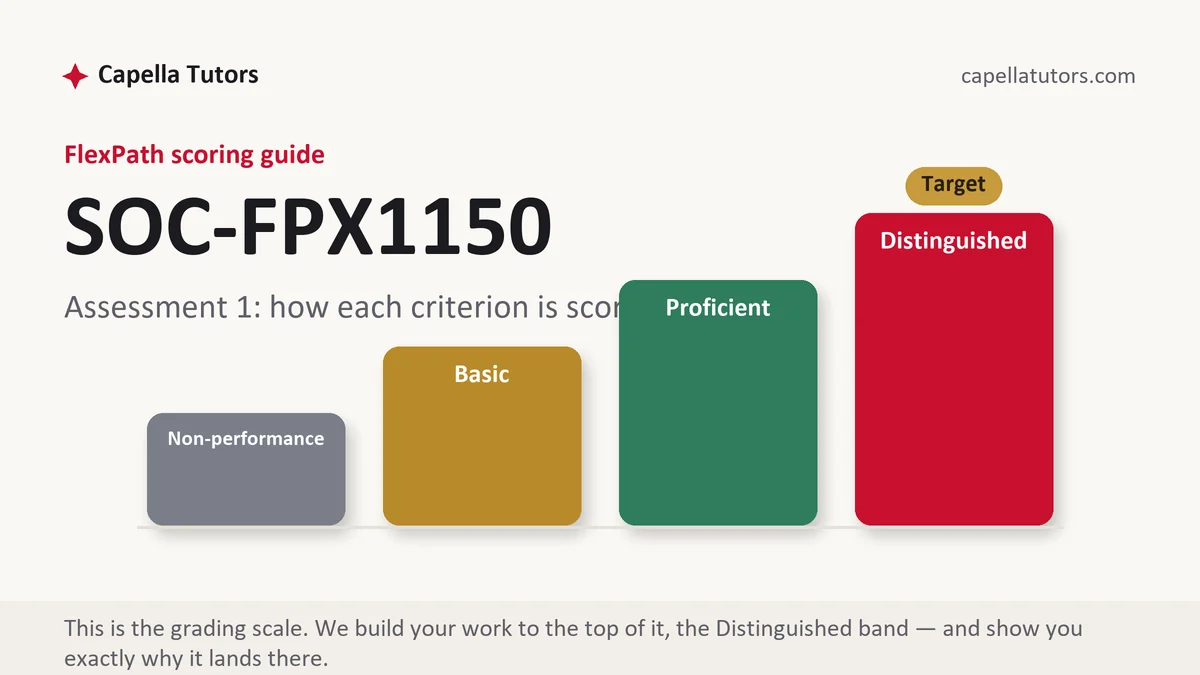
How SOC FPX 1150 Assessment 1 is scored
FlexPath grades each criterion by itself, at one of four levels, and the level wording is the brief:
| Level | What it means on a social structure analysis |
|---|---|
| Distinguished | Figures reported with their denominator, a second source that agrees or does not, and a prediction the account itself implies about the same setting. |
| Proficient | A pattern established from data and explained with a concept. |
| Basic | A personal observation generalized with a citation attached that shares its subject. The commonest result on a first structural analysis. |
| Non-performance | A required element absent, most often the evidence. |
Mills drew the line this course is built on when he separated a personal trouble, which belongs to a biography, from a public issue, which belongs to a structure. One person affected is a trouble. Four hundred affected the same way is an issue, and no account built out of individual character will explain it.
The SOC FPX 1150 Assessment 1 method, step by step
-
Turn the criteria into headings, then narrow to a place and an outcome
Neither inequality nor community is a question a paper can answer. A place, a population, an outcome and a period make one, and it has to be narrow enough that evidence could contradict it. That narrowing is the decision the rest of the paper rests on.
-
Operationalize the concept before you use it
Define the concept in your own words and say how you would recognize it if you saw it. That step is what separates a sociology paper from an essay about how things feel, and a criterion asking you to apply a concept is asking whether the concept has a recognizable referent.
-
Build each section as a four-rung ladder
Begin at the observation, in specifics. Move up to the concept that names it. Bring the evidence, which means a dataset, a study or a recorded case carrying its year and the group it covers. Then come back down and say what the concept predicts should also be true in that setting. The last rung is the one most drafts skip.
-
Report every figure with its denominator
A rate needs the population it describes, the geography it covers and the year it was collected. Numbers without denominators cannot be compared, and a second source that agrees or disagrees is what turns one estimate into evidence.
-
Hold the level of analysis
Decide whether your explanation runs at the level of interaction, organization or institution, and stay there unless you move deliberately and say so. Sliding between levels changes the subject mid-argument, and a group statistic read onto an individual is the specific error this course exists to prevent.
-
Attribute the theory, then self-score
The sociological imagination is Mills, latent functions are Merton, symbolic interactionism is Blumer's term. A first course is where that habit forms or does not. Then check every figure against the source it came from, grade each row yourself, and submit early, since faculty have two business days.
A structure that maps to the criteria
Word counts are our tutors' planning targets for an analysis of this kind, not Capella rules; wherever your guide asks for more, write more.
| Section | What it must do | Guide |
|---|---|---|
| The question | A place, a population, an outcome and a period, stated so evidence could contradict it. | ~150 words |
| The observation | What you watched happen, in specifics, before any concept is applied to it. | ~220 words |
| Concept and level | The concept defined and made recognizable, with the level of analysis named and held. | ~250 words |
| Evidence | Public data or published research with source, year, geography and population, plus a second source. | ~300 words |
| What the account predicts | What should also be true in this setting if the explanation is right, and whether it is. | ~230 words |
| References | Current APA both ways, concepts attributed to their originators, data cited to the agency. | as needed |
Annotated sample excerpt
A model excerpt from our team, showing a trouble carried up into an issue and back down again. Learn the four rungs in it, then build them around the setting your own prompt names.
The bell moved from 8:35 to 7:35, and the parent I spoke with lost the twenty minutes that had let her drop two children off before an 8:00 shift.1 That is a trouble until it is patterned, and the pattern is visible in the district itself: 61 percent of elementary families in these four attendance zones list a household adult whose reported work start is before 8:00, against 34 percent district-wide, and the American Community Survey estimates for the same tracts show a median commute of 31 minutes with 18 percent of workers using transit.2 The concept is not inconvenience, it is the fit between institutional schedules that were set independently of each other, and if the account is right then two further things should hold in this setting, that late arrivals rose most in the zones with the highest transit share and that the effect is concentrated in the youngest grades where a child cannot be left alone, both of which the district attendance data can confirm or refuse.3
- 1The observation in specifics, with a time and a shift. One person, named as one person, which is the starting rung rather than the argument.
- 2Two figures with denominators, geographies and a comparison, plus a named survey with its estimates. This is the rung that turns a trouble into an issue.
- 3Names the concept as a relation between institutions rather than a feeling, then states two predictions the account implies and says what data would settle them. Predicting is the rung that demonstrates understanding rather than recall.
The full premium sample for your exact assessment, written fresh to your scoring guide and issue, is free to request. Study it, revise it into your own voice, and submit work you understand.
The five mistakes that cost Distinguished
- A view held first and a reference attached to it afterward. The source has to support the specific claim rather than merely share its subject.
- Personal character used to explain a pattern. If the same behavior appears across thousands of people, personal failing is the explanation the evidence rules out.
- A group statistic read onto one person. A rate belongs to a group, and reading one person out of it is exactly the reasoning this material is meant to stop.
- A figure with no denominator. Percentages that do not say of what cannot be compared with anything, including each other.
- A concept named and never operationalized. If the paper cannot say how the concept would be recognized, the concept is a label.
Pre-submission checklist
- The question names a place, a population, an outcome and a period
- The observation is written in specifics before any concept arrives
- The concept is defined and made recognizable
- Every figure carries source, year, geography and population
- The level of analysis is named and held, or moved deliberately
- Concepts attributed to their originators, APA matched both ways
Sociology assessment due this week?
Send the criteria, the setting you want analyzed and the perspective your courseroom is using. The draft comes back with figures pulled from named public datasets, each carrying its geography, its year and its population, so a reader can go and check. It returns inside 24 to 48 hours, reworked at no charge until nothing on the guide is short.