This manual is for SOC FPX 1150 Assessment 3, start to submission. A closing assessment in this course usually asks you to apply a sociological perspective and defend the choice. The assessment usually wants one perspective doing the analytical work rather than three named in an introduction, and it wants the choice justified by the question you asked. If you would rather hand it over, a premium original sample holding one perspective at one level arrives inside 24 to 48 hours, revised free until the criteria are satisfied. Capella's catalog lists the course as SOC-FPX1150, and some courserooms print SOC1150; both point to this same Assessment 3.
One honesty note before the manual: Capella revises courses and scoring guides over time, so always write to the exact scoring guide attached to your assessment in the courseroom. The course identity above is verified on capella.edu; the method and structure below are our tutors' approach to it, not Capella's official rubric text.
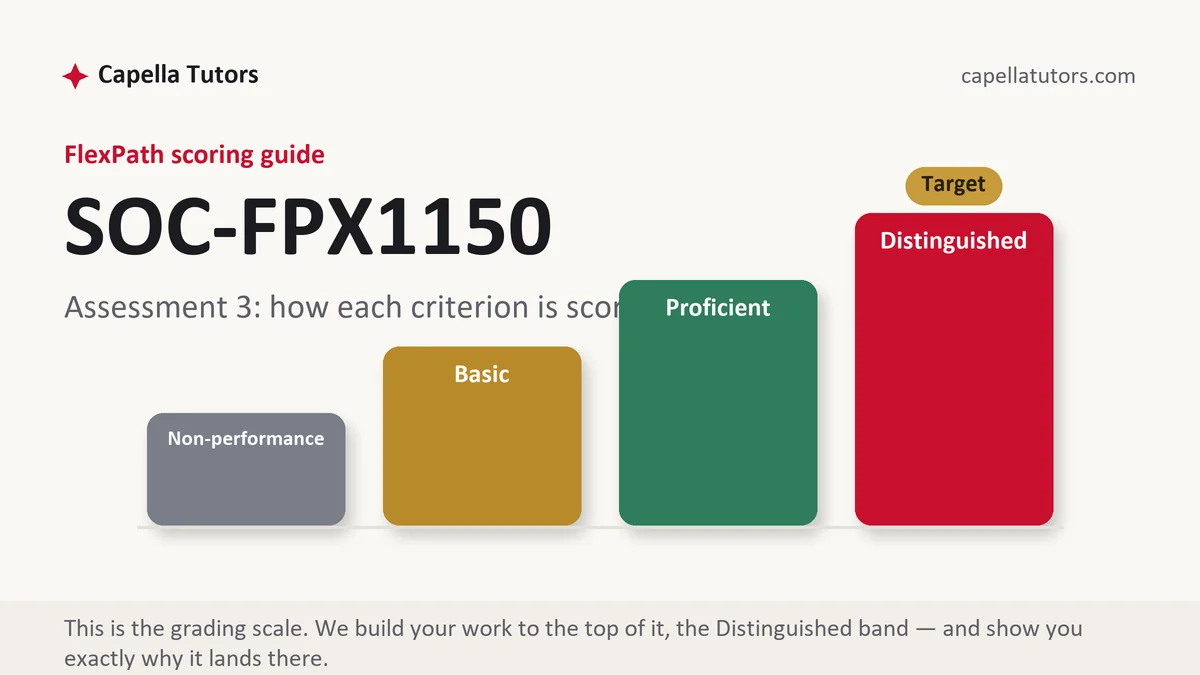
How SOC FPX 1150 Assessment 3 is scored
Each criterion is placed on one of four levels on its own merits, and the level wording is your specification:
| Level | What it means on a perspective application |
|---|---|
| Distinguished | A frame chosen for the question rather than listed, what it leaves out admitted, and the level of analysis held throughout. |
| Proficient | A perspective correctly applied to the case and defended in a sentence. |
| Basic | A frame announced at the start and doing no work anywhere after it. The commonest way this criterion is lost. |
| Non-performance | A required element absent, usually the application. |
Each perspective answers a different question about the same case. The functionalist frame asks what an arrangement does for the whole and gets sharper with Merton's distinction between intended consequences and unannounced ones. The conflict frame asks who sets the terms and who absorbs the cost. Symbolic interactionism works at eye level, where meaning is produced in the exchange itself, and it explains things the other two step over.
The SOC FPX 1150 Assessment 3 method, step by step
-
Turn the criteria into headings and write the question first
The perspective follows the question, not the reading you liked most. Write the question down, then choose by what it asks: what an arrangement does for its beneficiaries, who sets the rules and absorbs the cost, or how meaning gets made in an exchange.
-
Defend the choice in a sentence
Say why this frame fits this question and name what it will not reach. Two perspectives are fine where the assessment invites comparison, on one condition: apply each to the same case and say what each reveals that the other misses. Naming three and applying none is how the row is usually lost.
-
Fix the level of analysis and stay on it
Interaction, organization and institution are different subjects, and a paper that slides between them has changed what it is about. If your frame works at eye level, keep the evidence at eye level and resist the pull toward statistics that describe a different unit.
-
Record the exchange before you interpret it
Write what was said and done, in order, with the roles named and no meaning claimed yet. An interpretation with no exchange under it has nothing to be checked against, and this is where interaction-level papers most often thin out.
-
Use each kind of evidence for what it can do
Survey data tells you how widespread something is and cannot tell you what an arrangement means to the people inside it. Interview and observational work tells you the mechanism from a sample never designed to estimate a prevalence. Say which question each source answers, then use one to test the other.
-
Attribute, reconcile, then self-score
Cite the concept to the person who built it, the data to the agency and the release year, and confirm every figure still matches its table. Then score every row yourself and submit early enough that the review window costs you nothing.
A structure that maps to the criteria
Treat the figures below as our tutors' working plan rather than a Capella rule, and shift the weight wherever your guide asks.
| Section | What it must do | Guide |
|---|---|---|
| The question and the frame | The question asked, the perspective chosen, and the sentence defending the choice. | ~170 words |
| The exchange, recorded | What was said and done, in order, with roles named and no interpretation yet. | ~250 words |
| Level of analysis | The unit the explanation runs at, stated, with any move between levels made deliberately. | ~200 words |
| The interpretation | What the exchange produces, using the frame, with the concept attributed to its originator. | ~290 words |
| What the frame misses | What another perspective would catch here, and why it is not the one governing the paper. | ~230 words |
| References | Peer-reviewed work for patterns, documented cases for mechanism, current APA both ways. | as needed |
Annotated sample excerpt
An original excerpt from our team showing an interaction held at its own level. Read it for the discipline, then apply the same frame to the exchange your prompt describes.
At the intake desk the volunteer asks for a name, a household size and a zip code, writes them on a numbered card, and hands the card across; from that moment the person is addressed by the number for the rest of the visit.1 Nothing in the exchange is unkind and none of it is accidental, and the interactionist reading is that the card is where the identity of client is produced, because it converts a person with a reason for being there into a case with a position in a queue, and both parties then behave toward the card rather than toward each other.2 This account is held deliberately at the level of the interaction and does not reach the question of why the pantry needs a queue at all, which is a question about funding and demand that a conflict frame would answer better, and naming that boundary is what keeps the analysis honest rather than making it complete.3
- 1The exchange recorded in order, with roles and objects named and no meaning claimed. An interactionist paper lives or dies on whether this paragraph exists.
- 2Applies the frame to the object in the exchange and says what the object does, attributing the mechanism to the interaction rather than to anybody's intent. Refusing to blame is what keeps the analysis at eye level.
- 3States the level explicitly, names the question the frame cannot answer, and says which perspective would answer it. Admitting the boundary is the top-column move rather than a weakness.
The full premium sample for your exact assessment, written fresh to your scoring guide and issue, is free to request. Study it, revise it into your own voice, and submit work you understand.
The five mistakes that cost Distinguished
- A perspective named and never used. The frame has to produce the analysis, otherwise it is a label sitting in an introduction.
- Three perspectives listed and none applied. Breadth here reads as avoidance, and the row asks for one frame doing work.
- Levels crossed without notice. An interaction explained with institutional statistics has changed its subject halfway through.
- Interpretation with no exchange recorded. A claim about meaning needs the words and actions it was drawn from.
- Qualitative and quantitative treated as rivals. Each answers a different question, and ranking them is a mistake this course watches for.
Pre-submission checklist
- The question is written before the perspective is chosen
- The choice of frame is defended in a sentence
- The exchange is recorded in order with no interpretation inside it
- The level of analysis is stated and held
- What the frame misses is named, with the perspective that would catch it
- Every concept credited to its originator, every figure cited to the agency behind it, APA checked both ways
Perspective application due and the frame keeps disappearing?
Send the criteria, the setting and the perspective your course is working from. The draft defends the frame against the question, holds one level of analysis, records the exchange before interpreting it, and names what the frame cannot reach. Returned inside 24 to 48 hours, and reworked without charge until the whole guide is satisfied.