Send the capstone prompt, the scoring guide and the papers you already have, and an original premium draft is with you within 24 to 48 hours, matched to the Distinguished wording of the criteria, scoped so your existing reading can actually support it, with revisions free until the score lands. The catalog line is PSYC FPX 4900, Psychology Capstone Project, 3 program points, the capstone of Capella's FlexPath BS in Psychology, scheduled in the final quarter after PSYC FPX 4600 and not satisfiable by transfer credit or prior learning, inside a degree that runs to 90 program points or more, 27 of them at the 3000 level or above. In Capella's catalog the course code is written PSYC-FPX4900.
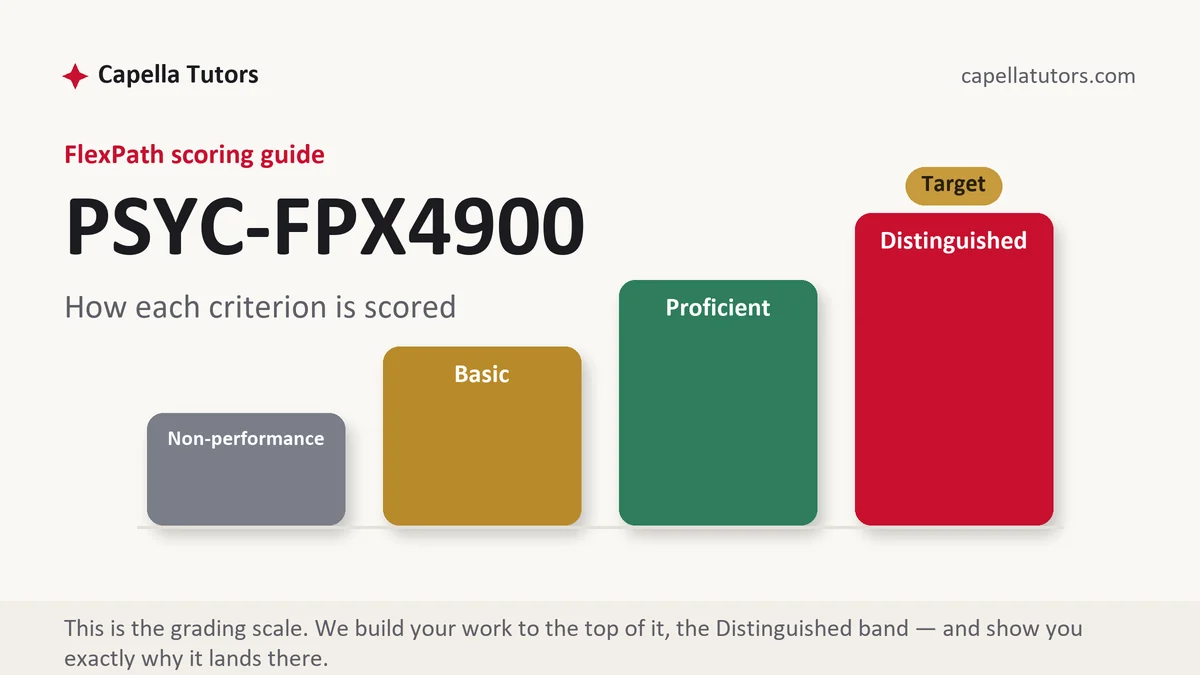
What PSYC FPX 4900 actually grades
The first thing to understand is that nothing new is being taught. Every earlier course handed you a topic, a theory and often the sources; this one asks what you have. The criteria are written at program level rather than course level, which means they look across several skills at once, whether you can locate and weigh research, whether you can apply theory to a question that matters outside a classroom, whether you can reason ethically about it, and whether you can write so that an intelligent reader who is not a psychologist follows you. The practical consequence is that the work of the course is selection. Choosing one question narrow enough to answer with reading you can actually obtain is most of the grade.
The second thing graded is assembly, and the distinction that matters is reuse against recycling. Carrying forward a literature search, a construct definition, a coding scheme or a dataset you built earlier is expected and sensible, because the degree was designed to accumulate. Submitting an earlier paper again, or lifting paragraphs from it without a citation, is an integrity problem with its own rules, and the fix is simple: cite your own prior work the way you would cite anyone's. The statistics course gave you the ability to read a results section, research methods gave you the vocabulary for design, history gave you the arc of the argument, and the specialization courses gave you the topic. A capstone that shows those four doing work together reads differently from one that mentions them.
The third thing graded is ethics used rather than quoted. Professional codes and review requirements appear in most capstone guides, and the Basic version reproduces a principle while the Distinguished version applies it to a decision the project actually faces: what you would do with identifiable workplace material, why the project stays a scholarly review rather than becoming human-subjects research, who could be harmed by a recommendation drawn from thin evidence. An undergraduate capstone is normally a scholarly project rather than a study on people, and saying that in one sentence, with the condition that would change it, satisfies the criterion more cleanly than a page of general commitment.
How we help in this course
Start by sending the guide, the list of courses you have finished and the two or three strongest papers you wrote along the way. The analyst reads those first, because the fastest route through this course is a question your existing shelf already supports. From there the whole document is drafted as one piece rather than as sections stapled together, with the integration and the ethics criteria written deliberately instead of appended at the end.
The commercial terms do not change for the capstone. One premium original piece of work at a time, measured against the Distinguished column of the guide you send, back in 24 to 48 hours, through the same eight readers, with one pass reserved for reading the document as a non-specialist would and flagging every term that arrives undefined. Revisions stay free until the criteria clear, and faculty comments come back into the cycle at no charge, which matters most in a long document where one structural note affects every section.
The assessments, one by one
Assessment 1
Analyze a capstone case study in which a cultural crisis arises from a lack of professional cultural competency, identify the issues, and recommend solutions. Read the full Assessment 1 manual.
Assessment 2: An Ethical Analysis of a Case Study
Identify the ethical concerns in a case, apply APA and other professional ethical principles and standards, propose alternative solutions and support them with research. Read the full Assessment 2 manual.
Assessment 3: Comprehensive Case Presentation
Present a case study analysis covering cultural differences, ethics, professional behaviors and solutions, integrating knowledge from the psychology program. Read the full Assessment 3 manual.
How to actually write PSYC FPX 4900: where to begin
Take the guide apart, then take stock. Each criterion becomes a heading, and underneath it goes the Distinguished language and the question of what evidence you already hold that could satisfy it. Then list every substantial paper you have written in the program with its topic and its best three sources, and choose your question from the deepest column in that list. In current courserooms the assessments include "An Ethical Analysis of a Case Study" and "Comprehensive Case Presentation" among others, and your scoring guide decides the exact format of each.
Then name, in writing, how this differs from everything you have submitted so far, because the differences are what the criteria are built on. Earlier assessments gave you the scenario and the theory, so the reading was mostly done for you; here you choose the question and defend the choice. Earlier criteria examined one skill at a time; here a single criterion can ask for evidence, application and ethical reasoning in the same paragraph. Earlier work was short enough that structure took care of itself; at capstone length, headings, signposting and the order of sections become graded features. Earlier readers were faculty who had just taught you the terminology; here the reader is treated as capable but not specialist, so the introduction you would have skipped in an abnormal psychology paper is now required, and every construct is defined the first time it appears.
Then write for that reader on purpose. Define a term in a sentence that contains no other undefined term, and do it at first use rather than in a glossary. Put the plain claim in front of the statistics, so the reader learns that employees who completed the short scheduling training missed fewer shifts before they meet the numbers that support it. Keep the discipline's hedges, associated with, consistent with, suggests, because they are accurate, and drop the discipline's shorthand. Read the draft aloud once and mark every sentence you would have to explain to a competent colleague in another field, then fix those sentences rather than defending them.
Then close with an answer rather than a summary. The final section says what the evidence supports, how confident that lets you be, what the project could not settle, and what the next step would be. Students continuing into graduate work often reuse this document as a writing sample, and the ones who plan on the MS in Psychology should write it knowing a graduate committee may eventually read it.
| Section | What goes in it | What Distinguished looks like |
|---|---|---|
| Question and significance | The question, its boundaries, and why it matters to someone outside the classroom. | A question narrow enough to answer with obtainable sources, with the stakes stated concretely. |
| What is already known | The review, organized by claim, with the strength and design of the evidence behind each one. | Disagreement in the literature named and adjudicated rather than averaged into a middle position. |
| Approach | How the question is addressed, whether by review, analysis, applied proposal or case work. | The approach justified against an alternative, with what it cannot deliver stated up front. |
| Integration across the program | The earlier coursework the project draws on, and what each contributed. | Prior learning used as a tool in the argument, cited where it is your own earlier writing. |
| Ethics | The codes and review requirements that apply, and the decisions in this project they govern. | A principle applied to a specific choice, with the condition that would change the answer named. |
| Communication and references | Structure, definitions, plain-language framing, current APA in both directions. | Every construct defined at first use, and each statistical result preceded by its plain sentence. |
Developing the synthesis
The capstone synthesis is organized by claim, never by source. Build a table before you write with one row per study and columns for design, sample, measure and finding, then write your review from the columns rather than the rows, so each paragraph advances a claim and cites the three studies that bear on it. A section that walks through sources one at a time is the clearest signal that integration has not happened.
Then make the earlier courses argue with each other where they disagree. A design point from methods can undercut a finding your specialization course presented as settled, and saying so is the highest-value paragraph in the document, because it demonstrates the program outcome the criteria are really testing. Where the literature splits, say which body of work you find more persuasive and why, on grounds a reader can check, then state what would change your mind.
Citations that survive faculty review
The review has to be built rather than remembered. Run the searches deliberately in the Capella library, PsycINFO, PsycARTICLES and PubMed where the topic reaches health, record the terms, the databases and the date range you used, and keep that record. Prefer primary empirical articles to reviews that summarize them, prefer peer-reviewed work to trade and popular writing, and where a framework or an instrument is central, go to the source that introduced it rather than to a later author describing it.
Two rules apply here more than anywhere else in the degree. Cite your own earlier coursework when you carry text or analysis forward, since self-citation is a normal scholarly act and its absence is what turns reuse into a problem. And keep the reference list clean enough to survive a spot check, with every citation in the paper present in the list and every entry in the list present in the paper, formatted in current APA, because a long document multiplies small formatting errors.
The mistakes that land Basic instead of Distinguished
- A question too large to answer. Anything phrased as the effects of social media on mental health is a book, and a capstone graded against it will read thin everywhere.
- An earlier paper resubmitted. Reuse is fine and expected; reuse without a citation is an integrity matter with consequences beyond the grade.
- Terminology left undefined. At capstone length a reader who is not a specialist is assumed, and unexplained constructs cost the communication criterion.
- An ethics section that quotes a code and applies nothing. Principles are graded on the decision they governed, not on the accuracy of the quotation.
- A conclusion that summarizes. The last section answers the question asked at the start, with the confidence the evidence supports.
PSYC FPX 4900 questions students actually ask
Can I reuse a paper I already submitted?
You can reuse the work, and you have to handle it correctly. Carrying earlier searching, sources and analysis into the capstone is exactly what the course is for. What you cannot do is present earlier text as new writing, which is the reason self-citation exists: quote or paraphrase your own prior paper and cite it the way you would cite anybody else's. If you are unsure how much reuse your instructor accepts, ask before drafting rather than after, and keep the earlier files.
How do I pick a capstone question small enough to answer?
Work backwards from the sources you can actually obtain. Start with a topic you already have reading on, then narrow it on three axes at once, the population, the outcome and the setting, until you can state the question in one sentence with all three in it. A question about whether a brief scheduling intervention reduces absenteeism among hourly retail employees is answerable with a modest set of studies. A question about workplace stress is not. Then run one search and count. If the search returns thousands of loosely relevant results, the question is still too broad; if it returns almost nothing peer-reviewed, it is too narrow or too new, and you should widen one axis rather than all three.
Who am I actually writing this for?
Write for an intelligent reader outside psychology, because most capstone guides describe the audience that way and the criteria follow from it. In practice that means two habits. Define each construct the first time it appears, in ordinary words. And lead every result with a plain sentence, putting the statistics behind it as support rather than as the claim itself. Your faculty evaluator will read the whole thing, but they are scoring whether the non-specialist reader would have understood it, which is a different and stricter standard than the one your earlier courses applied.
Capstone due this quarter?
Send the guide, your finished courses and your strongest earlier papers. First premium sample free, scoped to what your reading can support.