This manual is for PSYC-FPX4900 Assessment 3, start to submission. The closing deliverable is the assembled document, and assembly is the word the criteria are built around: earlier coursework carried forward and made to do work inside one argument, ethical reasoning applied to a decision the project actually faces, and the whole thing written so a capable reader outside psychology can follow it from the first page. Carrying forward searches, definitions and analysis is what the degree was designed for; handing in an earlier paper again is a different matter with its own consequences, and the difference between the two is a citation. Below is our tutors' method for assembling it, a structure keyed to the criteria, and an annotated excerpt from an original model. Want the assembly handled with backup? A premium original sample for this exact assessment arrives inside 24 to 48 hours, revised free until the criteria clear. Your courseroom may print this as PSYC FPX 4900 Assessment 3 or PSYC4900 Assessment 3; it is the same deliverable, and PSYC-FPX4900 Assessment 3 is what this manual walks through.
One honesty note before the manual: Capella revises courses and scoring guides over time, so always write to the exact scoring guide attached to your assessment in the courseroom. The course identity above is verified on capella.edu; the method and structure below are our tutors' approach to it, not Capella's official rubric text.
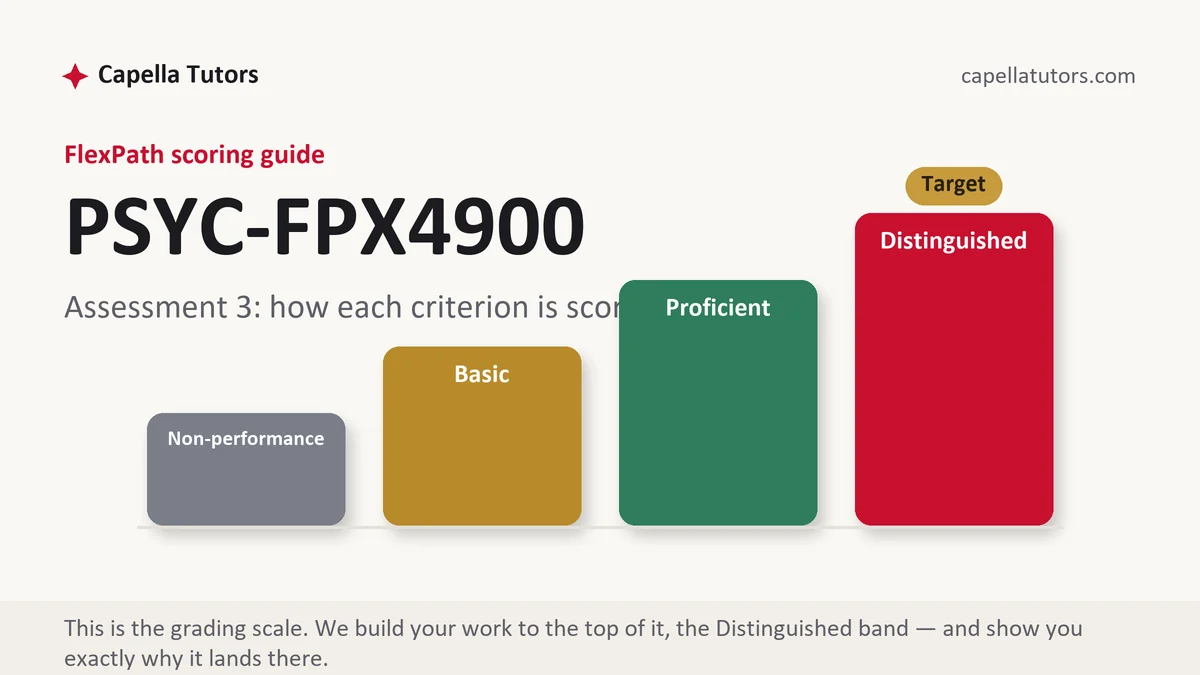
How PSYC-FPX4900 Assessment 3 is scored
Each criterion sits at one of four levels on its own, and in a long document one structural note from an evaluator can affect several of them at once:
| Level | What it means on the assembled capstone |
|---|---|
| Distinguished | Prior learning is used as a tool inside the argument and cited where the work is your own, one principle is applied to a decision the project actually faces, and every construct is defined the first time it appears. The top column rewards the document that reads as one piece. |
| Proficient | Complete and coherent, with an integration section that describes the earlier courses rather than putting them to work. |
| Basic | Sections joined end to end, earlier coursework mentioned in passing, a professional code quoted accurately and applied to nothing. |
| Non-performance | An earlier paper submitted again, or the ethics element missing from the document entirely. |
The last section is where the most marks are quietly available. A capstone closes with an answer, not a recap: what the evidence supports, how confident that lets you be, what the project could not settle, and what a next step would be.
The PSYC-FPX4900 Assessment 3 method, step by step
-
Read the guide twice, for structure and then for integration and ethics
The first pass gives you the sections. The second pass finds the two criteria students write last and lose most on, integration and ethics, which have to be planned into the document rather than appended to it. Put them in the outline as sections before you draft anything else.
-
Inventory what you are carrying forward and label it
List every element of earlier work you intend to reuse: a construct definition, a search strategy, a coding scheme, a set of sources, a paragraph of analysis. Mark each one as reused text, reused method or reused sources. Anything in the first category needs a citation to your own paper, in the same form you would use for anyone else's.
-
Make the earlier courses argue with each other
The highest-value paragraph in the document is usually the one where a design point from methods undercuts a finding a specialization course presented as settled. Find that collision and write it out, because it demonstrates the program outcome the criteria are really testing rather than describing it.
-
Apply one principle to a decision this project faces
Pick a real choice: whether identifiable workplace material can be used, why the project remains a scholarly review rather than research on people, who could be harmed by a recommendation drawn from thin evidence. Then name the principle, apply it, and state the condition that would change your answer.
-
Read the whole thing as a non-specialist would
Read it aloud once and mark every sentence you would have to explain to a competent colleague in another field, then fix those sentences instead of defending them. Define each term in a sentence containing no other undefined term, at first use rather than in a glossary at the back.
-
Close with an answer, then self-score
The final section answers the question the first section asked, at the confidence the evidence allows. Then mark every criterion at one of the four levels, check the reference list against the citations in both directions, and submit early in the week; a long document gives an evaluator more places to find a small formatting error.
A structure that maps to the criteria
Planning proportions our tutors use for an assembled capstone, not Capella rules; the integration and ethics sections are the ones most guides describe in the greatest detail.
| Section | What it must do | Guide |
|---|---|---|
| Introduction | The question, the stakes, the shape of the document, and the first definitions, written for a reader outside the field. | ~200 words |
| What is already known | The review compressed into claims, each with the strength and design of its evidence attached. | ~250 words |
| Approach | How the question is addressed, the alternative you rejected, and what your approach cannot deliver. | ~250 words |
| Integration across the program | The earlier coursework doing work in the argument, cited where the writing is your own, including where two courses disagree. | ~300 words |
| Ethics applied | One principle applied to a specific decision in this project, with the condition that would change the answer. | ~250 words |
| Answer, limits, references | The question answered, the confidence stated, the unsettled part named, current APA in both directions. | ~200 words |
Annotated sample excerpt
An original model excerpt from our team, written to show what integration looks like when the earlier courses are working rather than being listed. The prior papers named in it are invented.
Three of my own earlier papers do work in this document, and each is cited here as a source.1 The design vocabulary comes from a critique I wrote of a single-group sleep study (Reyes, 2025), which is why the review above sorts studies by whether anyone was assigned to anything before it sorts them by what they found; the developmental material comes from a paper on transitions in later life; and the appraisal framework comes from an analysis of a shift-work case, which is what lets this project treat controllability as a variable rather than as a description.2 Naming and citing the three is not modesty, it is the line between reuse, which this degree was built to make possible, and resubmission, which is a different act with different consequences, and it also shows the evaluator exactly where the integration criterion is being met.3
- 1States the reuse openly in the first sentence. Declaring it is what converts a risk into evidence for a criterion.
- 2Each earlier paper is followed by the specific thing it contributes to this argument, so the courses are tools rather than a list of titles.
- 3Names the distinction the integrity rules turn on and then tells the evaluator where to find the criterion being satisfied. Two criteria served by one sentence.
The full premium sample for your exact assessment, written fresh to your scoring guide and issue, is free to request. Study it, revise it into your own voice, and submit work you understand.
The five mistakes that cost Distinguished
- Chapters that never meet. Six competent sections with no argument running through them is the commonest shape of a capstone that reads thinner than the work behind it.
- The same paper handed in twice. Reuse is expected and citation is what makes it legitimate; without the citation the consequences reach past the grade.
- A code quoted where a decision needed making. Principles are graded on the choice they governed, so a page of accurate quotation with no decision in it earns little.
- A final section that recaps. Summarizing what the document said leaves the question from page one unanswered, and evaluators read for the answer.
- Vocabulary the reader was never handed. At this length the reader is assumed to be outside psychology, and a construct used before it is defined costs the communication criterion every time.
Pre-submission checklist
- Every criterion answered under its own labeled heading
- An inventory of reused material, with reused text cited to your own earlier work
- One paragraph where two earlier courses disagree, and the disagreement resolved
- One ethical principle applied to a real decision, with its changing condition named
- Every construct defined at first use, and a plain sentence before every statistical result
- A closing section that answers rather than recaps, current APA both directions, self-scored before submitting
Capstone due and the sections will not join up?
Send the guide, the finished sections and the earlier papers you are drawing on. We draft the document as one piece, write the integration and ethics criteria deliberately rather than at the end, and one reader does nothing but flag terms that arrive undefined. It comes back to you in 24 to 48 hours, with revisions free until the criteria clear.