Send the prompt with your scoring guide and an original premium sample is back inside 24 to 48 hours, worked up against the Distinguished wording of your own criteria, with every school of thought attached to the people and the papers that founded it, and revisions free until the score lands. The registrar's version reads PSYC FPX 4101, History, Systems, and Contemporary Psychology, worth 3 program points, a required core course in Capella's FlexPath BS in Psychology, a bachelor's degree built from 90 program points or more, 27 of which are required at the 3000 level or above. In Capella's catalog the course code is written PSYC-FPX4101.
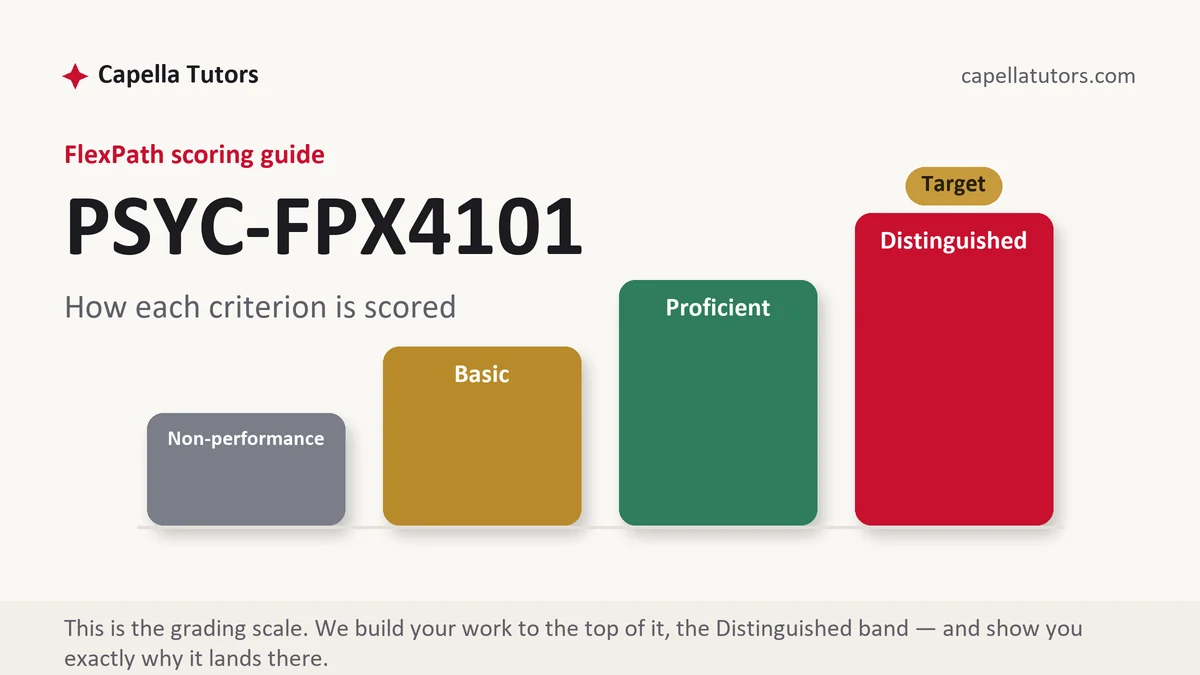
What PSYC FPX 4101 actually grades
Undergraduate history and systems criteria are not asking you to remember dates. They ask whether you can say what each school of thought was arguing, who it was arguing against, and what it was willing to count as evidence. Wundt's Leipzig laboratory in 1879 is the conventional marker, and a strong paper explains why it is a marker rather than a birth, since Fechner was already relating sensation to stimulus in the 1860s. From there the sequence has a logic worth writing out: structuralism tried to inventory the contents of consciousness, functionalism asked what mental life is for instead, Watson's 1913 argument threw consciousness out as a subject matter, Gestalt writers objected that experience does not arrive in countable elements, psychoanalysis worked from clinical material no laboratory could reach, humanistic psychology rejected both the couch and the maze as accounts of a whole person, and the cognitive turn of the 1950s and 1960s put internal representation back on the table using methods the behaviorists had built.
The second thing under grade is how you handle history as history, and this is where most drafts drop a criterion. Judging an 1890 researcher by a 2026 standard is presentism, and it reads as unserious to anyone who teaches the period. Handing a whole movement to one founder is the companion error, because laboratories, journals and funding decide which ideas travel. Mary Whiton Calkins finished the doctoral requirements at Harvard and was refused the degree because she was a woman, then became the first woman to lead the American Psychological Association. Francis Cecil Sumner took his psychology doctorate at Clark University in 1920, the first African American to earn one. Work by Kenneth and Mamie Clark on how segregation shaped children's self-perception was cited when the Supreme Court decided Brown v. Board of Education in 1954. Naming that layer, then saying what it changes about the standard account, is a Distinguished move and not a decorative one.
The third strand is the word contemporary in the course title. Present-day psychology is treated as the current chapter of the same argument, which in practice means the reliability of the published record. When one large collaboration repeated a hundred published psychology findings in 2015, roughly a third came back statistically significant and the average effect shrank by about half. The narrowness of the populations most of those studies sampled belongs in the same section, as does the ethics record: the conditioning of a single infant by Watson and Rayner, Milgram's obedience procedure, the Stanford prison study and the criticisms later made of how it was run. The American Psychological Association issued its first ethics code in 1953, and the federal review system that governs research now grew out of the 1974 National Research Act and the Belmont Report that followed in 1979. Setting a modern rule beside the case that produced it is the fastest way to show a criterion you understand the system rather than the anecdote.
How we help in this course
Send the prompt, the criteria and the week you are working in, and the research analyst pulls the original material before anyone drafts a line, so the paper argues from Watson's own sentences rather than from a summary of them. Tell us your specialization and the contemporary half gets aimed at debates you will meet again later in the degree.
Delivery matches every other course in the studio. One premium original sample per deliverable, built to the Distinguished column of the guide you upload, back inside 24 to 48 hours, read by eight people in sequence with one pass given only to whether each attribution belongs to the person it is hung on. Revisions are unmetered and free until the criteria clear, faculty comments included, which matters in a course where one misdated claim can undercut an otherwise sound argument.
The assessments, one by one
Assessment 1: Exploring Developmental Psychology: Insights and Theories
The opening deliverable in History, Systems, and Contemporary Psychology usually asks you to take one school of thought and set it inside the period that produced it, which is a different job from summarizing what the school believed. Read the full Assessment 1 manual.
Assessment 2: Behaviorism's Evolution and Impact
Trace the development of behaviorism, the schools that influenced it, its major figures and its influence on contemporary psychology. Read the full Assessment 2 manual.
Assessment 3
The closing deliverable in this course usually turns the third word of the course title into the assignment: take something psychology is arguing about now and trace it back to the argument it descends from. Read the full Assessment 3 manual.
How to actually write PSYC FPX 4101: where to begin
Print the scoring guide and turn each criterion into a heading before you decide what to say. Then label every criterion descriptive, comparative or evaluative, because explaining a system is different work from weighing two of them. In current courserooms the assessments include "Exploring Developmental Psychology: Insights and Theories" and "Behaviorism's Evolution and Impact" among others, and your scoring guide decides the exact format of each. Your scoring guide decides the container, whether that is a paper, an annotated timeline with narrative, or slides with speaker notes.
Build the comparison as a grid before you build it in sentences. Four questions separate any two systems cleanly: what counts as data, what the unit of analysis is, which methods are licensed, and what the school refuses to study. A child who freezes at the sight of a dog is, to a behaviorist, a history of pairing measurable as approach distance and undoable by graded exposure. To a cognitive psychologist the same child holds an expectancy that can be probed by what she predicts will happen and revised by evidence against it. Both accounts make testable claims, they disagree about what an explanation is made of, and writing that last part down is the whole difference between a comparison and a list.
Date things and place them. Anything you call a beginning needs a year, a city and a name, and anything you call a decline needs the reason it lost ground rather than the assertion that it was refuted. Behaviorism did not fall to a single experiment. It lost its monopoly when the problems it had ruled out of bounds, memory, language and attention, turned out to be tractable with laboratory methods, and when computing handed the field a vocabulary for internal process. That is a historical claim you can support with sources. The version most drafts write, that the school was replaced because it was wrong, is not.
| Section | What goes in it | What Distinguished looks like |
|---|---|---|
| Question and scope | The period, school or debate the assessment names, and the boundary you draw around it. | A scope sentence that says what the paper leaves out and why that exclusion is defensible. |
| The system in its period | Founding figures, dates, institutions, and the problem the school formed in order to solve. | The intellectual opponent named, so the school reads as an argument rather than a description. |
| Comparison | Two or more systems set against shared questions: data, unit of analysis, method, exclusions. | Points of real disagreement identified, not differences of vocabulary dressed up as conflict. |
| Evidence and sources | The primary texts, the historical scholarship, and a visible origin for every claim. | Primary material quoted from the original, with secondary reading used to interpret rather than replace it. |
| Contemporary connection | The present-day debate, practice or reform the earlier argument explains. | A line of descent traced with both the continuities and the breaks stated. |
| Conclusion, limits and references | What the history supports, what it cannot settle, current APA in both directions. | A judgment offered with its grounds, and the rival reading acknowledged rather than ignored. |
Developing the synthesis
Synthesis here means making the systems speak to one another instead of parading past the reader. The reliable way in is to organize by question rather than by school. Take what psychology should accept as data and give it one section, moving through introspection, observable behavior, verbal report, reaction time and neural measurement, saying at each step what the new measure bought and what it cost. That structure forces comparison. A section per school lets you avoid it.
Then be honest about the shape of the story you were handed. The tidy succession of schools is itself a construction, assembled later by writers who needed chapters, and in practice the periods overlapped heavily. Saying so, and citing a historian who says so, demonstrates the skill the top of the scale actually describes, which is reading a narrative as an argument somebody made rather than as the way things were.
Citations that survive faculty review
Three tiers of source do three different jobs, and the criteria can tell them apart. Primary material is the original article, book or address, read in the original and cited with both dates when you use a reprint or a translation, so a 1913 paper reissued in 1994 carries both years rather than the later one alone. Secondary scholarship is the peer-reviewed history of psychology literature reached through the Capella library, PsycINFO and PsycARTICLES, and it is what you cite for interpretation, influence and context. Tertiary material, meaning your textbook and any encyclopedia entry, is for orientation only.
Then get the mechanics right, because they are unusually visible here. Give the original publication year whenever the age of an idea is part of your point, and where you can only reach an original through another author, use the as-cited-in construction and admit it rather than implying you held the book. Check citations against the reference list in both directions, then read the document once more for attributions alone, since a claim hung on the wrong name is the error a faculty evaluator in this field will always find.
The mistakes that land Basic instead of Distinguished
- A chronology with no argument inside it. Dates in order are a timeline, and a timeline is a Basic answer to a comparative criterion.
- Presentism. Scoring a nineteenth century researcher against a modern ethics code without stating what the standards of his own time were.
- One founder credited with a movement. That erases the laboratories, journals and students who did the work of spreading the idea.
- A primary claim cited to the course textbook. The original paper is usually two clicks away in the library, and graders check.
- The word disproved applied to a school of thought. What happens to schools is that their questions stop paying, which is a different and more interesting claim.
PSYC FPX 4101 questions students actually ask
Do I really have to read the original papers?
Read a few of them, chosen rather than all of them. Pick the two or three texts your assessment turns on, read those in the original, and use historical scholarship for the rest. Early papers are short by modern standards and usually clearer than their summaries, because the author is arguing with someone specific. Quoting from the original also lets you report what was actually claimed, including the parts a textbook trimmed, and that detail separates a paper that has read the period from one that has read about it.
How do I compare two schools without just listing them?
Ask both of them the same question, then report where they part company. Choose the questions your criterion cares about and write one paragraph per question rather than one paragraph per school. Inside each paragraph state what the first system claims, what the second claims instead, and then the sentence most drafts leave out, which is what the disagreement is really about, whether that is evidence, method, or a prior decision about what psychology is for. Finish with a judgment, because a comparative criterion at the top of the scale expects you to say which account handles the case better and on what grounds.
Where does the contemporary part come in if the course is about history?
It comes in as descent, and the criteria usually want it named. Take something happening in psychology now, the tightening of methodological standards or the argument over how far findings from narrow samples generalize, then show the older argument it grew out of. The strongest version says what has genuinely changed rather than claiming the debate is identical, because sample sizes, instruments and ethical constraints are not what they were. Two paragraphs written that way outscore two pages of general remarks about why history matters.
History and systems paper due?
Send the prompt together with your criteria. First premium sample free, with the primary sources pulled and every attribution checked.