This manual is for PSYC FPX 4101 Assessment 3, start to submission. The closing deliverable in this course usually turns the third word of the course title into the assignment: take something psychology is arguing about now and trace it back to the argument it descends from. Descent is the graded idea, and it has three parts, what carried forward, what genuinely changed, and what the older dispute explains about the newer one. Below sits our tutors' method for that argument, a structure keyed to the criteria, and an annotated excerpt from an original model. Would you rather have it drafted for you? A premium original sample for this exact assessment arrives in 24 to 48 hours and is revised free until the criteria clear. Capella's catalog lists the course as PSYC-FPX4101, and some courserooms print PSYC4101; both point to this same Assessment 3. In current courserooms this assessment typically appears as "Violent Behavior in Adolescents".
One honesty note before the manual: Capella revises courses and scoring guides over time, so always write to the exact scoring guide attached to your assessment in the courseroom. The course identity above is verified on capella.edu; the method and structure below are our tutors' approach to it, not Capella's official rubric text.
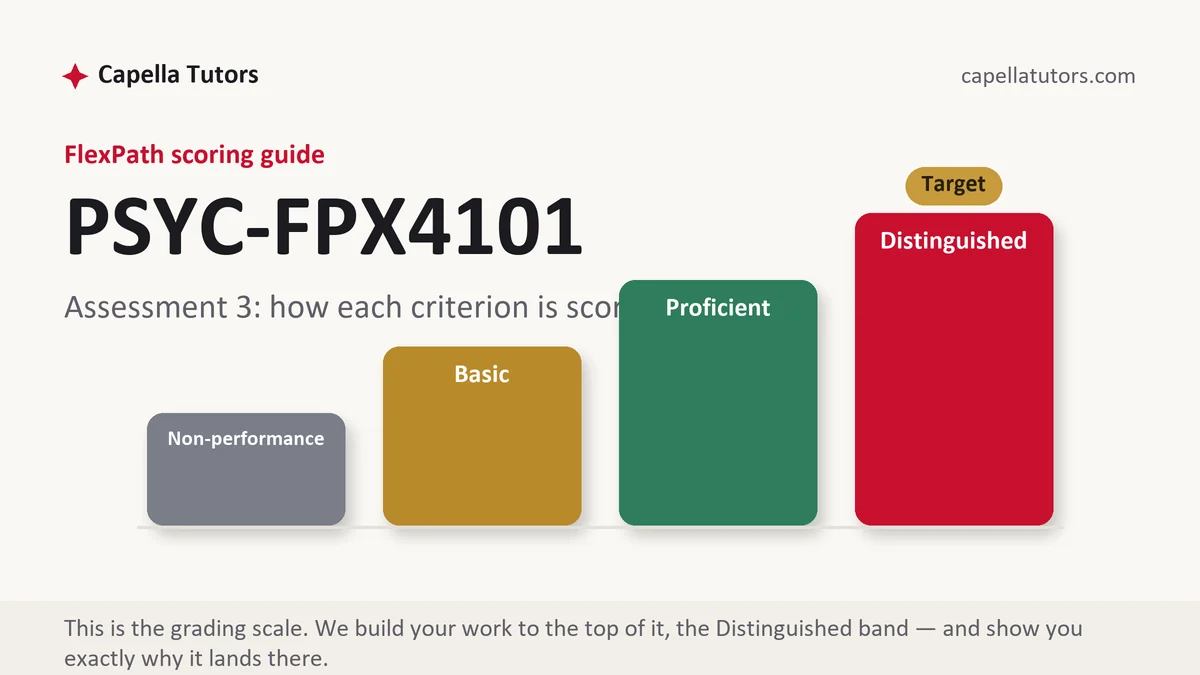
How PSYC FPX 4101 Assessment 3 is scored
There is no partial credit in FlexPath and no curve. Each criterion is placed at one of four levels, and the level wording is the specification for the paragraph:
| Level | What it means on a descent argument |
|---|---|
| Distinguished | Both the continuity and the break are stated, the older problem explains the modern practice rather than merely resembling it, and both ends of the line are dated and sourced. The top column always asks for the sentence a comparison alone would skip. |
| Proficient | The historical parallel is drawn accurately and the connection is asserted rather than argued. Everything true, nothing demonstrated. |
| Basic | A modern debate summarized, a period summarized, and the word similarly doing all the work between them. |
| Non-performance | One end of the line is missing, usually the historical end, or the present-day claim arrives with no source behind it. |
The strongest version of this paper is also the most modest. Claiming the argument is unchanged is easy to write and easy to disprove, because sample sizes, instruments, statistical training and ethical constraints are all different now. Saying what changed is what makes the continuity you claim believable.
The PSYC FPX 4101 Assessment 3 method, step by step
-
Read the guide and decide which end you are weakest at
Every criterion becomes a heading, as always, and then you make one honest judgment: is your gap the modern literature or the historical one. That decides where your reading week goes. Most students in this course are stronger on the history and underestimate how current the contemporary sources have to be.
-
Pick a present-day dispute narrow enough to date
Choose an argument with a decade attached to it rather than a theme. How psychology decides that a published finding is reliable, how far results from narrow samples travel, how much a statistical threshold should decide: each of those has papers, years and named participants. A topic like the future of psychology has none.
-
Find the ancestor by problem, not by keyword
Two arguments that use the same word are often unrelated, and two that share no vocabulary can share a structure. Ask what problem the modern dispute is trying to solve, then look for the period in which the field first ran into that problem without a procedure for settling it. That is your ancestor, and the shared problem is your thesis.
-
Write the continuity in one sentence and the break in the next
Force the pair. "What persists is X; what has changed is Y." If you cannot fill the second blank, you have found a resemblance rather than a descent, and the criterion that pays for analysis will notice. This pair usually becomes the strongest paragraph in the paper.
-
Source each end to its own literature
The historical end takes primary texts and peer-reviewed history of psychology, reached through the Capella library, PsycINFO and PsycARTICLES. The contemporary end takes current empirical articles and, where a reform is at issue, the document that established it. Do not let a history source carry a claim about the present or a recent review carry a claim about 1905.
-
Check every date, then self-score
Read the draft once for dates alone and once for attributions alone; a misplaced decade in this assessment undercuts the whole argument. Then mark yourself at one of the four levels for every criterion, revise anything short of the top, and submit early in the week rather than late.
A structure that maps to the criteria
These are planning targets our tutors use for a short paper of this kind, not Capella rules; give more room to whichever end your scoring guide weights.
| Section | What it must do | Guide |
|---|---|---|
| Introduction and the line you draw | Name the present-day dispute, name the older argument, and state the claim about descent in one sentence. | ~150 words |
| The dispute now | What is actually being argued today, with participants, dates and current sources, described narrowly enough to be checked. | ~250 words |
| The older argument | The earlier dispute in its period, with the same structural problem identified and primary material behind it. | ~300 words |
| What carried forward | The mechanism of descent: the shared problem, the vocabulary, the institution or the training that transmitted it. | ~250 words |
| What has changed | The genuine breaks in method, scale, statistics or ethical constraint, stated plainly rather than minimized. | ~200 words |
| Conclusion and references | What the history explains about the present dispute, what it cannot settle, current APA in both directions. | ~150 words |
Annotated sample excerpt
An original model excerpt from our team, offered as study material for the register rather than as content to submit. Read the moves, then make them with your own dispute.
A large collaboration repeated a hundred published psychology findings in 2015 and reported that roughly a third reached significance again, with average effects near half their original size.1 The response, registering hypotheses and analysis plans before data collection, is new; the underlying problem is not, because between about 1901 and 1910 laboratories at Cornell and Wurzburg produced incompatible introspective results and had no agreed procedure for deciding which set of trained observers to believe.2 What carried forward is the structural problem, a field with results and no arbitration rule; what has changed is the response, since the discipline now builds machinery, public registration, shared materials, published null findings, instead of settling the matter by asserting the competence of its own laboratory.3
- 1Opens on the present with a year and a number rather than a general remark about a crisis, so the contemporary end can be checked against a source.
- 2Names the ancestor by its structural problem, with places and a date range, and separates the new response from the old difficulty in one sentence.
- 3Delivers the continuity and the break as an explicit pair. This is the sentence a paper built on resemblance cannot write, and it is usually where the analysis criterion is won.
The full premium sample for your exact assessment, written fresh to your scoring guide and issue, is free to request. Study it, revise it into your own voice, and submit work you understand.
The five mistakes that cost Distinguished
- Nothing new under the sun. Presenting the modern dispute as the old one unchanged ignores every difference in method and scale, and one informed reader can dismantle it.
- The parallel asserted. Similarly and likewise are transitions, not arguments; the mechanism of descent has to be named.
- An ancestor chosen by keyword. Shared vocabulary across a century usually means the word moved, not the argument.
- A present-day claim with no citation. The contemporary half needs sources as current as the debate, and a textbook chapter is not one.
- History used as ornament. An opening paragraph of background followed by a paper that never returns to it leaves the connection criterion unearned.
Pre-submission checklist
- Every criterion on the guide answered under its own heading
- The descent claim stated in one sentence in the introduction
- Both ends dated, with participants and places named
- The continuity and the break written as an explicit pair
- Contemporary sources current, historical sources primary where the claim is central
- One read for dates, one for attributions, current APA both directions, self-scored before submitting
Contemporary connection paper due?
Send the prompt, the criteria and the debate you want to write about. The analyst finds the ancestor by matching the problem rather than the vocabulary, pulls both literatures, and a team of eight returns a premium original sample built to the top column in 24 to 48 hours, with revisions free until it clears.