How to write PSYC-FPX4101 Assessment 2

The short answer

This manual is for PSYC-FPX4101 Assessment 2, start to submission. The middle deliverable in this course usually moves from one school to two, and the assessment normally asks you to set the systems against each other rather than describe them in turn. What earns the criterion is a shared question, both schools answering the same thing, with the point of real disagreement located instead of a difference in vocabulary dressed up as conflict. Below is our tutors' method for building that comparison, a structure keyed to the criteria, and an annotated excerpt from an original model. Want it built with backup instead? A premium original sample for this exact assessment lands in 24 to 48 hours with free revisions until the guide is satisfied. Your courseroom may print this as PSYC FPX 4101 Assessment 2 or PSYC4101 Assessment 2; it is the same deliverable, and PSYC-FPX4101 Assessment 2 is what this manual walks through.

One honesty note before the manual: Capella revises courses and scoring guides over time, so always write to the exact scoring guide attached to your assessment in the courseroom. The course identity above is verified on capella.edu; the method and structure below are our tutors' approach to it, not Capella's official rubric text.
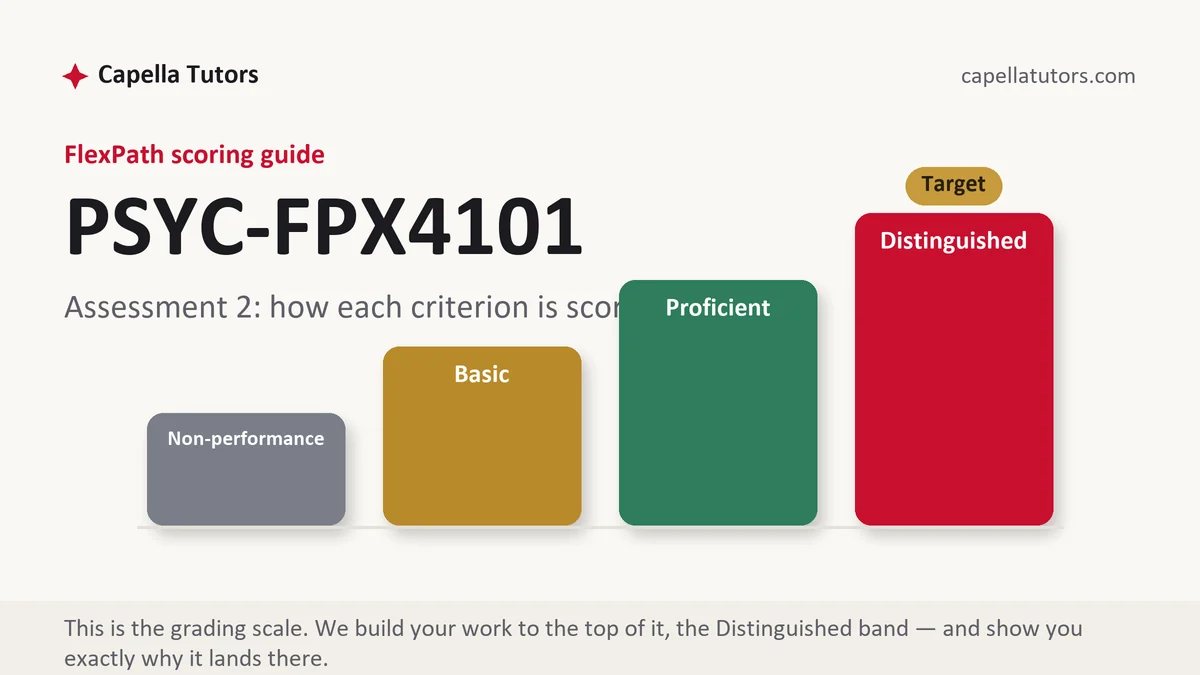
PSYC-FPX4101 Assessment 2 grading scale at Capella FlexPath, the criterion levels this assessment is scored on, from Capella Tutors
How Capella FlexPath grades PSYC-FPX4101 Assessment 2, visualized by Capella Tutors.

How PSYC-FPX4101 Assessment 2 is scored

Nothing in FlexPath is graded on a curve. Each criterion is placed at one of four levels, and the level descriptions tell you what the paragraph has to accomplish:

LevelWhat it means on a two-system comparison
DistinguishedBoth systems answer the same stated questions, the disagreement is located exactly, and the paper says which account handles the test case better and on what grounds. A comparative criterion at the top of the scale is asking for a verdict.
ProficientBoth systems are explained accurately and compared on shared ground, with no judgment offered at the end. Correct, and stopping one sentence early.
BasicTwo accurate descriptions set side by side, the comparison left for the reader to make. This is the shape almost every first draft arrives in.
Non-performanceOne system is absent, or missing the element the criterion names, usually its method or its standard of evidence.

The quiet trap here is symmetry for its own sake. Two systems rarely disagree about everything, and stating where they overlap makes the disagreement you did find more credible rather than less.

The PSYC-FPX4101 Assessment 2 method, step by step

  1. Sort the criteria into describe, compare and judge

    Copy the guide into your outline and mark each criterion with one of those three words. Describing takes fewer words than students expect and comparing takes more, so the marking tells you where the length belongs. A comparative criterion answered with two descriptions is the single most expensive miss in this assessment.

  2. Choose your questions before you choose your paragraphs

    Four questions separate any two systems cleanly: what the school counts as data, what it treats as the unit of analysis, which methods it licenses, and what it refuses to study at all. Pick the two or three your criteria actually care about and make each one a section heading. The grid comes first, the prose second.

  3. Find one phenomenon both schools must explain

    A comparison needs a shared object or it drifts into abstraction. Choose something small and concrete, a melody played in a new key, a rat learning a maze, a slip of the tongue, and hand it to both systems. The phenomenon does most of the analytic work, because each account has to say what it is made of.

  4. Fill the grid from sources, primary where the claim is central

    Take each cell from the literature rather than from memory. Where a claim carries a section of your paper, go to the original article or address through the Capella library or PsycINFO and cite it with both dates if you are reading a reprint. Use historical scholarship for context and interpretation, and keep your textbook for orientation only.

  5. Write by question, never by school

    Each section opens with the question, states what the first system claims, states what the second claims instead, then adds the sentence most drafts omit: what the disagreement is really about, whether that is evidence, method, or a prior decision about what psychology is for. If a paragraph mentions only one school, it belongs somewhere else.

  6. Deliver a verdict with grounds, then self-score

    Say which account handles your test case better, on grounds a reader can check, and name what would change your mind. Then read the draft once per criterion, mark yourself at one of the four levels, and give any criterion below the top one more pass. Submit early in the week, since evaluation can take two business days.

A structure that maps to the criteria

The lengths below are planning targets our tutors use for a short comparative paper, not Capella requirements; move words to whichever section your scoring guide weights hardest.

SectionWhat it must doGuide
Introduction and shared questionName the two systems, the questions you will ask both of them, and the phenomenon they will both have to explain.~150 words
The two systems in briefEach school in its period, with founders, dates and the problem it formed to solve, kept short enough to leave room for the comparison.~200 words
What counts as dataBoth answers to the evidence question, with the method each one licenses and the observation each one rules out.~250 words
Unit of analysisWhat each system treats as the smallest real thing, and how that choice constrains everything it can say afterward.~250 words
The test caseThe shared phenomenon run through both accounts, ending in the sentence that says what the disagreement is about.~250 words
Verdict, limits, referencesWhich account you find stronger and why, what the comparison cannot settle, current APA in both directions.~200 words

Annotated sample excerpt

Original model work from our team, included so the graded moves are visible on the page. Take the pattern, then build the comparison your own criteria ask for.

Sample excerpt: the test case Original model · Capella Tutors

A melody moved from C to G keeps none of its original tones and stays the same melody, and that plain fact is the case the Gestalt writers set in front of the structuralists.1 An account assembled from elements has to explain the constancy as a sum of parts that have all changed, and Titchener's answer, that the relations between tones are themselves contents a trained observer can report, is coherent and quietly expensive, since it admits an element nobody can point at.2 The Gestalt claim costs less: the pattern is the psychological unit and the tones are what it is made of rather than what it is, which is why the disagreement reaches method as well, one school training observers to decompose an experience and the other asking what the experience is organized into.3

  • 1Opens on a phenomenon instead of a definition and hands both schools the same thing to explain. The shared case is what turns the next two sentences into a comparison.
  • 2States the rival position at its strongest and in its own terms before naming the cost. Fairness first is the move a comparative criterion pays for at the top.
  • 3Places the disagreement at the unit of analysis and follows it into method, which is where a difference between systems becomes visible in practice.

The full premium sample for your exact assessment, written fresh to your scoring guide and issue, is free to request. Study it, revise it into your own voice, and submit work you understand.

Get the full sample free

The five mistakes that cost Distinguished

  • The parade. A section on one school, a section on the other, and no paragraph anywhere in which they meet.
  • Vocabulary mistaken for conflict. Two names for the same claim is not a disagreement, and presenting it as one costs the criterion it was meant to satisfy.
  • The strawman. Comparing one school at its weakest against its rival at its best, usually by quoting the loser through a critic.
  • A verdict with no grounds. Preferring the account that sounds modern is taste; preferring it because it explains the test case with fewer unobservables is an argument.
  • Decades collapsed. Systems separated by forty years compared as contemporaries, with neither claim dated, reads as a paper that has not checked.

Pre-submission checklist

  • Each criterion on the guide has its own labeled section
  • The comparison questions named in the introduction and used as headings
  • One shared phenomenon both systems are made to explain
  • No paragraph in the comparison sections mentioning only one school
  • A verdict with grounds, plus what would change your mind
  • Primary sources cited where the claim is central, current APA both directions, self-scored before submitting

Comparison paper due this week?

Upload the scoring guide and tell us which two systems the prompt names. We build the grid first, pull the primary material for the cells that carry the argument, and return a premium original sample aimed at the top column in 24 to 48 hours, revised free until the criteria clear.

Keep going

Online now