This manual is for PSYC FPX 4101 Assessment 1, start to submission. The opening deliverable in History, Systems, and Contemporary Psychology usually asks you to take one school of thought and set it inside the period that produced it, which is a different job from summarizing what the school believed. The graded skill is showing that a school was an argument: who it was arguing with, what it accepted as evidence, and what it declined to study at all. Below sits the method our tutors use for it, a structure keyed to the criteria, and an annotated excerpt from an original model. Prefer to hand it over? A premium original sample for this exact assessment comes back in 24 to 48 hours, revised free until your guide is satisfied. Capella's catalog lists the course as PSYC-FPX4101, and some courserooms print PSYC4101; both point to this same Assessment 1.
One honesty note before the manual: Capella revises courses and scoring guides over time, so always write to the exact scoring guide attached to your assessment in the courseroom. The course identity above is verified on capella.edu; the method and structure below are our tutors' approach to it, not Capella's official rubric text.
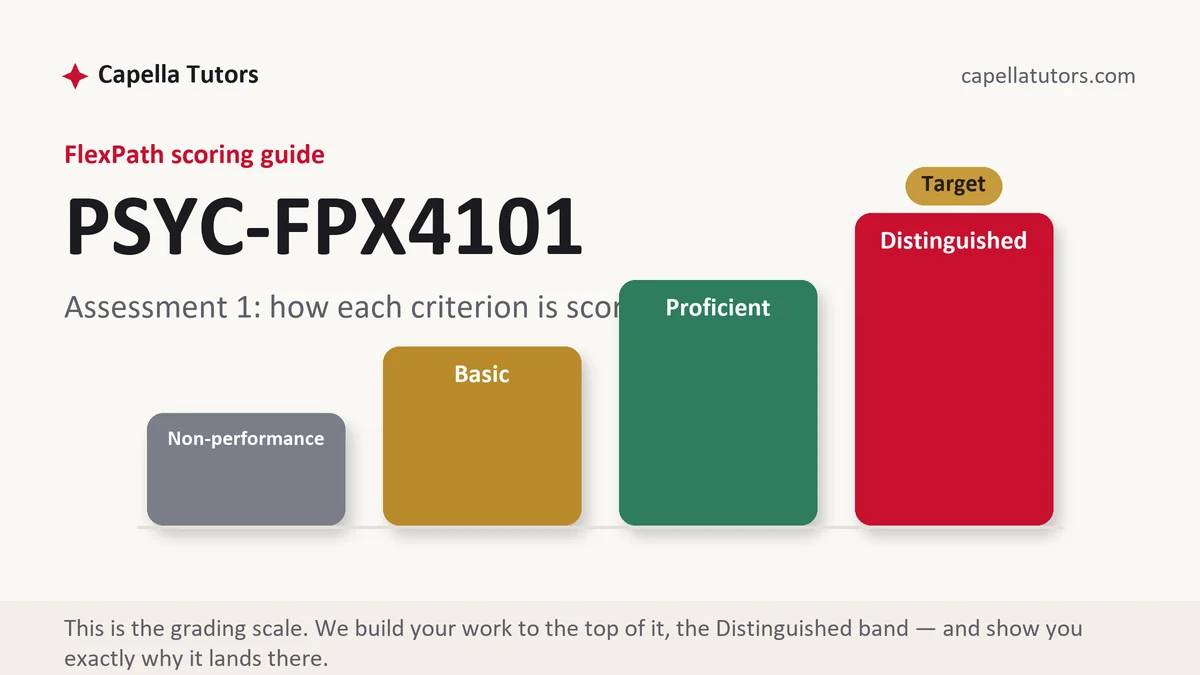
How PSYC FPX 4101 Assessment 1 is scored
FlexPath does not hand out letter grades. Each criterion on the scoring guide lands on one of four levels, and the wording of those levels is the brief you are writing to:
| Level | What it means on a school-in-its-period paper |
|---|---|
| Distinguished | The school reads as a position inside a live dispute, the opponent is named, and the standards of the period are stated before any judgment is passed on the work. The extra move is written into the criterion; find its verb and do it. |
| Proficient | The school is explained accurately and placed in its period, with founders, dates and institutions correct. Complete, and one move short of the top of the guide. |
| Basic | A tidy account of what the school believed, with the argument it was having left outside the paper. A chronology lands here almost every time. |
| Non-performance | A required element is missing outright, most often the historical context or the primary source. A criterion drops to the floor for what is not there, never for what is merely thin. |
Assessment 1 usually arrives early enough to set your habits for the rest of the course, and the habit it teaches is small: a claim about the past carries a year, a place and a person. Build it here and the comparative work later becomes assembly rather than research.
The PSYC FPX 4101 Assessment 1 method, step by step
-
Turn the criteria into headings before you pick a school
Print the guide, copy each criterion into your outline as a heading, and paste its top-level description underneath. Then label each one descriptive, contextual or evaluative, because describing a system, situating it and weighing it are three different paragraphs. Anything you write outside that outline is unpaid work.
-
Choose a school, then shrink it to a decade
Whole movements ran for fifty years and cannot be handled in a short undergraduate paper. Take structuralism at Cornell in the 1900s, or American behaviorism between 1913 and 1920, and say in your scope sentence what you are leaving out. A narrow window read closely beats a wide one skimmed, and graders can tell the difference in a paragraph.
-
Find out who it was arguing with
Every school formed against something. Ask what question the founders thought their predecessors had answered badly, then name that predecessor in your introduction rather than on page four. A paper that says what a school was for and against has already earned the contextual criterion; one that only defines terms has not.
-
Get to the original text, and quote from it
Pick one or two primary sources the paper actually turns on, reach them through the Capella library, PsycINFO or PsycARTICLES, and read them. Early papers are short and unusually direct, because the author is answering somebody specific. Quote a clause from the original and your claim stops depending on a textbook's paraphrase of it.
-
Attach a year, a place and a person to every historical claim
Write "Watson argued in 1913, in Psychological Review, that psychology should abandon consciousness as a subject" rather than "behaviorism rejected consciousness". The first can be checked and the second cannot, and checkability is what the evidence criterion is measuring. Use both dates when you cite a reprint or a translation.
-
Self-score criterion by criterion, then submit early in the week
Read the draft once per criterion and mark yourself honestly at one of the four levels. Anything short of the top gets one more pass, and a separate read for attributions alone, since a claim hung on the wrong name is the error a faculty evaluator in this field always finds. Submit early; evaluations can take two business days.
A structure that maps to the criteria
These lengths are planning targets our tutors use for a short undergraduate history paper, not Capella rules; expand any section your scoring guide asks more of.
| Section | What it must do | Guide |
|---|---|---|
| Introduction and scope | Name the school, the years you are covering and the question the paper answers, and say plainly what falls outside the boundary. | ~150 words |
| The problem it inherited | What the previous generation had settled, and why the founders found that answer unsatisfying, with the predecessor named. | ~250 words |
| The school in its own terms | Founders, dates, institutions, method, and what the school counted as data, drawn from primary material. | ~350 words |
| What it argued against | The dispute stated fairly from both sides, and the standard of evidence each side was working to at the time. | ~250 words |
| Limits and one line forward | What the school could not explain, why it lost ground, and one present-day practice that still carries its mark. | ~200 words |
| References | Current APA, primary and secondary separated by function, every citation matched in both directions. | as needed |
Annotated sample excerpt
An original model excerpt from our team, written to show the register the top of a guide rewards. Study the moves, then build your own version from your own reading.
Watson's 1913 paper in Psychological Review is usually called a manifesto, which is fair and also conceals what it was, namely one side of a working argument about what a psychologist is allowed to count as data.1 Titchener's laboratory at Cornell had spent a decade training observers to report the contents of their own consciousness, and by 1913 that program had produced findings other laboratories could not reproduce and no procedure for deciding whose trained observers to believe.2 Watson's proposal was not that private experience is unreal but that psychology should stop asking about it, and this paper reads the 1913 argument in those narrower terms, against the standards of evidence available in 1913 rather than the ones available now.3
- 1Names the conventional label, then refuses it in the same sentence. The paper announces that it will treat the source as an argument, which is the contextual criterion in miniature.
- 2Supplies the opponent with a person, an institution and a decade attached, and states the technical problem rather than calling the dispute important.
- 3Corrects a claim the reader was likely to expect, sets the scope, and rules out presentism in advance. Three criteria are addressed before the first section begins.
The full premium sample for your exact assessment, written fresh to your scoring guide and issue, is free to request. Study it, revise it into your own voice, and submit work you understand.
The five mistakes that cost Distinguished
- The encyclopedia entry. An accurate summary with no dispute inside it satisfies a descriptive criterion and leaves the contextual one unearned.
- Marking 1913 against 2026. State the standard the period worked to before you say the work fell short of yours, or the judgment reads as unserious.
- One man handed a whole movement. Journals, laboratories and students carried the idea outward, and naming them is part of the history rather than decoration.
- A primary claim cited to your textbook. The original sits two clicks inside the library, and evaluators in this field open the reference list.
- Adjectives standing in for dates. Influential, groundbreaking and controversial prove nothing; a year, a city and a citation prove something.
Pre-submission checklist
- Every criterion on the guide has its own labeled section
- A scope sentence naming the years covered and what is excluded
- The school's intellectual opponent named in the introduction
- At least one primary text read in the original and quoted from it
- Every founding claim carrying a year, a place and a person
- Attributions read once on their own, current APA both directions, self-scored before submitting
Want this one written with backup?
Send the prompt and the scoring guide and say which school you have in mind. The research analyst pulls the primary material before anyone drafts a line, so the paper argues from the founder's own sentences, and a team of eight returns a premium original sample aimed at the top column in 24 to 48 hours with free revisions until it gets there.