Send the prompt, the scoring guide, and whichever task, interface, or study problem you picked, and a premium original sample lands inside 24 to 48 hours, aimed at the Distinguished descriptors, second-read before delivery, with revisions included until the criteria are met. The course reads PSYC FPX 3501, Cognitive Psychology in Action, 3 program points, an upper-division course on the General Psychology specialization menu of the BS in Psychology, delivered in FlexPath, and one of the 3000-level courses that fills the 27 upper-division points required inside the 90-point degree. In Capella's catalog the course code is written PSYC-FPX3501.
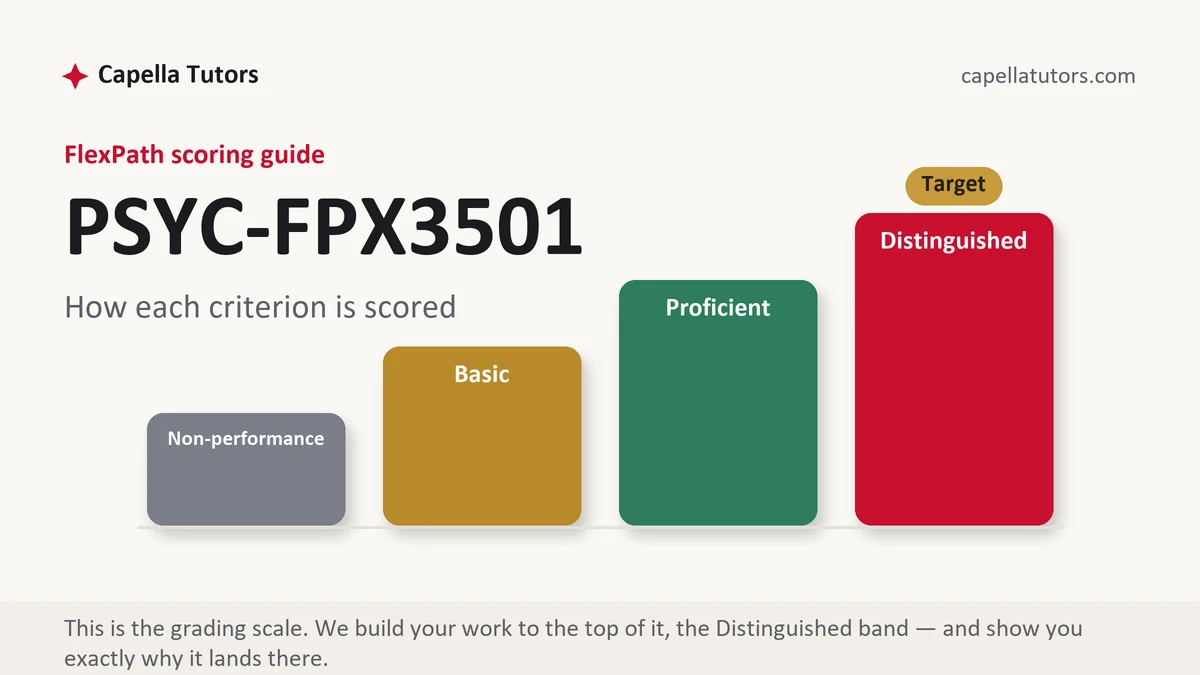
What PSYC FPX 3501 actually grades
The two words doing the work in this course title are in action, and the criteria enforce them. Describing a memory model earns a middling score in a course that wants the model used to fix something, so the assessments in this course usually give you a real task, a real error, or a real learning problem and ask you to explain the failure with a cognitive mechanism and then change the conditions so the failure gets less likely. The paper is graded as an intervention, which means the mechanism you name has to be the one your redesign acts on.
Attention supplies the first set of mechanisms, and they are more specific than the everyday word suggests. Selective attention means the information you were not attending to often goes unnoticed even when it is directly in front of you, which is why looked but did not see is a real category of error rather than an excuse. Two demanding tasks at once do not run in parallel, they alternate, and the cost of each switch shows up as slower responses and more errors, so any recommendation built on doing both at once is arguing against the evidence. Working memory adds a hard ceiling, since the number of independent items a person can hold and manipulate at once is small, closer to a handful than to the older textbook figure, and grouping related items into larger meaningful units is the standard way around it.
Memory and judgment supply the rest. Retrieval is reconstruction rather than replay, so a question's wording can alter what gets recalled and later information can be absorbed into an earlier memory without the person noticing the seam. Learning responds to retrieval practice and spacing more than to rereading, and the reason students resist both is that they feel less productive while working better, which is a metacognitive illusion your paper should name. Judgment carries its own systematic tilts, with availability, anchoring, and framing the three most usable in an applied paper. Expertise is the counterweight, being largely a matter of recognizing patterns that a novice has to work out one piece at a time.
How we help in this course
Our 3501 drafts are written as applied papers, not as chapter summaries. The task gets described concretely enough that a reader can picture the error, the mechanism is named at the level of the limit it involves, the redesign changes something a person could actually change on Monday, and the measurement plan says what would count as improvement. Give us the task you chose, the criteria, and the readings your instructor set, and the sample will work inside your own example rather than a generic one.
Studio terms apply. Turnaround of 24 to 48 hours, written to the top of the four criterion levels, and moved through an eight-person pipeline on the way out: sources first from a research analyst, a psychology writer drafting, a criterion-by-criterion review against your scoring guide, a dedicated APA and originality pass, and an editor at the end. Revisions are free until the work meets the guide, and faculty comments return into the same cycle without another charge.
The assessments, one by one
Assessment 1
The opening deliverable in an applied cognition course is normally the diagnostic one: you choose a task that real people perform on repeat, describe an error it produces, and explain that error with a named limit of attention or memory rather than with a remark about carelessness. Read the full Assessment 1 manual.
Assessment 2
Where the first deliverable in this course diagnoses, the second one usually builds: the assessment normally asks you to take a task that fails, change the task rather than the person, and say how you would know whether the change worked. Read the full Assessment 2 manual.
Assessment 3
The last deliverable in a course like this one usually pulls the strands together: the assessment tends to ask for an applied recommendation that draws on more than one area of the research, states honestly where the evidence is contested, and still commits to a position. Read the full Assessment 3 manual.
How to actually write PSYC FPX 3501: where to begin
Read the scoring guide first and make each criterion a heading with the Distinguished sentence pasted underneath, then write to those headings only. The clusters in this course tend to run as a chain: describe the task and the failure, name the cognitive limit that produces it, support that with research, propose a change to the task, say how you would measure whether the change worked, and state the limits of your own reasoning.
Here is the difference the top column pays for. A weak paper says a nurse missed a medication step because of cognitive overload, then recommends more training and greater care. A strong paper says the step was missed because the sequence required holding six unrelated values in mind while a phone interrupted the middle of it, names the working memory ceiling and the switch cost as the mechanisms, and then changes the task rather than the person: the six values are printed on the form in the order used, the interruption is deferred by a physical signal, and recognition replaces recall by putting the cue where the action happens. Same evidence, but the second version acts on a mechanism instead of naming a mood.
Measurement is where these papers are won or lost, because the criteria usually ask what would count as success and most drafts answer with satisfaction. Pick an outcome that moves, take a baseline before you change anything, and report both speed and accuracy, since almost any change that makes people faster can make them less accurate and reporting one number alone hides that trade. If your prompt allows a small demonstration, run it within participants so each person serves as their own comparison, alternate which condition comes first so practice and fatigue do not pile up on one side, and say how many observations you collected. Two sentences of that kind read as competence and cost you nothing.
| Section | What goes in it | What Distinguished looks like |
|---|---|---|
| Task and failure | The activity described step by step, with the error and the conditions it occurs under. | A specific observable failure rather than a general complaint about performance. |
| Mechanism | The cognitive limit involved, named at the level of attention, memory, or judgment. | One mechanism selected and defended over the plausible alternative explanation. |
| Evidence | Studies supporting that mechanism, with design, setting, and dependent measure. | Laboratory and applied findings distinguished, with generalization argued not assumed. |
| The redesign | What changes in the task, the environment, or the materials, described concretely. | A change that acts on the named mechanism, with recognition preferred over recall. |
| Measurement | The outcome, the baseline, the comparison, and how long you would observe. | Speed and accuracy both reported, with the trade-off between them acknowledged. |
| Limits and sources | What the intervention will not fix, and current APA citations both ways. | A stated condition under which the redesign would fail, plus what you would try next. |
Developing the synthesis
Applied cognition has several popular ideas that the evidence does not support, and naming one is the fastest way to show you read past the summary. Matching instruction to a learner's preferred style has been tested repeatedly and does not improve learning, however confidently it is asserted in training materials. Commercial cognitive training improves performance on the trained exercises with transfer to untrained abilities that is narrow at best, which is a useful lesson about practice specificity rather than a scandal. Against those, the findings on retrieval practice, spacing, and varying the conditions of study have held up well, including the awkward part where the methods that work feel harder and are rated less effective by the people using them. Pick one dispute, describe the studies that settle it, and then say what your recommendation does about it. Writing that the comfortable method is the weaker one, with a citation attached, is the kind of paragraph that lifts a criterion.
Citations that survive faculty review
Four source types belong in an applied cognition paper. Peer-reviewed cognitive psychology and human factors journals, retrieved through the Capella library and PsycINFO, carry the mechanisms and the intervention evidence. Models get cited to the work that proposed them, so a paper leaning on a component model of working memory cites its authors rather than a chapter that redraws the diagram. Where the task lives in a regulated setting, the agency material matters, and safety and transportation authorities publish workload and distraction data that beats any textbook for applied numbers. Practitioner standards and design guidance can be cited for conventions, clearly marked as guidance rather than evidence. When you report a study, name the setting and the dependent measure before the result, because a millisecond difference in a laboratory task and a reduction in real errors on a ward are not the same kind of finding and only one of them supports a recommendation. Then run the two-way APA check.
The mistakes that land Basic instead of Distinguished
- Recommending more effort. Telling people to concentrate harder is the intervention this entire course exists to replace.
- Building the paper on learning styles. The claim is tested and unsupported, and using it undercuts every criterion at once.
- Reporting speed without accuracy. Either number alone can hide a trade-off that makes the redesign worse than the original.
- Naming a label instead of a limit. Overload is a summary word, and the criterion wants the specific capacity that ran out.
- No baseline and no outcome. Without a before measurement there is nothing for the redesign to have improved.
PSYC FPX 3501 questions students actually ask
What makes a good task to choose for this course?
Pick something you watch happen repeatedly, where the errors are visible and the conditions are changeable. A medication handoff, a shift report, a customer intake screen, a warehouse pick list, a study routine for your own hardest course, the checkout flow you abandon on your phone: all of them generate observable failures under identifiable conditions. Avoid topics where you cannot say what went wrong, since the criteria depend on a describable error, and avoid anything so large that the redesign becomes organizational rather than cognitive. The test is whether you can write one sentence that says who did what, under what conditions, and what went wrong. If that sentence is hard to write, choose again before you invest a week.
Is multitasking actually impossible?
It depends entirely on what the two tasks demand. Practised, automatic activities can genuinely run alongside something else, which is why walking and holding a conversation is fine. Two tasks that both need decisions, language, or working memory do not run together, they take turns, and the switching shows up as slower responses and higher error rates even when the person feels efficient. That gap between feeling and performance is the interesting part for an applied paper, because people asked to rate their own divided attention rate it far better than their measured results. Write the distinction that way, automatic against controlled, and you have answered the question and demonstrated the mechanism in the same paragraph.
Do I have to collect real data for this course?
Only if your prompt says so, and your scoring guide decides. Many deliverables in this course are argued from published research plus a described task, with the measurement section written as a plan rather than a result. If you do gather anything informal, keep the claims proportionate to what a handful of observations can support, describe exactly what you did, and note that a demonstration illustrates a mechanism it cannot establish. Where a prompt asks for an actual small study, the design details are worth more than the outcome: same people in both conditions where possible, order alternated, both speed and accuracy recorded, and a stated count of observations.
Applied cognition project due?
Send the prompt, the criteria, and the task or interface you chose. We will build the redesign and attach a measurement plan to it. One free premium sample to start.