This manual is for PSYC FPX 3501 Assessment 2, start to submission. Where the first deliverable in this course diagnoses, the second one usually builds: the assessment normally asks you to take a task that fails, change the task rather than the person, and say how you would know whether the change worked. That last part is where marks sit unclaimed, because most drafts answer with satisfaction where the criterion asked for a measurement. What follows is our tutors' method, a structure that answers the criteria in order, and an annotated excerpt from a model redesign. Short on time? A premium original sample built around your own task and criteria arrives inside 24 to 48 hours, with revisions free until the guide is satisfied. Capella's catalog lists the course as PSYC-FPX3501, and some courserooms print PSYC3501; both point to this same Assessment 2.
One honesty note before the manual: Capella revises courses and scoring guides over time, so always write to the exact scoring guide attached to your assessment in the courseroom. The course identity above is verified on capella.edu; the method and structure below are our tutors' approach to it, not Capella's official rubric text.
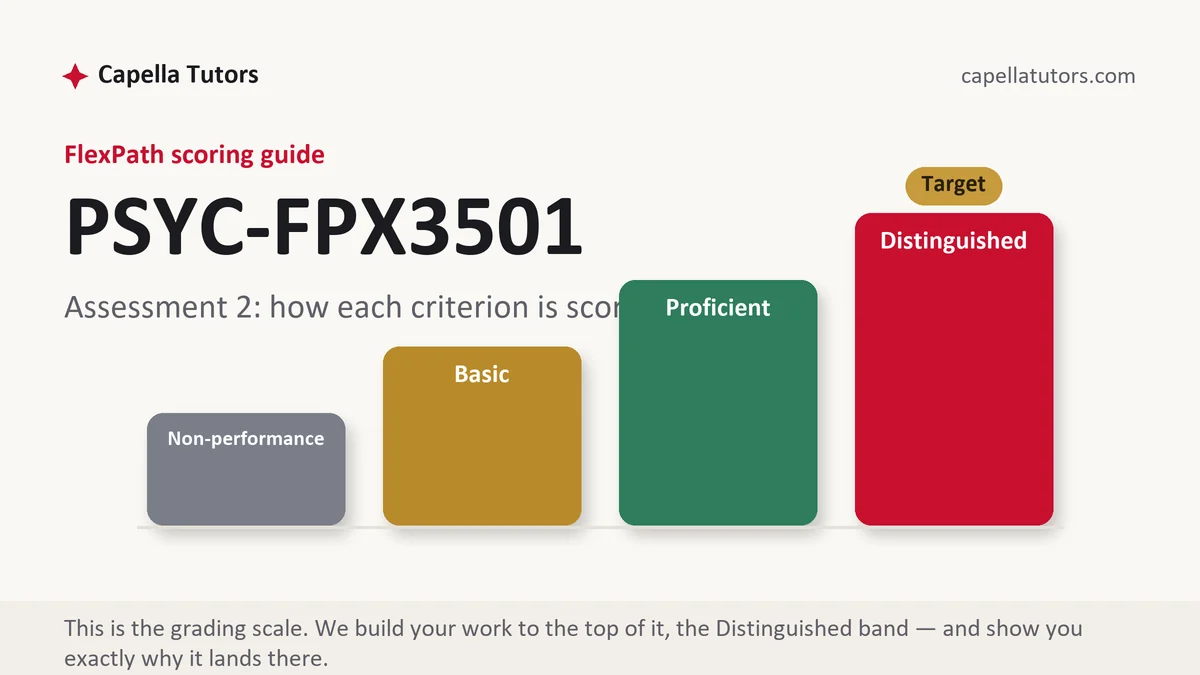
How PSYC FPX 3501 Assessment 2 is scored
Four levels, one per criterion, and no letter grade anywhere. Read the levels as instructions rather than as verdicts:
| Level | What it means on a redesign |
|---|---|
| Distinguished | The change acts on the mechanism you named, a person in that role could make it on Monday, and the plan says what would count as improvement and what would count as the change backfiring. Both halves of that last clause are usually in the criterion text. |
| Proficient | A sound change with evidence behind it and an outcome named. What is missing is the trade-off, the cost, or the condition under which it fails. |
| Basic | A reasonable-sounding recommendation that anyone could have written without the coursework, most often training, reminders, or a policy asking for more care. |
| Non-performance | No baseline, no outcome, or a recommendation with no stated link to a cognitive process. The criterion has nothing to grade against. |
One test separates the two top rows on almost every submission we review. Ask whether your redesign would still make sense if the mechanism you named were wrong. If the answer is yes, the change is generic and the mechanism was decoration. A redesign that only makes sense given one specific limit is a redesign that argues for itself.
The PSYC FPX 3501 Assessment 2 method, step by step
-
Bring the mechanism forward in one paragraph
Restate the task, the error, and the limit in a tight opening paragraph rather than reprinting your earlier analysis. Everything that follows has to point back to that limit, so it needs to be visible on page one and phrased the same way every time you refer to it.
-
Take the baseline before you touch anything
Count the current rate of the error over a defined period and write the counting rule down: what counted as one error, who counted, over how many days. A baseline collected after the change has begun is not a baseline, and a rate quoted without its period cannot be compared with anything later.
-
Replace recall with recognition wherever the task allows
Holding a value in mind is fragile and choosing between visible options is not, which makes the most reliable redesign in this course the one that puts the information where the action happens. Reordering fields to match the source document, printing the values in the order they are used, and grouping digits into small blocks all trade memory for perception, and each of them cites cleanly.
-
Design the interruption, since you cannot abolish it
Interruptions cost accuracy at the point of resumption, so the useful question is not how to stop them but what the person returns to. A visible marker of where the sequence stopped, a rule about which steps may not be broken, and a place to park an incoming request all address resumption directly, which is the part the evidence says goes wrong.
-
Name two outcomes, one of them speed
Almost any change that makes a task faster can make it less accurate, and reporting a single number hides that. Choose an accuracy measure and a time measure, state how each is collected, and say in advance which trade-off you would accept. That sentence is often the whole practical significance criterion.
-
Write the limits, then self-score
Say plainly what the redesign will not fix, name a condition under which it would fail, and add the next thing you would try. Then grade yourself against each criterion and repair anything under the top level before you submit rather than after the evaluation comes back.
A structure that maps to the criteria
Treat these lengths as our planning targets for a redesign of this size rather than as instructions from Capella, and reweight them toward whichever criterion your guide describes in the most detail.
| Section | What it must do | Guide |
|---|---|---|
| Task, error, mechanism | Compress the diagnosis into one paragraph, with the limit named in the words you will keep using. | ~200 words |
| Baseline | The current error rate, the counting rule, the period, and where the figure came from. | ~150 words |
| The redesign | Each change described concretely, with the process it acts on stated for every one of them. | ~350 words |
| Why it should work | The research behind each change, with the setting each study ran in reported before its result. | ~300 words |
| Measurement plan | Two outcomes, the comparison, the observation window, and the trade-off you would accept. | ~250 words |
| Limits and references | What stays broken, when the change would fail, and current APA both ways. | ~150 words |
Annotated sample excerpt
A model paragraph from our own team, at the register the Distinguished column asks for. Read it for the structure of the moves, then write yours around your own task.
At the volunteer tax clinic the intake worksheet asks for income figures in the order the software stores them, while the documents clients bring list those figures in an entirely different order, so each entry requires the volunteer to find a number, carry it across the page, and hold it while searching for the next field.1 The redesign changes the sheet rather than the volunteer: the fields are reprinted in the order they appear on the source documents, each amount is entered in a box divided into three-digit blocks, and the running total moves to the top of the page where it is visible during entry instead of being recomputed at the end.2 Every one of those changes removes something from working memory and puts it on the page, which is the process the transposition errors point to; none of them asks anyone to be more careful.3
- 1Explains the error as a mismatch between two artifacts rather than as a lapse in a person. The evaluator can see the load without being told the volunteer was overwhelmed.
- 2Three concrete changes, each of them something a coordinator could print this week. Concrete beats comprehensive in this criterion every time.
- 3Ties the whole redesign back to one named limit and refuses the generic fix out loud. That last clause is often what moves the criterion off Proficient.
The full premium sample for your exact assessment, written fresh to your scoring guide and issue, is free to request. Study it, revise it into your own voice, and submit work you understand.
The five mistakes that cost Distinguished
- Training as the recommendation. A course about task design that recommends another course has changed nothing about the task.
- No baseline. Without a before figure there is nothing for the redesign to have improved, and the criterion asking for evaluation cannot be met.
- Accuracy reported alone. A change that halves errors and doubles the time may be worse; two numbers protect you and one exposes you.
- A redesign any course could have produced. If the change survives your mechanism being wrong, the mechanism was ornamental.
- Silence about side effects. Naming what the change might crowd out is cheap, and its absence caps a criterion that would otherwise have been yours.
Pre-submission checklist
- The mechanism from the analysis is named in the opening paragraph and reused verbatim
- A baseline figure with its counting rule and its period appears before any change
- Each change states the cognitive process it acts on
- Two outcomes, one of them time, with a stated trade-off you would accept
- One condition under which the redesign would fail, plus what you would try next
- Current APA both ways, then a self-score criterion by criterion
Redesign due this week?
Send the prompt, the criteria, and the task you analyzed. We will build the change, attach a measurement plan a supervisor would accept, and write the limits section most drafts leave out. The first premium sample costs nothing.