This manual is for PSYC FPX 3501 Assessment 1, start to submission. The opening deliverable in an applied cognition course is normally the diagnostic one: you choose a task that real people perform on repeat, describe an error it produces, and explain that error with a named limit of attention or memory rather than with a remark about carelessness. The prompt tells you what to produce and the scoring guide tells you what it pays for, and those are two different documents. Below is the method our tutors use for it, a structure that lines up with the criteria, and an annotated excerpt from an original model paper. Would you rather hand the draft off? A premium original sample written to your own task and your own scoring guide comes back in 24 to 48 hours, revised free until every criterion is met. Capella's catalog lists the course as PSYC-FPX3501, and some courserooms print PSYC3501; both point to this same Assessment 1.
One honesty note before the manual: Capella revises courses and scoring guides over time, so always write to the exact scoring guide attached to your assessment in the courseroom. The course identity above is verified on capella.edu; the method and structure below are our tutors' approach to it, not Capella's official rubric text.
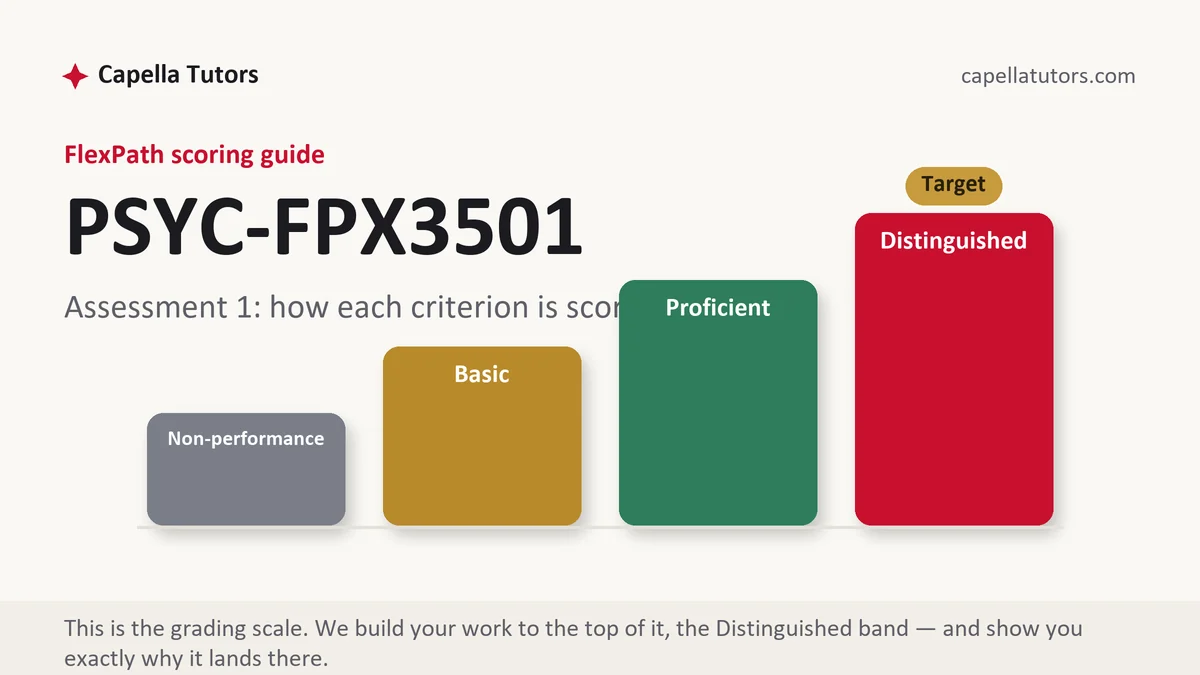
How PSYC FPX 3501 Assessment 1 is scored
FlexPath issues no letter grades. Every criterion on your scoring guide lands on one of four levels, and the wording of those levels is the brief you should be writing to:
| Level | What it means on a task analysis |
|---|---|
| Distinguished | The task is described exactly enough that a reader can watch the error happen, one cognitive limit is chosen over the obvious rival, and the studies cited were run on something close to your setting. Whichever extra clause your criterion carries, that clause is where the top level is hiding. |
| Proficient | The task is described and a mechanism is named with support behind it. Accurate, complete, and one comparison short of the top level. |
| Basic | A general account of the topic, the error implied rather than shown, and the mechanism given as a label such as overload. That combination is where most opening drafts in 3501 come to rest. |
| Non-performance | A required element is absent, most often the conditions the error appears under or the evidence behind the mechanism. Missing, rather than thin, is what drops a criterion to the floor. |
This is upper-division work inside a bachelor's degree, so nobody expects a published experiment from you. The criteria do expect the vocabulary of the research rather than the vocabulary of the break room, a source behind every claim about how attention or memory behaves, and a paper that reads as one argument instead of six answers stapled together.
The PSYC FPX 3501 Assessment 1 method, step by step
-
Turn the scoring guide into the outline
Open a blank document, make every criterion a heading, and paste its Distinguished sentence underneath before you write anything of your own. Then write only under those headings. Work that does not sit under one of them is unpaid, however good it is, and the habit of checking that costs a minute and saves a resubmission.
-
Pick a task you can watch, not a topic you can search
The strongest choices are ordinary and repetitive: a kiosk, a paper form, a service counter, a delivery route. You want to have seen the error at least twice, because the criteria ask about the conditions it occurs under and two sightings are where a condition becomes visible. If nothing comes to mind, watch one task with a notebook for an afternoon and the choice makes itself.
-
Write the failure as one countable sentence
Finish this sentence before drafting: who did what, under which circumstances, and what went wrong, with a number attached. Patrons leave a card in the reader about once a shift is a failure. People are careless with the machine is a complaint, and a complaint has nothing in it to analyze.
-
Name the limit rather than the mood
Overload, stress, and distraction are summary words for how somebody felt. The criteria want the capacity that ran out: the count of unrelated items being held when the phone rang, the step that arrived after the person's own goal was already met, the display that was looked at and not seen. Pick one, then defend it in a sentence against the next most plausible mechanism.
-
Match the evidence to your setting
Take three to five current peer-reviewed sources from the Capella library or PsycINFO, and note what each one measured and where before you use its result. A gap of milliseconds on a laboratory task and a drop in real errors at a counter are different kinds of finding, and saying which kind you hold is worth a criterion by itself.
-
Self-score, then read it aloud
Mark your own draft criterion by criterion as Distinguished, Proficient, Basic, or Non-performance, and be unkind about it. Anything below the top level gets one more pass. Reading the paper out loud catches the sentences where a citation was stapled on after the period, which is the comment faculty in this course write most often.
A structure that maps to the criteria
The word counts are planning targets our tutors work to for an analysis of this size, not Capella rules; stretch whichever section your own criteria weight more heavily.
| Section | What it must do | Guide |
|---|---|---|
| The task, introduced | Name the setting, the people, the steps in order, and why the task is worth a cognitive analysis at all. | ~150 words |
| The failure, described | The error itself, how often it happens, and the conditions that separate the times it occurs from the times it does not. | ~250 words |
| The limit, named | One mechanism of attention or memory stated in the language of the research, tied line by line to the description above. | ~300 words |
| Evidence | Studies supporting that mechanism, each with its measure and its setting reported before its result. | ~300 words |
| The rival explanation | The competing account named fairly, and what you would have to observe for it to be the better one. | ~200 words |
| Close and references | What the analysis licenses next, then current APA with every citation matched both ways. | ~150 words |
Annotated sample excerpt
An original model excerpt from our team, written at the register the top of the guide describes. Read it for the sequence of moves, then build that same sequence around your own task.
The self-checkout station at the branch library where I volunteer holds a borrower's card in a slot until the receipt prints, and about one card a shift is left behind in it.1 The abandoned cards are not spread evenly across the transaction, since they follow the sessions where the receipt printed while the borrower was already gathering the books, which is to say the goal that brought the person to the machine was satisfied before the last step of the sequence arrived.2 Errors of that shape are documented across devices that require a step after the user's own task is finished, and they persist in people who know the step exists, which is why the instruction sticker added to the housing in March has not reduced them.3
- 1Names the setting, the mechanics of the device, and a countable rate in one sentence. A number the evaluator can hold onto is the line between a described task and an anecdote.
- 2States the condition under which the error appears instead of reporting that it appears. The criteria ask for conditions, and this is exactly where most drafts stop early.
- 3Generalizes to the class of error and disposes of the obvious fix in the same breath. Explaining why the sticker failed shows the mechanism is understood rather than labeled.
The full premium sample for your exact assessment, written fresh to your scoring guide and issue, is free to request. Study it, revise it into your own voice, and submit work you understand.
The five mistakes that cost Distinguished
- Recommending attention. Telling people to concentrate harder is the move this course exists to replace, and it signals that no mechanism was found.
- A label where a limit belongs. Overload names a feeling; the criterion wants the specific capacity that was exceeded and the count that exceeded it.
- A task nobody can picture. If the reader cannot say who was standing where, the description criterion has already capped at Basic.
- Laboratory findings used as field findings. Report what was measured and on whom, then argue the generalization instead of assuming it.
- No rival account. Naming one mechanism and never testing it against another leaves the analysis criterion looking like a guess.
Pre-submission checklist
- Every criterion on the guide has its own labeled section in the paper
- The failure appears as one sentence with a number and a condition in it
- One cognitive limit named in research vocabulary, not one adjective
- Three to five current peer-reviewed sources, each with its setting reported
- The rival explanation stated, with a test that would decide between them
- Citations and references matched both ways in current APA, then self-scored
Want this one done with backup?
Send the prompt, the scoring guide, and the task you have been watching. A team of eight returns a premium original sample written to the Distinguished column in 24 to 48 hours, then revises it until it lands there, and faculty comments come back into the same cycle at no charge.