This manual is for PSYC FPX 3501 Assessment 3, start to submission. The last deliverable in a course like this one usually pulls the strands together: the assessment tends to ask for an applied recommendation that draws on more than one area of the research, states honestly where the evidence is contested, and still commits to a position. Learning research is the area most prompts land on, and it rewards a writer who knows that the study methods people prefer are not the ones that work. Below is the method, a structure built to the criteria, an annotated model excerpt, and the mistakes we see most. Rather have it drafted for you? A premium original sample written to your prompt and guide returns in 24 to 48 hours and is revised free until the criteria are met. Capella's catalog lists the course as PSYC-FPX3501, and some courserooms print PSYC3501; both point to this same Assessment 3.
One honesty note before the manual: Capella revises courses and scoring guides over time, so always write to the exact scoring guide attached to your assessment in the courseroom. The course identity above is verified on capella.edu; the method and structure below are our tutors' approach to it, not Capella's official rubric text.
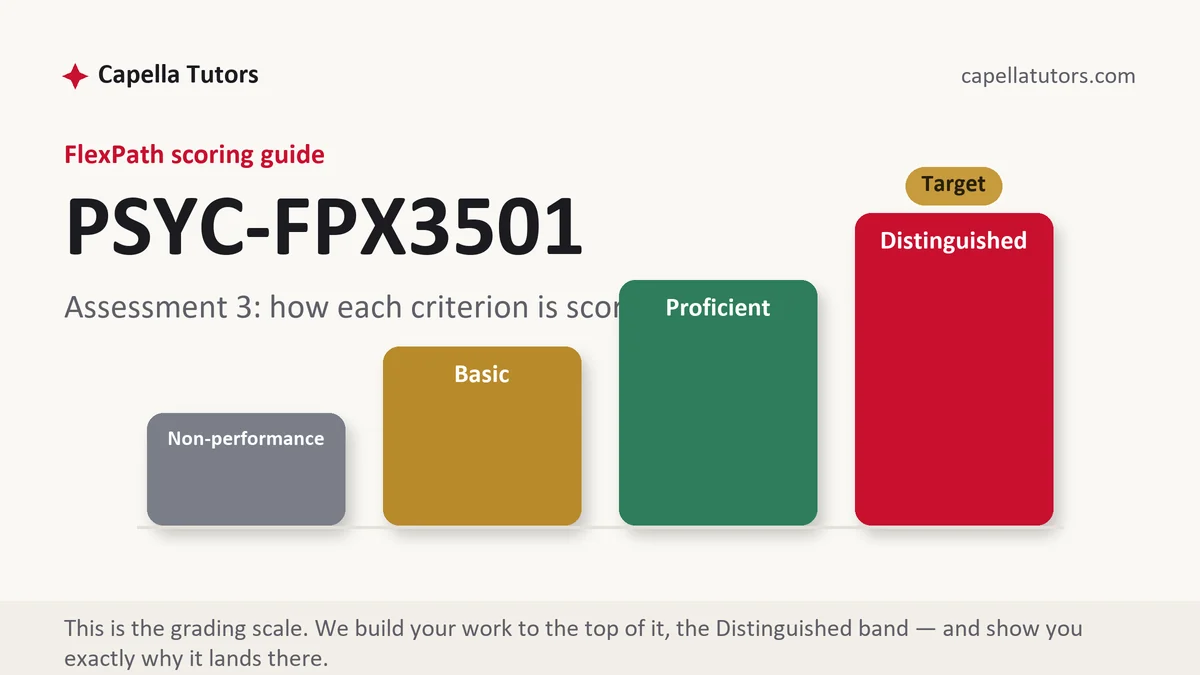
How PSYC FPX 3501 Assessment 3 is scored
Each criterion is graded on its own against four levels, and the level wording tells you what sentence is missing:
| Level | What it means on a synthesis |
|---|---|
| Distinguished | Two or more strands of the research are brought to bear on one applied problem, a disagreement in the literature is reported at its real strength, and a recommendation is made anyway with its conditions attached. |
| Proficient | The strands are covered accurately and the recommendation follows from them. What is missing is the disagreement, or the courage to take a side after describing it. |
| Basic | Each topic summarized in turn with no traffic between the sections, then a recommendation that could have been written before the reading. |
| Non-performance | A required strand is absent, or the recommendation contradicts the evidence presented in the paper. Internal contradiction reads as absence here. |
Synthesis is a verb in this criterion, not a section heading. The test an evaluator applies is whether any paragraph puts two findings in the same sentence and states the relationship between them. Three paragraphs that each report one study, however well written, are three summaries and score as such.
The PSYC FPX 3501 Assessment 3 method, step by step
-
Set the problem before you set the theory
Open with the applied problem and a figure that shows it exists, then bring the research in as the thing that explains it. Papers that open with a paragraph about the history of memory research and reach the problem on page three have spent their introduction criterion on background nobody asked for.
-
Choose two strands and make them argue
Pick two areas that bear on your problem, such as how practice is scheduled and how people judge their own learning, and write at least one paragraph where a finding from each appears in the same sentence with a stated relationship. That paragraph is the synthesis criterion, and it should be identifiable at a glance.
-
Report the illusion, because it is the interesting part
Spacing practice out and testing yourself both beat rereading, and both feel less productive while they are working, which is why learners rate the weaker method higher. Writing that sentence with a citation attached does two things at once: it demonstrates you read past the summary, and it explains in advance why your recommendation will meet resistance.
-
Name a dispute and give it its actual size
This part of psychology has audited itself in public. Matching teaching to a learner's preferred style has been tested repeatedly and does not improve learning; commercial brain-training transfers narrowly at best. Say which claim you are setting aside, cite the work that settled it, and keep the tone descriptive rather than triumphant.
-
Make the recommendation implementable and measurable
Write the change as a schedule somebody could follow: how often, for how long, who runs it, what they stop doing to make room. Attach one behavioral indicator and one date. A recommendation that cannot be started on a specific day is a conclusion, and conclusions score lower than plans.
-
Close on limits, then grade yourself
State what your evidence cannot support, name the group your sources were not drawn from, and add the single study you would run next. Then self-score every criterion, fix whatever sits below the top level, and submit early in the week so the evaluation window does not swallow your weekend.
A structure that maps to the criteria
These are our planning lengths for a synthesis of this scale rather than Capella requirements, and the last two rows are the ones worth expanding if your guide gives them their own criteria.
| Section | What it must do | Guide |
|---|---|---|
| The applied problem | The setting, the people, the performance figure that shows a problem exists, and what a fix would be worth. | ~200 words |
| Strand one | The first body of research, reported with methods and measures rather than as conclusions. | ~250 words |
| Strand two | The second body of research, chosen because it changes what strand one implies. | ~250 words |
| Where they meet | At least one paragraph holding both strands in the same sentences, with the relationship stated. | ~250 words |
| The recommendation | A schedule someone could start, the indicator, the review date, and the resistance you expect. | ~300 words |
| Limits and references | What the evidence will not carry, who it was not collected from, and current APA both ways. | ~200 words |
Annotated sample excerpt
One paragraph from an original model paper of ours, showing what a synthesis criterion looks like when it is actually met rather than announced.
The district trains new kitchen staff in one demonstration day before the first service, and by week six the line supervisor's checks record holding-temperature steps being skipped in about a third of stations.1 Two findings explain that decay together rather than separately: practice distributed across several short sessions produces better retention weeks later than the same total time massed into one block, and being asked to retrieve a step from memory strengthens it more than watching it demonstrated again.2 The awkward part is that trainees rate the massed demonstration day as more useful than the distributed schedule while performing worse after it, so any plan built on trainee preference will select the weaker method by design.3
- 1Problem first, with a number and a source for it. The reader knows what is at stake before any research arrives.
- 2Two strands inside one sentence with the relationship stated. This is what the synthesis criterion is looking for, and it takes one sentence rather than a section.
- 3Reports the contested and counterintuitive part, then converts it into a design constraint. Naming the resistance in advance is what makes the recommendation read as informed.
The full premium sample for your exact assessment, written fresh to your scoring guide and issue, is free to request. Study it, revise it into your own voice, and submit work you understand.
The five mistakes that cost Distinguished
- Sections that never speak to each other. Summary, summary, summary, recommendation is the standard Basic paper in a synthesis assessment.
- Building on learning styles. The claim has been tested and unsupported for years, and one appearance of it undercuts several criteria at once.
- Treating trainee or student preference as evidence. Preference tracks how easy something feels, and the research is about what is retained.
- A recommendation with no schedule. Without a frequency, an owner, and a date, there is nothing anyone could implement or evaluate.
- Limits written as modesty. Say which population your sources came from and what your design cannot show, in specifics, not in apology.
Pre-submission checklist
- The applied problem and its figure appear in the first paragraph
- At least one paragraph carries findings from both strands in the same sentences
- One contested claim reported at its real strength, with the source that settled it
- The recommendation names frequency, owner, indicator, and review date
- The expected resistance stated, with the reason it is predictable
- Limits, population, and current APA both ways, then a self-score
Final deliverable, and the term is closing?
Send the prompt, the scoring guide, and the setting you have been writing about. We will build the synthesis paragraph the criteria are hunting for, give the recommendation a schedule and an indicator, and hand you something you can defend line by line. First premium sample free.