Send the prompt, the criteria, and whichever system or behavior you were assigned, and a premium original sample arrives inside 24 to 48 hours, written to the Distinguished descriptors, checked by a second reader for terminology as well as for style, and revised free until it scores. The transcript entry is PSYC FPX 3310, Brain, Body, and Behavior, worth 3 program points, a required core course in the BS in Psychology, taught in FlexPath, and a 3000-level course that counts inside the minimum of 27 upper-division points the 90-point degree sets. In Capella's catalog the course code is written PSYC-FPX3310.
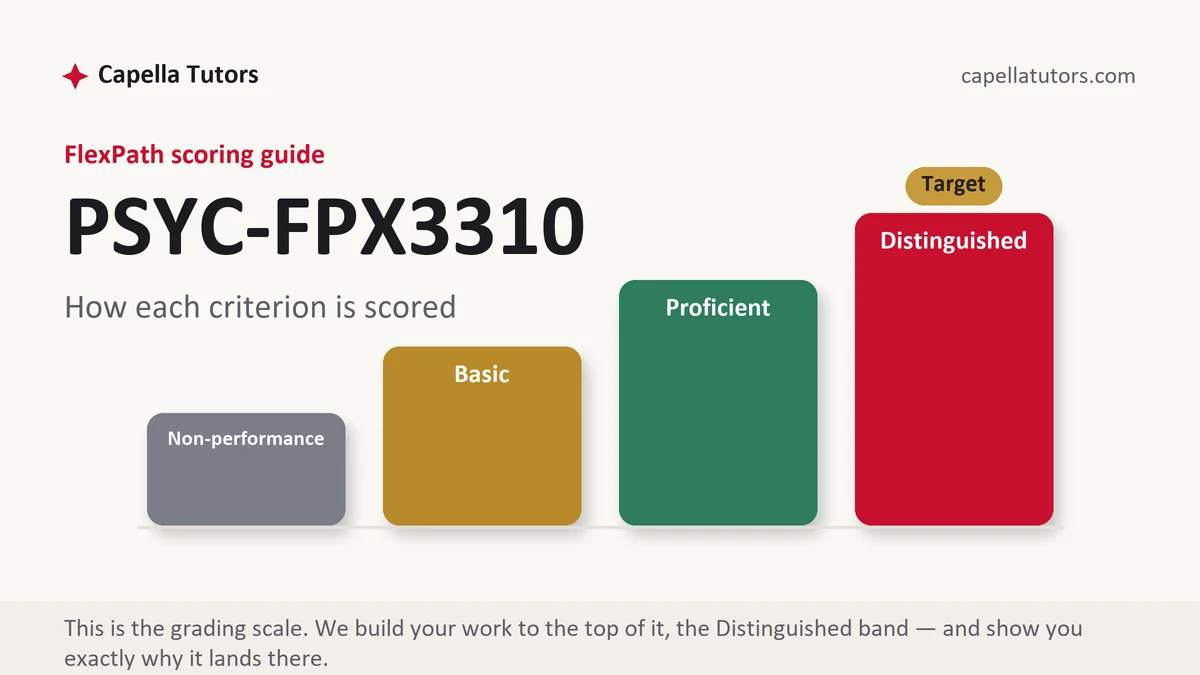
What PSYC FPX 3310 actually grades
What gets graded in this course is the order of your explanation. A behavior has to be traced through a chain, from the physical event, to the receptor that registers it, to the pathway that carries the signal, to the structures that process it, to the response you can observe, and each link has to be present. Papers lose criteria by jumping the chain, naming a brain region and then a behavior as though the region did the behaving. Write the intermediate steps and the same argument becomes a mechanism, which is the word most scoring guides in this course actually use.
Cellular precision is the second thing being marked, and it is where confident writing gets caught. An action potential is all or nothing, so a stronger stimulus does not produce a bigger one, it produces more of them and recruits more cells, and that distinction alone appears in more quiz and short-answer criteria than any other fact in the course. At the synapse, what matters is not the transmitter's name but which receptor subtype it reaches and what that receptor does when it opens, which is why the same molecule can quiet one circuit and excite another. That is also why the popular shorthand about a chemical imbalance does not survive contact with the literature, and why a paper that writes about receptor availability, reuptake, and circuit-level effects reads two levels above one that assigns each transmitter a single mood.
The third strand is the body attached to the brain. Endocrine signaling runs on a slower clock than neural signaling and the stress axis is the standard example, with a cascade that ends in a hormone measurable in saliva, a daily rhythm that makes time of sampling part of the finding, and a short-term profile that is adaptive against a sustained one that is not. Sleep gets similar treatment, staged rather than uniform, with different stages doing different work, so a paper that treats sleep as a single quantity misses what the research is about. Plasticity closes the loop, since experience changes the structure that produced the behavior, and that reciprocal relationship is the sentence this course is built to teach.
How we help in this course
Our 3310 samples are written by people who check the anatomy before they write the sentence. Pathways run in the right direction, structures are named at the right level of the hierarchy, transmitter effects are tied to receptors rather than asserted, and every study cited arrives with the method that produced it. Tell us the behavior or system in the prompt, the criteria, and the terminology your course uses, and the draft will use your vocabulary, since this is a course where two textbooks can name the same structure two ways.
The commercial terms do not change. A premium original sample in 24 to 48 hours, built for the Distinguished column, and passed through an eight-person pipeline before it reaches you, with a research analyst pulling sources, a subject writer drafting, a reviewer marking the draft against your scoring guide criterion by criterion, an APA and originality check on every citation, and an editor last. Revisions run free until the work meets the guide, and faculty comments come back into that cycle at no charge, which matters here because a single misnamed structure can pull down a whole criterion.
The assessments, one by one
Assessment 1
The opening deliverable in Brain, Body, and Behavior usually takes one behavior and asks for the physical chain behind it, from the event in the world to the response an observer could record, with every link in between written down instead of assumed. Read the full Assessment 1 manual.
Assessment 2
The middle deliverable in Brain, Body, and Behavior usually stops asking you to explain a mechanism and starts asking you to judge evidence about one: a published study, its method, and the distance between what was measured and what has been claimed on the strength of it. Read the full Assessment 2 manual.
Assessment 3
The closing deliverable in Brain, Body, and Behavior usually asks you to carry a mechanism out of the textbook and into something that happens to people: a substance, a condition, a night of lost sleep, a decision made the next morning. Read the full Assessment 3 manual.
How to actually write PSYC FPX 3310: where to begin
Set the scoring guide beside you and convert each criterion into a heading with its Distinguished wording underneath, then write only what belongs under a heading. The clusters in this course usually run in one direction: state the behavior and the question, lay out the anatomy and the pathway, drop to the cellular and synaptic level, bring evidence with its method attached, connect the mechanism to something clinical or applied, and close on limits.
The method sentence is the cheapest upgrade available in this course, so practise it. Functional imaging does not record neurons firing, it records a slow change in blood oxygenation that follows neural activity by a few seconds, which makes it good at where and poor at when. Electrical recording at the scalp reverses that trade, resolving events to the millisecond while leaving the source ambiguous. Work with lesions, stimulation, and animal preparations supports stronger causal language, with the cost that generalization across species has to be argued rather than assumed. Say which of those produced your finding, in one clause, before you say what the finding was, and your verbs will look after themselves.
Then fix the verb. A structure is involved in a function, is active during a task, is necessary for a capacity when damage abolishes it, and is almost never responsible for a behavior. The reason is not politeness. Regions participate in many processes, so activity in one place does not tell you which process occurred, and inferring the mental state backwards from the map is the most common error in popular writing about the brain. A paper that names a network rather than a spot, and says what the evidence would have to look like for the stronger claim to hold, is writing at the top of this scale.
| Section | What goes in it | What Distinguished looks like |
|---|---|---|
| Behavior and question | The observable behavior or capacity, stated precisely enough to be measured. | A question with a testable shape rather than a topic heading. |
| Anatomy and pathway | Structures named at consistent levels, with the route the signal takes stated in order. | Correct hierarchy and direction, with afferent and efferent traffic distinguished. |
| Cellular mechanism | Receptors, transmitters, and what happens at the synapse, tied to the pathway above. | Receptor subtype and circuit doing the explaining, not the transmitter's reputation. |
| Evidence and method | Studies with species, sample, technique, and what that technique can resolve. | Method named before finding, with temporal and spatial limits acknowledged. |
| Applied link | The clinical, pharmacological, or everyday consequence of the mechanism described. | An application that follows from the mechanism, with drug action stated at receptor level. |
| Limits and sources | What the evidence cannot show, plus current APA citations and references. | Limits specific to the studies cited rather than a general caution about research. |
Developing the synthesis
Biological psychology argues with itself in ways an undergraduate paper can profitably report. The older habit of assigning one function to one structure has given way to network accounts, and both appear in current reading, so a paper that notices the shift and explains why a distributed account fits its behavior better is making an argument rather than a summary. Single-transmitter explanations of mood are the clearest case of a model that outlived its evidence, since decades of work found the story more complicated than depletion and repletion, and saying so with a citation is the kind of sentence faculty remember. Imaging has its own caution attached, because small samples and flexible analysis choices inflated some early effects, which is why replication and preregistration turn up in recent methods sections. Choose one of these disputes, weigh the designs, and then commit. Naming a limitation and still reaching a conclusion is the difference between the top two columns.
Citations that survive faculty review
Four kinds of source carry this material. Peer-reviewed neuroscience and biological psychology journals, retrieved through the Capella library, PsycINFO, and PubMed, support every empirical claim, and the primary report is what you cite rather than the press release that covered it. Federal research institutes, principally the National Institute of Neurological Disorders and Stroke, the National Institute of Mental Health, and the National Institute on Aging, are reliable for mechanism overviews and disease definitions and should be cited as the specific publication. Theory and models get cited to the paper that proposed them. A textbook or atlas is legitimate for a definition or a structure's location and for nothing else. One habit protects you throughout: read the methods for species, sample size, and technique before you read the conclusion, because a result in rodents and a result in undergraduates support different sentences. Finish with the two-way check that citations and references match in current APA.
The mistakes that land Basic instead of Distinguished
- Making a structure responsible for a behavior. Regions participate in processes, and the stronger verb needs lesion or stimulation evidence behind it.
- Giving a neurotransmitter one job. Effects come from receptor subtypes and circuits, and the imbalance shorthand contradicts the reading.
- Reporting an imaging result with no method. Without the technique and the sample, the reader cannot tell what the finding is allowed to mean.
- Repeating left brain and right brain claims. Lateralization is real, modest, and nothing like the popular version.
- Using terms loosely. Neuron and nerve, receptor and transmitter, potential and impulse are not interchangeable, and this course marks the difference.
PSYC FPX 3310 questions students actually ask
Do I need biology or chemistry behind me to pass this course?
No, and the students who struggle are usually not the ones who lack science background. The load in this course is vocabulary and sequence, not calculation, and both respond to method rather than aptitude. Learn the structures in relation to each other instead of as a list, draw the pathway by hand once for each system, and say the mechanism out loud before you write it, since a chain you can narrate is a chain you understand. Where a prompt asks about a drug, learn to state the action at the receptor rather than at the level of the mood it changes. Two weeks of that habit does more than any prior chemistry course would.
How much detail does a mechanism paragraph actually need?
Enough that a reader could redraw the chain from your sentences, and no more. The working test is whether every step that changes the signal appears: what was detected, what converted it, where it travelled, what processed it, and what came out as behavior. Detail below that level, the specific ion channels or the exact conductances, belongs in the paper only when your prompt is about them. The failure mode is not brevity, it is a gap, because a paragraph that moves from a stimulus to a feeling without the pathway in between reads as a summary of a textbook heading rather than an explanation.
Can I cite a brain imaging study to show a behavior has a biological cause?
You can cite it for what it measured, which is activity accompanying a task in a sample of people. That supports a sentence saying the behavior involves particular systems, and it does not settle cause, because activity follows the mental event as readily as it produces it. Stronger causal ground comes from work where something was changed rather than observed, so damage that removes a capacity, stimulation that alters performance, or a manipulation that shifts physiology and behavior together. State which kind of evidence you have, use involved in for the observational studies and necessary for where the damage evidence supports it, and note that biological involvement is not an alternative to learning or environment. Every behavior in this course has both.
Biological psychology paper due?
Send the prompt, the criteria, and the system or behavior you were assigned. We will trace the mechanism and cite the method behind every finding. First sample free, no card needed.