This manual is for PSYC FPX 3310 Assessment 3, start to submission. The closing deliverable in Brain, Body, and Behavior usually asks you to carry a mechanism out of the textbook and into something that happens to people: a substance, a condition, a night of lost sleep, a decision made the next morning. The criteria reward a paper where the biology earns the application, which means the substance is described where it acts rather than by the feeling it produces, and the account states what it cannot explain. Below is the order our tutors use, a structure that keeps the mechanism inside the applied section, and an annotated excerpt from an original model. Would you rather hand it over? Send the prompt with your scoring guide and the system or agent you were assigned, and a premium original sample comes back inside 24 to 48 hours, revised free until every criterion clears. Capella's catalog lists the course as PSYC-FPX3310, and some courserooms print PSYC3310; both point to this same Assessment 3.
One honesty note before the manual: Capella revises courses and scoring guides over time, so always write to the exact scoring guide attached to your assessment in the courseroom. The course identity above is verified on capella.edu; the method and structure below are our tutors' approach to it, not Capella's official rubric text.
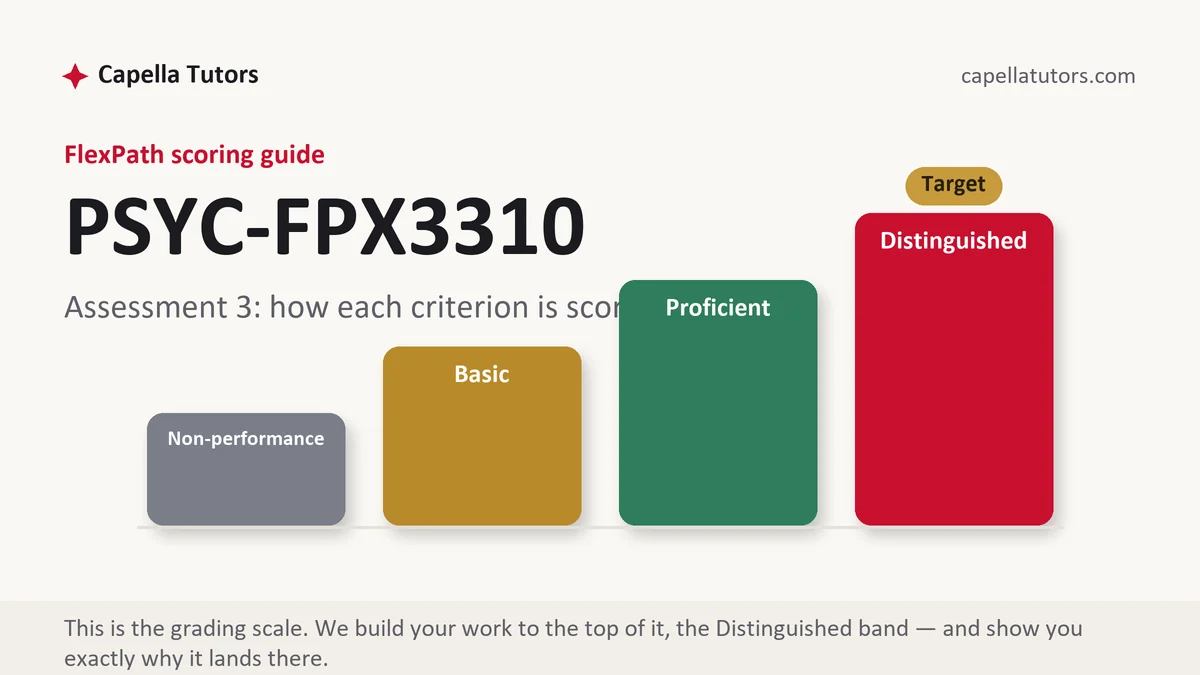
How PSYC FPX 3310 Assessment 3 is scored
FlexPath scores each criterion separately, and on an applied paper the four columns separate over where the biology is written:
| Level | What it means on an applied paper |
|---|---|
| Distinguished | The mechanism is carried into the application rather than repeated before it, any substance is described at the receptor it acts on, the measured outcome is named, and the account marks what it leaves unexplained. |
| Proficient | An accurate mechanism and a correct application, evidenced and cited. Reliable work that describes the substance by its effect on the person instead of by its action. |
| Basic | A physiology section followed by a consequences section, with the second one written in the language of feeling and the two never joined. |
| Non-performance | The applied link is missing, or the paper offers dosing or treatment instruction, which is outside what a course paper may conclude. |
Scope matters here as much as accuracy. An undergraduate paper in this course explains mechanisms, reports what studies measured, and can reasonably recommend a behavior change or a referral. It does not set doses, diagnose anyone, or tell a reader to alter a prescribed regimen, and a sentence that strays across that line costs a criterion that has nothing to do with your biology.
The PSYC FPX 3310 Assessment 3 method, step by step
-
Inherit the mechanism, do not restate it
The applied section should read as the next sentence of the physiology rather than as a fresh chapter. Open it with the specific step in the chain that the application acts on, then move outward, so a reader can see which link is being pushed and what is downstream of it.
-
Describe the substance where it actually acts
Name what binds what, and what happens when it does. Blocking a receptor, occupying it, and clearing the molecule that normally reaches it are three different events with three different consequences, and a paper that writes any of them as boosting energy has given the criterion nothing to grade.
-
Keep masking apart from repair
An agent that prevents a signal from being received has not removed whatever produced the signal. Say which one your evidence supports, because the difference decides what happens next: a pressure that was silenced returns when the block wears off, and a debt that was paid does not.
-
Treat the outcome as structured, not as a quantity
Sleep is staged, stress hormones follow a daily rhythm, and both facts make when you measured part of what you found. Write the outcome with its structure attached, and say which portion of it a shortened night or a mistimed sample would remove, since a total on its own hides the part the research is about.
-
Use self-report as one measure among several
How a person rates their own state is data, and it is not the state. Where a study measured both a rating and a performance, report the two separately and note when they disagree, because the disagreement is usually the interesting result and it is exactly what an applied criterion wants explained.
-
Mark the limits and stay in scope, then self-score
Close on the studies you leaned on and what they cannot establish, in terms specific to those studies rather than as a general caution. Recommend behavior, timing, or a conversation with a clinician, never a dose. Then mark each criterion against the guide yourself and repair every row below the top column.
A structure that maps to the criteria
The word targets are our tutors' planning figures for an applied paper of this size, not Capella rules; stretch whichever row your own guide weights hardest.
| Section | What it must do | Guide |
|---|---|---|
| The everyday problem | The situation and the observable outcome that needs explaining, stated in measurable terms. | ~150 words |
| The link being acted on | The step in the mechanism the application touches, inherited from the physiology rather than reintroduced. | ~200 words |
| Action at the receptor | What binds what, what that does to the circuit, and what the agent leaves untouched. | ~250 words |
| Evidence with method | Studies with species, sample, design and what was measured, each stated before its result. | ~250 words |
| Consequence and the reporting gap | The applied outcome, plus what happens when a person's rating and their performance disagree. | ~200 words |
| Limits, scope, references | What these studies cannot show, what a student may and may not recommend, current APA both ways. | ~150 words |
Annotated sample excerpt
An original model excerpt from our team, taken from the join where physiology becomes an applied claim. Learn the moves, then write your own version.
Adenosine accumulates across a long waking day and acts at receptors whose effect is to quiet the circuits holding arousal up, which is part of why a sixteenth hour awake does not feel like a second one.1 Caffeine competes for those same receptors without removing any of the adenosine that has gathered, so the signal is blocked rather than settled, and the pressure present at midnight is still present at six with a molecule parked in front of it.2 That distinction predicts what the student in this scenario reported, since her rating of her own sharpness recovered within forty minutes of the first cup while her error rate on the proofreading task did not, and the gap between those two measures is the finding an applied paper should name rather than smooth over.3
- 1The mechanism is inherited from the earlier section and written at the level of the receptor, with an ordinary observation attached so the reader sees what it explains.
- 2Blocking a signal and clearing a molecule are kept apart, which is the distinction a criterion about drug action is built to check.
- 3Self-report is handled as one measure rather than as the state itself, and the disagreement between two measures becomes the point of the paragraph.
The full premium sample for your exact assessment, written fresh to your scoring guide and issue, is free to request. Study it, revise it into your own voice, and submit work you understand.
The five mistakes that cost Distinguished
- The application that repeats the physiology. A second pass over the same chain is not an applied section, and the criterion asking for a consequence goes unanswered.
- A substance described by its feeling. Lifts energy and improves focus are outcomes, and the row is asking what the molecule does at the receptor.
- Masking sold as repair. A blocked signal returns when the block clears, and treating that as recovery misstates the mechanism.
- An outcome counted as a lump. Hours of sleep, or one hormone sample at an unstated time, throws away the structure the research depends on.
- A recommendation written as a prescription. Doses, regimens and diagnoses sit outside a course paper, and one sentence of it can cost the scope criterion.
Pre-submission checklist
- The applied section opens on the specific link in the mechanism it acts upon
- Any substance described at its receptor, with what it does not do stated too
- Masking and repair distinguished, with the consequence of each spelled out
- The outcome reported with its structure or timing rather than as a single total
- Ratings and performance reported separately wherever a study measured both
- Limits tied to the studies cited, scope respected, APA matched, criteria self-scored
Applied paper due and the biology will not reach the behavior?
Send the prompt, the scoring guide and the agent or condition you were assigned. A team of eight, including a research analyst and two QA reviewers, returns a premium original sample where the receptor-level account drives the applied claim, in 24 to 48 hours, revised free until the guide is satisfied.