This manual is for PSYC FPX 3310 Assessment 1, start to submission. The opening deliverable in Brain, Body, and Behavior usually takes one behavior and asks for the physical chain behind it, from the event in the world to the response an observer could record, with every link in between written down instead of assumed. It is the assessment where writing habits get rebuilt, because a paragraph that names a structure and then a feeling has skipped the part being graded. Below is the working order our tutors use for it, a structure that answers the criteria link by link, and an annotated excerpt pitched where the top column sits. Would you rather hand it over? Send the prompt with your scoring guide and the system you were assigned, and a premium original sample comes back inside 24 to 48 hours, checked for anatomy as well as style and revised free until it scores. Capella's catalog lists the course as PSYC-FPX3310, and some courserooms print PSYC3310; both point to this same Assessment 1.
One honesty note before the manual: Capella revises courses and scoring guides over time, so always write to the exact scoring guide attached to your assessment in the courseroom. The course identity above is verified on capella.edu; the method and structure below are our tutors' approach to it, not Capella's official rubric text.
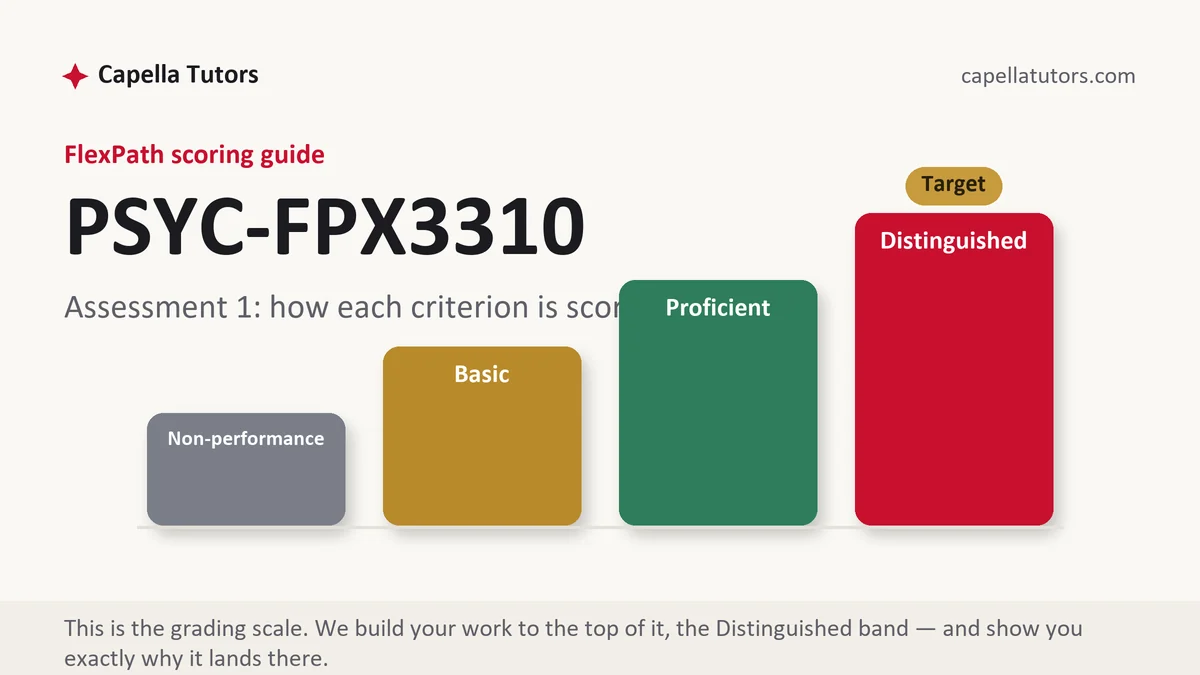
How PSYC FPX 3310 Assessment 1 is scored
FlexPath grades criteria rather than papers, and on a mechanism explanation the four columns separate over completeness of the chain:
| Level | What it means on a mechanism explanation |
|---|---|
| Distinguished | Every link present and in order, structures named at a consistent grain, signal direction correct, and the timing of the chain used to predict something about the behavior. The prediction is what usually lifts the row. |
| Proficient | The pathway accurate and complete, terminology handled correctly. Reliable work that stops at describing the route instead of using it to explain what is observed. |
| Basic | The right vocabulary in roughly the right order, with one or two links assumed rather than written, which is where most first submissions in this course land. |
| Non-performance | A required link is absent, or the explanation jumps from a stimulus to a behavior with no pathway between them at all. |
Undergraduate writing loses this assessment on gaps rather than on ignorance. Most students know the structures; fewer write the connections between them, and a criterion asking for a mechanism is asking for exactly the connections. If a reader could not redraw your chain from your sentences, the chain is not on the page yet.
The PSYC FPX 3310 Assessment 1 method, step by step
-
Draw the chain before you write a sentence
One sheet of paper, boxes for the event, the receptor, the route in, the processing, the output and the behavior, with arrows connecting them. Anything you cannot draw you cannot yet explain, and the blank arrows on that sheet are precisely the sentences the criteria are waiting for.
-
Keep one grain of description per clause
A receptor, a cell, a nucleus, a region and a system are five different levels of magnification. Say which one you are using and stay there until you deliberately step up or down, because a sentence that pairs a receptor subtype with a lobe reads as vocabulary assembled rather than anatomy understood.
-
Get the direction of traffic right
Sensory signals travel in, motor commands travel out, and some circuits close long before others do. A reflex that resolves in the spinal cord finishes while the same signal is still climbing toward the cortex, and writing that difference down explains the ordinary observation that a limb moves before the person reports feeling anything.
-
Code intensity the way the cell actually does
An impulse is all or nothing, so a stronger stimulus never produces a larger one. It produces more of them per second and recruits more fibers, and that single correction appears in more short-answer criteria in this course than any other fact. Write frequency and recruitment wherever you are tempted to write bigger.
-
Put the method in front of every finding
One clause before the result, naming what produced it: recording from cells in an anesthetized animal, a person with damage to a specific region, a drug given to volunteers, a scan taken during a task. Cite the study that ran it rather than the article that reported it, and your verbs will police themselves.
-
Narrate the chain aloud, then self-score
Say the mechanism from memory to nobody in particular. The link you stumble on is the link that is missing from the draft. Then mark each criterion yourself against the guide and repair any row below the top column, remembering that a single misnamed structure can pull down a whole row.
A structure that maps to the criteria
The word targets are planning numbers our tutors use for a mechanism paper of this size, not Capella rules; expand whichever link your own guide weights hardest.
| Section | What it must do | Guide |
|---|---|---|
| Behavior and question | The observable behavior stated precisely enough to be measured, and the mechanism question it raises. | ~150 words |
| Stimulus and receptor | The physical event, what detects it, and how detection converts into a neural signal. | ~200 words |
| Route and processing | The pathway in order and in the right direction, with each synapse and structure named at a consistent level. | ~300 words |
| Output and behavior | The command leaving, the muscle or gland acting, and the timing that explains what an observer sees. | ~200 words |
| Evidence and method | Studies with species, sample and technique, each stated before the finding it produced. | ~250 words |
| Limits and references | What this evidence cannot establish, plus current APA citations matched in both directions. | ~150 words |
Annotated sample excerpt
An original model excerpt from our team, written at the point where a mechanism paragraph either carries the reader across every link or leaves one out. Learn the moves, then write your own.
When a palm lands on a pan handle at 70 degrees Celsius, free nerve endings in the skin respond to the heat and fire faster as the temperature rises, since each impulse is the same size and only their rate and the number of fibers recruited can carry the intensity.1 Those fibers enter the spinal cord and synapse onto interneurons that drive the motor neurons of the arm flexors directly, so the hand is already moving while the same signal is still climbing through the brainstem and thalamus toward the cortex.2 The burn is reported a moment after the withdrawal, which is not a curiosity but the predictable result of a short local circuit finishing before a longer one arrives.3
- 1Stimulus and receptor appear together, and the intensity question is answered at the level this course grades, rate and recruitment rather than a larger signal.
- 2The route runs in order and in the correct direction, with the reflex closing locally, which is the link most drafts leave to the reader.
- 3The behavior is explained by the timing of the chain, so the paragraph predicts what an observer sees instead of restating it in technical words.
The full premium sample for your exact assessment, written fresh to your scoring guide and issue, is free to request. Study it, revise it into your own voice, and submit work you understand.
The five mistakes that cost Distinguished
- The missing middle. A sentence that travels from an event to a feeling with no pathway between them is the single most common way to lose this criterion.
- Intensity written as amplitude. A hotter surface produces more impulses in more fibers, never a bigger impulse, and the difference is graded directly.
- Traffic sent the wrong way. Sensory in, motor out, and reversing them is a factual error a reader catches in one glance.
- Levels mixed inside one clause. A receptor, a nucleus and a lobe are three magnifications, and a sentence should stay on one of them.
- A finding with no method in front of it. A recording in an anesthetized animal, a patient with damage and a scan of healthy volunteers license three different verbs.
Pre-submission checklist
- The chain is drawn on paper first, with no unexplained arrow left on the page
- Every structure named at a consistent level of magnification
- Signal direction stated, and any circuit that closes early identified as such
- Intensity described as rate and recruitment rather than size
- Each finding preceded by species, sample and technique, cited to the original report
- Chain narrated aloud without notes, every criterion self-scored, APA matched both ways
Mechanism paper due and one link keeps escaping?
Send the prompt, the scoring guide and the behavior or system you were assigned. A team of eight, including a research analyst and two QA reviewers, returns a premium original sample with the chain written link by link, in 24 to 48 hours, revised free until every criterion clears.