This manual is for PSYC FPX 3310 Assessment 2, start to submission. The middle deliverable in Brain, Body, and Behavior usually stops asking you to explain a mechanism and starts asking you to judge evidence about one: a published study, its method, and the distance between what was measured and what has been claimed on the strength of it. The criteria here reward a reader rather than a summarizer, and the move that earns the top column is rewriting the paper's conclusion at the strength its design actually supports. Below is the order our tutors work in, a structure for an evidence critique, and an annotated excerpt from an original model. Would you rather hand it over? Send the article and your scoring guide and a premium original sample comes back inside 24 to 48 hours, revised free until the evaluation rows clear. Capella's catalog lists the course as PSYC-FPX3310, and some courserooms print PSYC3310; both point to this same Assessment 2.
One honesty note before the manual: Capella revises courses and scoring guides over time, so always write to the exact scoring guide attached to your assessment in the courseroom. The course identity above is verified on capella.edu; the method and structure below are our tutors' approach to it, not Capella's official rubric text.
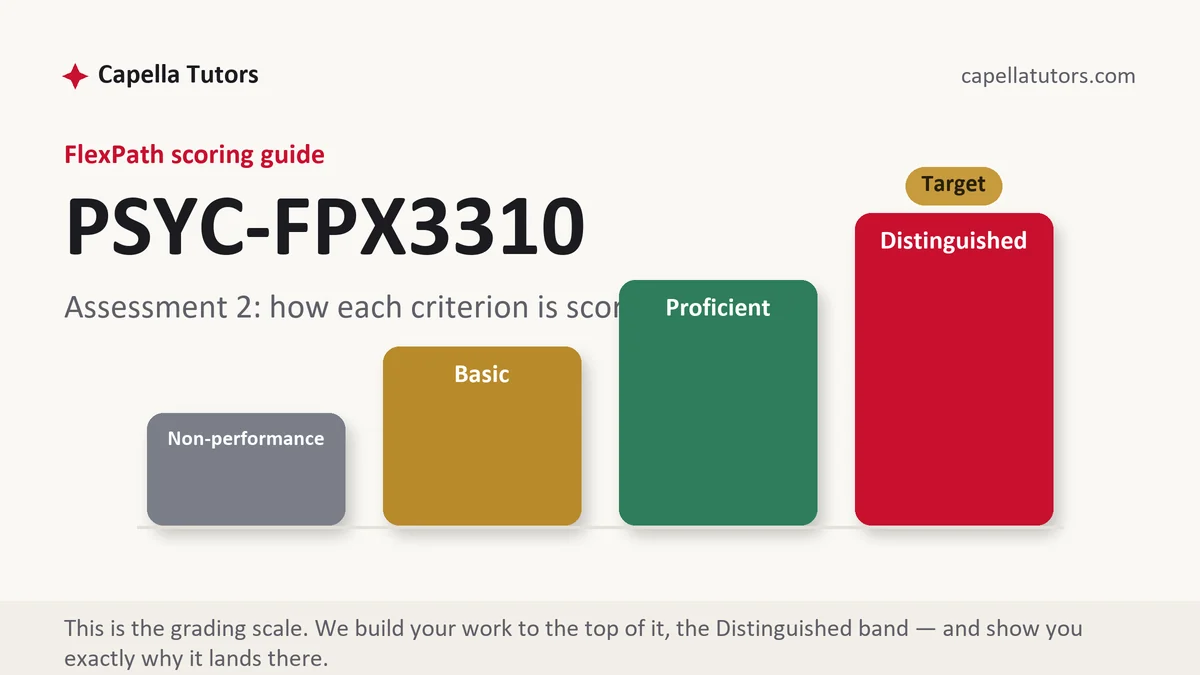
How PSYC FPX 3310 Assessment 2 is scored
Every criterion lands in one of four columns on its own merits, and on a critique the columns divide over whether you evaluated the design or the prose:
| Level | What it means on an evidence critique |
|---|---|
| Distinguished | What the instrument measured is separated from what the authors concluded, the sample is checked against the population being claimed, and the conclusion is rewritten at defensible strength with the study that would settle the question named. |
| Proficient | The method described accurately and real limitations identified. Competent work that lists weaknesses without saying what the finding is still entitled to support. |
| Basic | A summary of the article with a closing paragraph of generic cautions about sample size and further research being needed. |
| Non-performance | The evaluation is absent, or the paper repeats the authors' conclusion as established fact, which is the one thing a critique criterion cannot award. |
Nothing in this assessment requires you to doubt the study. Good papers are usually careful, and the overreach tends to happen downstream of them, in a press summary or a textbook sentence. Your job is to locate the point where the claim outgrew the design, and to say what remains true after that point.
The PSYC FPX 3310 Assessment 2 method, step by step
-
Start in the method section and take your notes there
Read the abstract last. Open the method and write down the species, the number of participants, who they were, what task they performed, what was recorded, and what was compared against what. Everything you will say later has to be supportable from those notes alone.
-
Separate what was recorded from what it is called
Functional imaging records a slow change in blood oxygenation that follows neural activity, not cells firing. Scalp electrical recording resolves timing to the millisecond while leaving the source uncertain. Say which quantity was measured and what that quantity can resolve, in one clause, before you evaluate any inference built on it.
-
Check the sample against the claim
Compare the population in the method with the population in the conclusion. Eighteen undergraduates in a scanner support a statement about eighteen undergraduates in a scanner, and a sentence about how people decide is a larger claim. State the gap in your own words rather than filing it under a general note about generalizability.
-
Test the step taken backwards
Activity in a region does not identify the mental process behind it, because regions take part in many processes, and inferring the process from the map is the most common error in popular writing about the brain. Ask whether the same activity would appear during a task the authors are not discussing, then say so plainly.
-
Cite the study, not the coverage
The primary report is the source, with the news article or the summarizing website used only to show what was claimed publicly, and labeled as such. At bachelor's level that habit alone lifts a communication criterion, and it lets you attribute the overreach to whoever committed it rather than to the researchers.
-
Rewrite the conclusion, then self-score
End by putting the finding in a sentence you would defend, and name the design that would earn the stronger claim: something changed rather than observed, or a larger preregistered replication. Then mark each criterion against the guide yourself and fix any row short of the top column.
A structure that maps to the criteria
These targets are our tutors' planning numbers for a critique of a single study rather than Capella requirements; expand whichever row your guide weights most heavily.
| Section | What it must do | Guide |
|---|---|---|
| The study, told once | Participants, task, what was recorded and what was compared, in your own words with no evaluation yet. | ~200 words |
| What the technique measures | The physical quantity recorded, its timing and spatial resolution, and what it therefore cannot show. | ~250 words |
| Sample and generalization | Who was studied, who the conclusion is about, and how far the gap between them stretches. | ~200 words |
| The inference examined | Whether the process can be read from the activity, and which rival accounts produce the same pattern. | ~250 words |
| The claim rewritten | The finding restated at defensible strength, with the verb matched to the design that produced it. | ~200 words |
| What would settle it, and sources | The study that would earn the stronger claim, plus current APA with the primary report cited. | ~150 words |
Annotated sample excerpt
An original model excerpt from our team, taken from the paragraph where a critique either does its work or turns into a summary with reservations. Study the moves and write your own version.
The authors scanned eighteen undergraduates choosing between a smaller payment today and a larger payment in three weeks, and reported more activity in a frontal region on the trials where the immediate option was taken.1 What the scanner recorded is a change in blood oxygenation that trails neural activity by several seconds, which locates the effect adequately and leaves the order of events inside a two-second decision unresolved.2 The result therefore supports the sentence that impatient choices in this sample involved that region, and it does not support the coverage that followed, which announced a brain basis for impulsiveness, because nothing here was manipulated and the same region is busy during tasks that have nothing to do with money.3
- 1The study is reported with its sample and its actual comparison, which gives the critique that follows something specific to hold on to.
- 2The measured quantity is separated from what the technique is casually said to show, in one clause, before any judgment is offered.
- 3The claim is rewritten at earned strength, the overreach is attributed to the coverage rather than to the researchers, and two independent reasons are given.
The full premium sample for your exact assessment, written fresh to your scoring guide and issue, is free to request. Study it, revise it into your own voice, and submit work you understand.
The five mistakes that cost Distinguished
- Critiquing the writing instead of the design. Comments on clarity and organization do not address a criterion about evidence.
- Sample size as the entire objection. A small sample is one limitation among several, and on its own it reads as a checklist rather than a reading.
- The coverage cited as the study. A news summary is evidence of what was claimed publicly, never evidence of what was found.
- The map read backwards. Naming a mental process from where activity appeared assumes the region does one thing, which the literature does not support.
- A critique with no repair. Listing faults without saying what the finding still supports leaves the evaluation criterion half answered.
Pre-submission checklist
- Notes taken from the method section before the abstract was reread
- The recorded quantity named, with its timing and spatial limits stated
- The studied population set beside the population the conclusion describes
- The backwards inference tested, with at least one rival account named
- The primary report cited in current APA, any coverage labeled as coverage
- The conclusion rewritten at defensible strength and every criterion self-scored
A study to critique and forty pages of method?
Send the article, the prompt and the scoring guide. A team of eight, including a research analyst and two QA reviewers, returns a premium original sample that separates the measurement from the claim and rewrites the conclusion at earned strength, in 24 to 48 hours, revised free until it meets the guide.