Hand us the prompt, the scoring guide, and the age range or person your assessment is built around, and an original sample written to the Distinguished descriptors returns in 24 to 48 hours, second-read before delivery and revised at no cost until it scores. The course line is PSYC FPX 3210, Human Lifespan Development, listed in Capella's PSYC-FPX catalog. We have not been able to verify a point value for it, and it did not appear on the General Psychology requirement list we checked, so confirm with your own program listing and catalog year before you build a term around it. If your listing does carry it, the 3000-level number places it inside the band where the BS in Psychology wants at least 27 of its 90 points. In Capella's catalog the course code is written PSYC-FPX3210.
What PSYC FPX 3210 actually grades
Developmental writing is graded on whether you can hold three things in view at once: physical change, cognitive change, and the social and emotional life that runs alongside them. The assessments in this course usually ask you to follow a person, a period, or a single process across time, and the criterion that separates the columns is integration. A Basic paper produces three tidy sections that never speak to each other. The stronger paper shows how a physical change alters what a person can attempt, how that attempt reshapes what they believe about their own ability, and how the people around them respond to the new version. Development is a set of consequences, and the scoring guide is looking for the causal joins.
The second thing this course grades is restraint about age. Age locates a change, it does not explain one, and the sentence that says a behavior happened because the child was seven has explained nothing. What does the explaining is a named process: a shift in how information is held and manipulated, a caregiving relationship that has become predictable, a peer group that has begun to outrank adults as an audience, a body that has started to signal adulthood before judgment catches up. Write the process and use the age as the address.
The third strand is the lifespan framing itself, which insists that development runs in more than one direction and continues to the end of life. Some capacities decline while others improve in the same decade, gains and losses coexist rather than trading places at midlife, and the system stays plastic enough that intervention keeps mattering long after the periods textbooks treat as formative. Late adulthood in particular is where undergraduate papers get lazy, describing loss and skipping the well-documented shifts in what people prioritize and how they regulate emotion as time horizons shorten. Cover both and the criterion resolves.
How we help in this course
Our 3210 drafts are built as one continuous account rather than a tour of stages. Each claim is attached to a process, each process is attached to a named source, and the passage of time is treated as something to explain instead of something to narrate. Where the prompt gives you a person or a scenario, the details in that scenario do the work. Send us the assessment, the criteria, and whichever developmental theorists your course has assigned, and the sample will argue inside your reading list rather than around it.
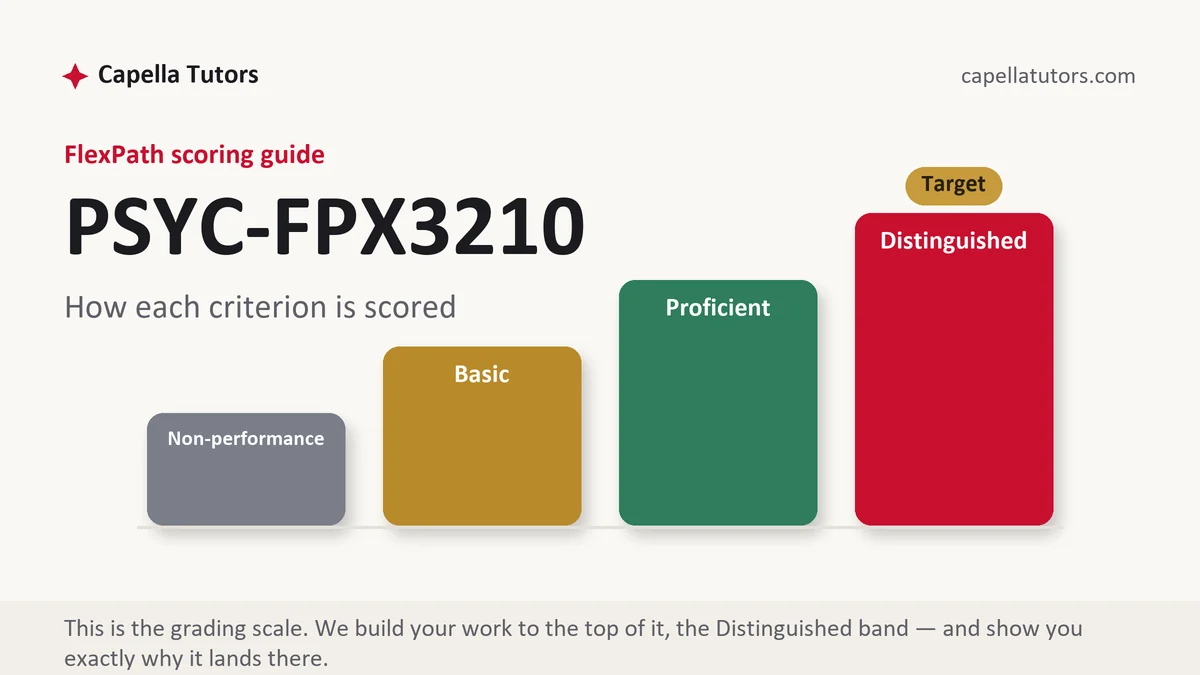
Delivery terms are the studio's standard. A premium original sample inside 24 to 48 hours, targeted at the top of the four criterion levels, and taken through an eight-person pipeline on the way to you: sources pulled by a research analyst, drafting by a psychology writer, a criterion-by-criterion review against your scoring guide, a dedicated APA and originality pass, then an editor. Revisions are unlimited and free until the work meets the guide, and anything faculty send back re-enters the same cycle without a charge.
The assessments, one by one
Assessment 1: Analyzing Sources
Answer questions using government data, library searches and scholarly articles on a lifespan development topic such as children and poverty. Read the full Assessment 1 manual.
Assessment 2
The middle deliverable in Human Lifespan Development usually moves off one person and onto evidence: a set of findings or a small dataset about age and some capacity, which you have to interpret rather than recompute. Read the full Assessment 2 manual.
Assessment 3
The closing deliverable in Human Lifespan Development usually asks you to do something with the material instead of reporting it: take a developmental mechanism, aim it at a real setting, and recommend a change a parent, teacher or practitioner could start on Monday. Read the full Assessment 3 manual.
How to actually write PSYC FPX 3210: where to begin
Start from the scoring guide, not from the chapter. Turn each criterion into a heading, put the Distinguished sentence under it, and let those headings decide what gets written. Assessments in this course tend to cluster the same way: establish the person and the period, describe change across the domains, explain it with a named theoretical account, support it with research whose design you can characterize, place it in family and cultural context, and draw an implication a parent, teacher, or practitioner could act on.
Then do the thing that reliably moves a criterion, which is putting two theories against the same behavior. Take a nine-year-old who cannot yet solve a problem alone but solves it with a well-timed hint from an adult. A stage account explains the failure by the child's current level of reasoning and predicts that the hint will not help much until the underlying structures mature. A social account explains the success by the gap between what the child can do alone and what the child can do with support, and treats the hint as the mechanism of development rather than a workaround. Both are defensible, they predict different things about what to try next, and a paper that says which prediction it backs and why is doing upper-division work.
Research design is the other place to earn marks cheaply. If a study compared seventy-year-olds with thirty-year-olds at one point in time, the difference it found may be age or may be the seventy years of different schooling, nutrition, and history those two groups lived through, and no amount of statistical adjustment settles that. Longitudinal work follows the same people and answers the change question, at the price of losing participants who often differ systematically from those who stay. Say which design produced your evidence and what that design can support. Two sentences of that kind read as a level of understanding faculty do not expect at this stage.
| Section | What goes in it | What Distinguished looks like |
|---|---|---|
| Person and period | Who is being followed, over what span, and why that span is the interesting one. | A stated reason the period matters developmentally, rather than a chosen convenience. |
| Change across domains | Physical, cognitive, and socioemotional change described concretely for that period. | The three domains linked causally, with one change shown driving another. |
| Theoretical account | The framework named, attributed to its originator, and applied to the specifics. | Two accounts compared on the same behavior, with a position taken and defended. |
| Evidence and design | Studies with their design, sample, and what they can and cannot establish. | Cross-sectional and longitudinal evidence distinguished, and cohort effects addressed. |
| Context and diversity | Family structure, culture, resources, and how each shapes the trajectory described. | Context integrated into the explanation instead of added as a closing paragraph. |
| Implication and sources | What a caregiver or professional should do differently, plus current APA both ways. | A recommendation that follows from the mechanism named earlier, cited to evidence. |
Developing the synthesis
The honest version of this literature is that the frameworks students learn as settled are useful maps drawn with uneven evidence. Sequenced accounts of cognitive development captured something real about how reasoning changes, and later work using gentler methods found children succeeding earlier than the original ages implied, which is why current writing treats the sequence as more informative than the timetable. Psychosocial stage accounts are widely taught and rest largely on clinical observation rather than measurement, so use them as organizing language and say so. Attachment research travels better, with measured early relationship patterns showing modest continuity into later relationships alongside substantial change. Take one of those tensions, state what the stronger designs show, and then explain why your chosen framework still earns its place in your paper. Committing to a framework while naming its limits is the top of the scale in this discipline.
Citations that survive faculty review
Four source types cover this course properly. Peer-reviewed developmental journals, retrieved through the Capella library and PsycINFO, carry every empirical claim, and recent work should sit alongside the older studies rather than replacing them, since some of the field's best evidence comes from cohorts followed for decades. Theory gets cited to its origin, so the paper that leans on a stage sequence cites the theorist who proposed it rather than a chapter that summarizes it, and quotes the summary only for a definition. Federal statistical sources supply population facts about family structure, life expectancy, and aging, and you name the survey and the year. Practice and policy bodies supply guidance where the prompt asks for an applied recommendation. When you report a study, give the age range and the sample size before the finding, because in this field those two details often decide whether the finding means what the abstract says. Then run the two-way APA check in both directions.
The mistakes that land Basic instead of Distinguished
- Writing stages as deadlines. A sequence describes order, and treating an age band as a pass mark misrepresents every theory in the course.
- Using age as the explanation. Name the process that changed, and let the age tell the reader where in the lifespan you are standing.
- Reading age differences as change. Comparing two age groups once measures cohorts as much as it measures development.
- One relative as the evidence base. An example illustrates a mechanism, and only research establishes that the mechanism is general.
- Late adulthood written as decline only. The lifespan frame requires gains and losses in the same period, and leaving out the gains is a criteria failure.
PSYC FPX 3210 questions students actually ask
Is this the same course as PSYC FPX 2600, and which one does my program want?
They cover overlapping ground, and they are not interchangeable on a requirement list. PSYC FPX 2600 Development Across the Lifespan is a named general education requirement in the listing we verified, and the program also runs a choose-one slot among PSYC FPX 2700 Child Development, PSYC FPX 2720 Adolescent Psychology, and PSYC FPX 2740 Adult Development and Aging. PSYC FPX 3210 sits in the PSYC-FPX catalog but did not appear on that requirement list, and we have not verified its point value. Before you register, open your own degree audit and confirm which developmental course your specialization and catalog year name, since paying for a course that satisfies nothing is an expensive way to learn this distinction. Your enrollment counselor can answer it in one message.
Can I use my own family as the case for this paper?
Usually yes if the prompt invites it, with two adjustments. Strip identifying detail and keep the analysis on observable behavior rather than on private history that the person never agreed to have written up, since a course paper is not a confidential setting. Then keep the evidential weight in the right place: your relative illustrates the mechanism and the research establishes it, so every claim about how development generally works needs a citation even when your example is vivid. Papers that invert that order read as memoir with references attached, which is a common way to lose an analysis criterion while writing something genuinely interesting.
How do I write about a stage theory when the research has moved past it?
Use it, date it, and say what replaced the parts that did not hold. The strongest undergraduate move is a short paragraph that credits the framework with the insight it contributed, notes the specific claim later work revised, and then applies the surviving part to your case. A sequence of reasoning that holds up while the original age boundaries have shifted is still a sequence, and saying that out loud is more impressive than pretending the timetable was never questioned. Cite the original theorist for the framework and a recent peer-reviewed source for the revision, and the criterion that asks you to evaluate theory answers itself.
Lifespan paper due?
Send the prompt, the scoring guide, and the age range you were given. We will build the developmental account and attach the theory to the evidence. The first sample is on us.