This manual is for PSYC FPX 3210 Assessment 3, start to submission. The closing deliverable in Human Lifespan Development usually asks you to do something with the material instead of reporting it: take a developmental mechanism, aim it at a real setting, and recommend a change a parent, teacher or practitioner could start on Monday. The criteria in this kind of paper reward two things that rarely travel together, a mechanism named precisely and a recommendation concrete enough to be carried out by somebody with thirty children and forty minutes. Below is the order our tutors use, a structure that keeps theory inside the proposal, and an annotated excerpt from an original model. Would you rather hand it over? Send the prompt and the scoring guide and a premium original sample comes back inside 24 to 48 hours, revised free until every row clears. Confirm the course against your own degree audit first if you have not already. Capella's catalog lists the course as PSYC-FPX3210, and some courserooms print PSYC3210; both point to this same Assessment 3. In current courserooms this assessment typically appears as "Meet the Washingtons Case Study".
One honesty note before the manual: Capella revises courses and scoring guides over time, so always write to the exact scoring guide attached to your assessment in the courseroom. The course identity above is verified on capella.edu; the method and structure below are our tutors' approach to it, not Capella's official rubric text.
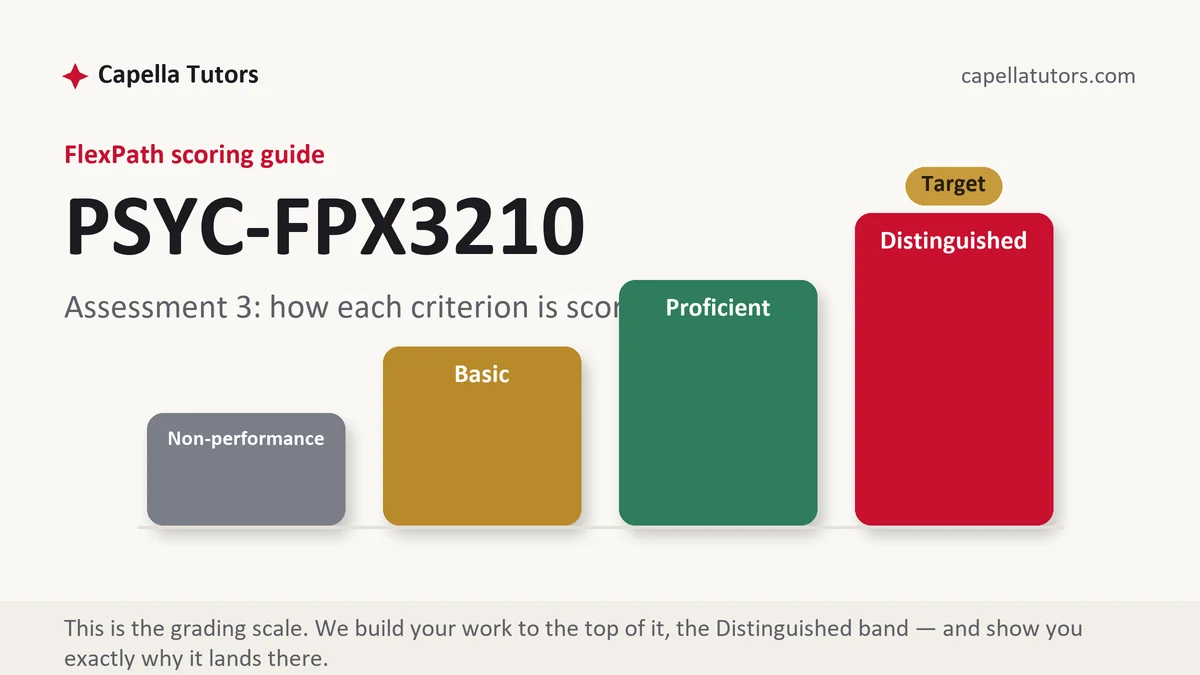
How PSYC FPX 3210 Assessment 3 is scored
Each criterion in FlexPath is judged on its own, and on an applied paper the columns divide over whether the advice could actually be followed:
| Level | What it means on an applied recommendation |
|---|---|
| Distinguished | A named developmental mechanism drives a proposal specific enough to schedule, the evidence behind it is attributed and its sample described, and the paper says how anyone would know whether it worked. The last of those is usually the row that decides the grade. |
| Proficient | A correct mechanism and a sensible recommendation that follows from it, supported by research. Solid, and silent about how the change would be detected or what it would cost. |
| Basic | A theory section, then an advice section, with the reader left to work out which part of the theory produced which part of the advice. |
| Non-performance | No recommendation is made, or the recommendation has no developmental reasoning attached to it and could have been written without the course. |
Applied criteria are where undergraduate papers are most often underpaid. The reading is done, the mechanism is understood, and then the closing section says the teacher should offer more encouragement. A criterion asking for an evidence-based recommendation is asking what will be done, by whom, how often, and on what signal it stops.
The PSYC FPX 3210 Assessment 3 method, step by step
-
Read each criterion as an instruction with a verb in it
Scoring guide rows are built from a verb and an object. Underline the verb first, because describe, explain, evaluate and recommend want differently shaped paragraphs, and a well-written description parked under a row that says recommend still scores in the middle. Copy the top-column wording under each heading and write toward it.
-
Turn the textbook concept into a mechanism
Your chapter hands you a term. Before you use it, write one sentence saying what has to happen, to whom, in what order, for that term to be doing any work. A term you can restate as a sequence of events becomes a recommendation almost by itself, and a term you can only define stays a definition on the page.
-
Fix the target in observable terms
Name the behavior you want changed as something a second observer could count: problems attempted before a hand goes up, minutes before a task is abandoned, questions asked in a session. Vague targets produce vague proposals, and criteria that ask for measurable outcomes have nothing to reward.
-
Build the support with its removal already planned
Help that never comes off has not developed anything. Say what the support is, who gives it, and the exact signal that retires it, which should be evidence of independent performance rather than the arrival of Friday. Write the fading condition into the proposal, not into a closing paragraph about future practice.
-
Say how anyone would know it worked
Add a check a working adult would genuinely run: a handful of items, no support available, scored in minutes, compared against the same items collected before you started. A stated comparison point is what the criteria treat as the difference between a proposal and a suggestion.
-
Cost it honestly, then self-score
Name what the recommendation cannot reach, what it asks of the adult in time, and which children or families it would not suit. Then grade yourself against each criterion and rewrite any row not sitting in the top column.
A structure that maps to the criteria
The word targets are our tutors' planning figures for an applied paper of this kind rather than Capella requirements; lengthen whichever section your guide weights most.
| Section | What it must do | Guide |
|---|---|---|
| The setting and the target | Who is involved, their developmental period, and the behavior to be changed stated in countable terms. | ~150 words |
| The mechanism, attributed | The developmental process doing the explaining, cited to the theorist or study that proposed it. | ~200 words |
| The proposal, step by step | What happens, in what order, who delivers it, how often, and the signal that support is withdrawn. | ~300 words |
| Evidence and its sample | Studies supporting the approach, each with design, age range and how closely the sample resembles your setting. | ~250 words |
| How the change is detected | The check, the comparison point, and what result would count as the proposal having failed. | ~200 words |
| Limits and references | Cost, reach, the families or learners it does not fit, and current APA matched in both directions. | ~150 words |
Annotated sample excerpt
An original model excerpt from our team, taken from the hinge where a recommendation either becomes schedulable or stays a sentiment. Study the moves and write your own.
For the next unit on fractions, the fourth-grade teacher should work the first two problems aloud with the whole class, hand the next two to pairs along with a written prompt naming the step this group most often skips, and only then assign practice to be done alone.1 The support is aimed at the distance between what a nine-year-old can complete with a well-timed hint and what the same child can complete unaided, so the prompt is withdrawn once three consecutive problems come back correct without it, rather than on Friday because the unit has moved on.2 The check is small enough to survive a real school week: four problems on Friday with no prompt available, scored in five minutes, set against the same four problems collected before the unit began.3
- 1The proposal is written as a sequence an adult could follow on Monday, with the number of problems specified instead of left to the reader's judgment.
- 2The mechanism sits inside the recommendation rather than in a separate theory section, and the condition for removing help is evidence instead of the calendar.
- 3An outcome check a busy teacher would actually run, with a stated comparison point, which is what turns advice into a proposal a criterion can reward.
The full premium sample for your exact assessment, written fresh to your scoring guide and issue, is free to request. Study it, revise it into your own voice, and submit work you understand.
The five mistakes that cost Distinguished
- Advice with no verb in it. More encouragement cannot be scheduled, delivered or checked, and a criterion asking for a plan finds nothing to grade.
- Theory in one room and the proposal in another. If the mechanism never appears inside the recommendation, the reader cannot tell that one produced the other.
- Support with no exit. Help that is never withdrawn keeps performance up and leaves development where it was.
- A plan that needs conditions nobody has. One adult per child, unlimited minutes and a quiet room is a wish rather than a recommendation.
- Evidence from the wrong ages. A finding from undergraduates supporting a claim about nine-year-olds needs the gap stated, or it should not be carrying the argument.
Pre-submission checklist
- Every criterion has its own heading and the verb in that row is answered in its shape
- The target behavior is written so a second observer could count it
- The mechanism is named, attributed, and visible inside the proposal itself
- The support has a stated withdrawal condition based on performance
- A check and a comparison point are described, along with what failure would look like
- Cost and reach acknowledged, current APA matched both ways, every criterion self-scored
Applied paper due and the advice sounds generic?
Send the prompt, the scoring guide, and the setting you were assigned. A premium original sample in which the mechanism drives a schedulable proposal comes back inside 24 to 48 hours, with free revisions until the guide is met.