This manual is for PSYC-FPX3210 Assessment 1, start to submission. The opening deliverable in Human Lifespan Development usually asks you to follow one person across a stated stretch of time and account for what changed in the body, in thinking, and in social and emotional life, as one story rather than three. Coverage is not what decides the grade; the joins are. A change in the body alters what a person attempts, the attempt alters what that person believes is still possible, and the people nearby respond to the version of the person they now see. Below is the working order our tutors use, a structure built around those joins, and an annotated excerpt from an original model. Would you rather hand it over? Send the prompt with your scoring guide and a premium original sample comes back inside 24 to 48 hours, revised free until every criterion clears. Worth one check first: open your own degree audit and confirm this is the developmental course your catalog year names. Your courseroom may print this as PSYC FPX 3210 Assessment 1 or PSYC3210 Assessment 1; it is the same deliverable, and PSYC-FPX3210 Assessment 1 is what this manual walks through.
One honesty note before the manual: Capella revises courses and scoring guides over time, so always write to the exact scoring guide attached to your assessment in the courseroom. The course identity above is verified on capella.edu; the method and structure below are our tutors' approach to it, not Capella's official rubric text.
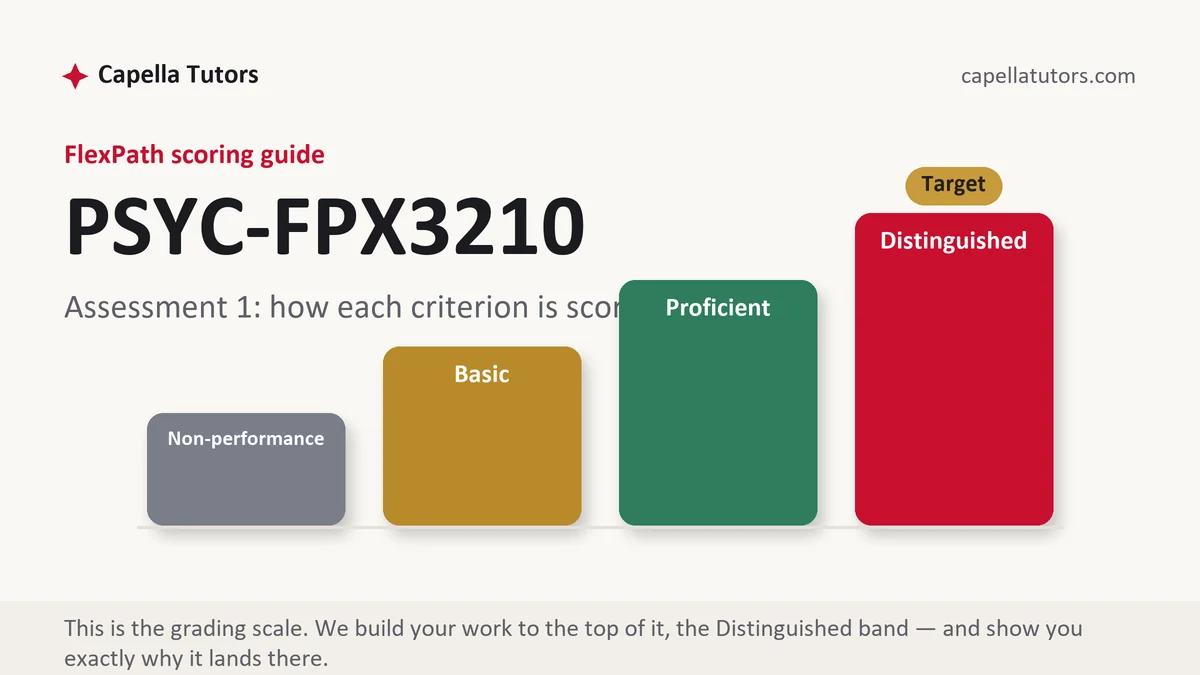
How PSYC-FPX3210 Assessment 1 is scored
FlexPath has no letter grades. Every criterion lands in one of four columns, and on a developmental profile the columns divide over whether the domains touch each other:
| Level | What it means on a developmental profile |
|---|---|
| Distinguished | One account, three domains. A bodily or cognitive change is shown driving a second change, the period is defended as the interesting one, and at least one gain appears alongside the losses. The causal join is the thing being paid for. |
| Proficient | All three domains described accurately for the right person and period, each supported by evidence. Correct work in which the domains sit beside one another instead of inside one another. |
| Basic | A guided tour of physical, then cognitive, then social change, with the connections left for the reader to assemble. |
| Non-performance | A domain is absent, or the profile never settles on a defined span, which leaves the criterion nothing to grade. |
Whatever the wording in your guide, treat every age in your draft as an address rather than an explanation. Nothing happens because a person turned seventy-eight. Things happen because a joint stopped tolerating stairs, or because a horizon shortened and made some relationships worth more than others.
The PSYC-FPX3210 Assessment 1 method, step by step
-
Choose the span before you choose the person
Pick a window in which something measurably shifted, then say in the paper why that window is worth reading. Two years around a surgery, a school transfer, a first job or a retirement will carry a profile. A quiet decade will not, and no amount of theory rescues a period in which nothing moved.
-
Write a fact sheet, and put dates on it
Before any interpretation, list what an observer could have recorded: what the person did, stopped doing, said about themselves, and who was present, each with a month attached. That sheet is the evidence your criteria will be checked against, and a profile assembled without one drifts into character description.
-
Draw the joins as arrows on paper
On one sheet, put each change in a box and connect the boxes with arrows that name a mechanism rather than a mood. Physical limit to dropped activity, dropped activity to lost contact, lost contact to a new self-description. Anything with no arrow into or out of it is background, and the paper reports the arrows in prose.
-
Name the process behind every age you mention
For each claim about a period, write the process doing the work: reasoning that can now hold two possibilities at once, a caregiving relationship that has grown predictable, a time horizon that has narrowed and pushed priorities toward the people who matter most.
-
Give every general claim a design in your own sentence
Any statement about how development usually runs needs a study, and the study needs its design written out by you: who was measured, how many, at how many time points, and over what ages. That one clause is what separates evidence from decoration, and it is cheap to add.
-
Audit for the gain, then self-score
Read the draft looking for something that improved in the same span as the losses, because a period written as pure decline fails a criterion the lifespan frame builds in. Then mark each criterion against the guide yourself and give any row below the top column one more pass.
A structure that maps to the criteria
These word targets are our tutors' planning numbers for a profile of this kind, not Capella rules; stretch whichever section your own guide weights most heavily.
| Section | What it must do | Guide |
|---|---|---|
| The person and the span | Who is being followed, over exactly what period, and the stated reason that period is developmentally interesting. | ~150 words |
| Bodily change and its reach | What changed physically and what that opened or closed in ordinary daily activity, described concretely. | ~200 words |
| Thinking and self-appraisal | Cognitive change over the same span, including how the person now describes their own competence. | ~200 words |
| Relationships and emotion | Who remained, who dropped away, and what shifted in how feeling is managed and priorities are set. | ~200 words |
| The joins, stated plainly | The arrows, in prose: which change drove which, and one gain reported inside the same period as the losses. | ~250 words |
| Evidence, context, references | Studies with design and age range, family and resource context, current APA matched both ways. | ~200 words |
Annotated sample excerpt
An original model excerpt from our team, taken from the paragraph where a profile stops describing and starts connecting. Study the moves and write your own.
Between the knee replacement in March and the move to a single-level apartment in September, the subject, a woman of seventy-eight, gave up a garden she had kept for thirty years and stopped attending a monthly supper held in a basement hall.1 Those two activities had supplied nearly all of her contact with people she knew slightly rather than well, so the calendar that survived the year holds her sister, one neighbor, and a daughter who telephones on Sundays, a smaller network and a warmer one.2 She now calls herself someone who manages, a description she did not use before the surgery, and it tracks the stairs she can no longer take in one go rather than the joint a surgeon repaired.3
- 1Two dated events and two dropped activities, with no theory in the sentence yet. Detail this specific gives a reader something to test an account against.
- 2The physical change is carried into the social one by naming where the lost contact lived, and a gain is reported in the same breath as a loss, which is what the lifespan criterion asks for.
- 3Self-appraisal is handled as a domain rather than a mood, and the causal claim points at something checkable instead of at the person's age.
The full premium sample for your exact assessment, written fresh to your scoring guide and issue, is free to request. Study it, revise it into your own voice, and submit work you understand.
The five mistakes that cost Distinguished
- Three domains in three silos. Accurate sections that never reach across to each other are the classic middle-column profile in this course.
- A span with nothing in it. If no dated change sits inside the window you chose, the analysis criteria have nothing to work on.
- Age standing in for a process. Turning eleven or seventy causes nothing; write the mechanism and let the age locate it.
- Decline with the gains left out. Later periods carry improvements as well as losses, and a one-directional account misreads the frame the course teaches.
- The general claim resting on the one case. Your subject shows how a mechanism could run, and only a study establishes that it usually does.
Pre-submission checklist
- The span is stated in dates and defended in one sentence as the interesting one
- All three domains appear, each with observable detail rather than adjectives
- At least two joins written as mechanisms, with the direction of the arrow stated
- Every general claim carries a study with its design, sample size and age range
- One documented gain reported inside the same period as the losses
- Self-scored criterion by criterion, with current APA matched in both directions
Profile due and the domains will not connect?
Send the prompt, the scoring guide, and whatever you have on the person or period you were given. A premium original sample built around the causal joins comes back in 24 to 48 hours, revised free until the guide is satisfied.