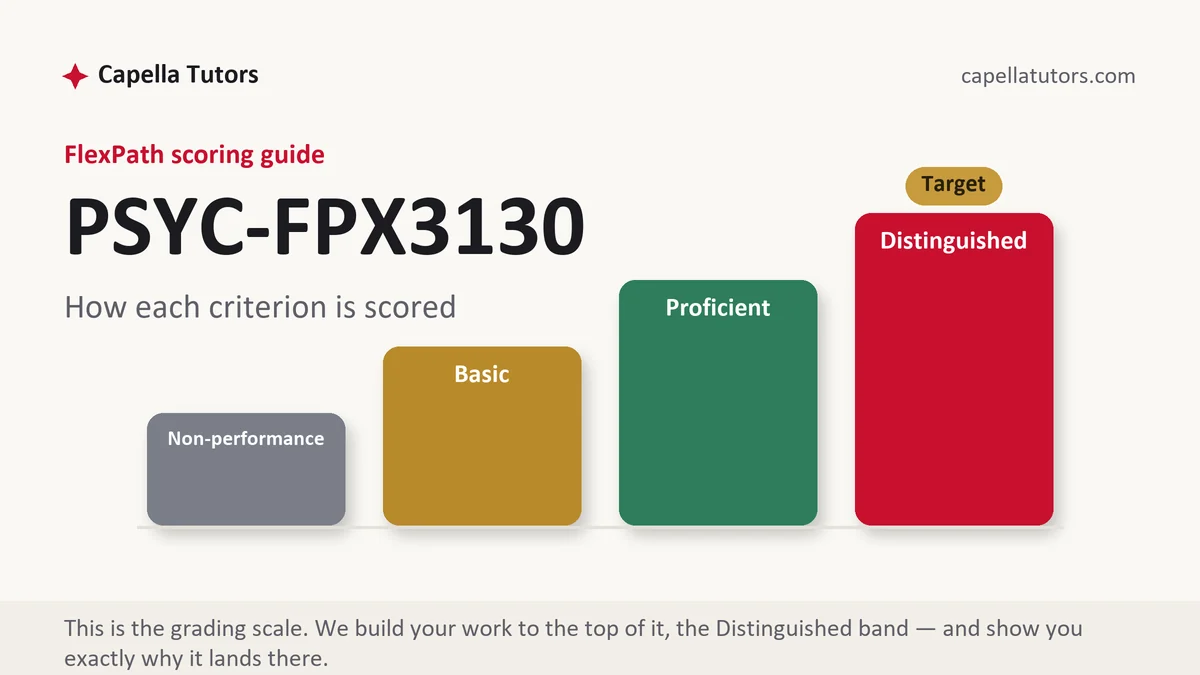
Give us the prompt, the criteria, and whichever case or offence type you were assigned, and an original sample built to the Distinguished descriptors comes back within 24 to 48 hours, checked by a second reader and revised free until the score lands. The course identity is PSYC FPX 3130, Criminal Psychology and Behavior, 3 program points, an upper-division elective on the General Psychology specialization menu of the BS in Psychology, taught in FlexPath, and one of the 3000-level courses that counts toward the 27 upper-division points the 90-point degree requires. In Capella's catalog the course code is written PSYC-FPX3130.
What PSYC FPX 3130 actually grades
The first thing this course grades is whether you know which discipline you are writing in. Criminal psychology asks why an individual offended and what that behavior consists of, forensic psychology is psychology practised inside legal proceedings, and criminology studies crime as a social pattern. Prompts in this course move between all three, and a paper that answers a psychological question with a sociological argument loses the criterion even when every sentence is true. Read the prompt for its unit of analysis first, because a question about one offender and a question about a neighbourhood rate are answered with different literatures.
Then the criteria want theory used rather than recited. Social learning accounts, strain accounts, low self-control accounts, and the routine activity model each explain something the others do not, and the assessments in this course usually ask you to pick one, justify the pick, and apply it to detail. The fact any account has to survive is the age-crime curve, the well-replicated finding that offending rises sharply in adolescence and falls through the twenties, which is why developmental taxonomies separating offending that is limited to adolescence from offending that persists across life do so much work in this literature. Your justification paragraph is where the marks are, because choosing a theory is easy and defending it against the obvious rival is not.
The third strand is measurement and the legal system, and it is where confident writing goes wrong. Psychopathy is a construct scored by trained raters on an instrument, not a diagnosis and not a synonym for violence, and the honest sentence notes that most people who score highly are never violent. Risk instruments produce a category with a comparison group attached, so the defensible sentence says that this person falls in a group whose reoffending rate over a stated period was such and such, and never that this person will reoffend. Insanity and competence to stand trial are legal determinations made by a court, and a diagnosis on its own answers neither question. Rubrics in this course check those distinctions directly.
How we help in this course
Our 3130 samples argue from evidence rather than from true-crime narrative. The theory is named and defended against a rival, the case detail is used instead of summarized, statistics arrive with a denominator and a time window, and anything from the legal side of the material is stated as a legal standard rather than a clinical one. Send the case file or offence type, the criteria, and any readings your instructor assigned, and the draft will argue inside your course's own frame.
The terms are the same across the studio. Every deliverable back in 24 to 48 hours, written at the Distinguished descriptors, and moved through an eight-person pipeline before delivery, with a research analyst sourcing first, a subject writer drafting, a scoring-guide reviewer marking it against the criteria row by row, an APA and originality reviewer checking every citation against its reference, and an editor closing. Revisions cost nothing until the work meets the guide, and faculty feedback returns into the same cycle. Faculty take up to two business days to evaluate an attempt, so tell us the date you want a grade by and we will build the schedule backwards from it.
The assessments, one by one
Assessment 1: Understanding Forensic Psychology Evaluations
Explain when forensic evaluations are used, their reliability and validity, and the ethical standards that govern them. Read the full Assessment 1 manual.
Assessment 2
The middle deliverable in Criminal Psychology and Behavior usually moves from explaining behavior to measuring it: an instrument, a score, a category, and a decision that somebody will make on the strength of what you wrote. Read the full Assessment 2 manual.
Assessment 3
The closing deliverable in Criminal Psychology and Behavior usually asks for judgment about judgment: how an investigation, an interview, or a courtroom decision went wrong, which documented effects on memory and reasoning explain it, and what a real unit could change. Read the full Assessment 3 manual.
How to actually write PSYC FPX 3130: where to begin
Lay the scoring guide out first and turn each criterion into a heading with the Distinguished wording pasted beneath it, then write only under those headings. The criteria in this course usually cluster in a familiar sequence: establish the behavior, select and justify a theoretical account, apply that account to the specifics, address measurement or risk where the prompt raises it, situate the case inside the legal or correctional system, and close on ethics and limits. Anything you cannot file under a heading is background reading rather than paper.
The application section is where most drafts stall, so work it as a mechanism rather than a label. A weak paragraph says the offender learned violence from a violent home. A strong paragraph names what was modelled, who modelled it, what reinforced the behavior when it first appeared, which competing influence failed to suppress it, and then what the account predicts should have happened but did not. Add the disconfirming detail deliberately, because a case that fits your theory perfectly usually means you selected the details rather than the theory.
Numbers need the same care. Any rate you quote has to say how many, out of how many, over what period, and from which counting system, since official police data record crimes that were reported to and recorded by participating agencies while victimization surveys capture incidents that were never reported at all. Those two systems disagree by design, and a paper that treats a change in recorded crime as a change in actual crime hands the evaluator an easy deduction.
| Section | What goes in it | What Distinguished looks like |
|---|---|---|
| The behavior | What was done, by whom, in what circumstances, described without explanatory language. | Facts separated from inference, with the sources of the account identified. |
| Theory selection | The chosen explanatory framework, its origin, and why it fits this behavior better than the alternative. | A rival account named and set aside for a stated reason rather than ignored. |
| Application | The mechanism traced through the case detail, including what the theory fails to explain. | Case specifics doing the argumentative work, with one disconfirming detail addressed. |
| Measurement and risk | Any instrument named with what it measures, who may score it, and what its output means. | Risk expressed as a group rate over a period, with base rates and error direction acknowledged. |
| System context | The legal or correctional response, and which decisions are legal rather than psychological. | Legal standards described as standards, with the psychologist's role bounded correctly. |
| Ethics and sources | Bias, stigma, the limits of retrospective analysis, and current APA both ways. | Limits argued in the writer's voice and tied to the specific claims being made. |
Developing the synthesis
This field disagrees with itself productively, and an upper-division paper should show that. Deterrence research generally finds the certainty of being caught matters more than the severity of the punishment, which cuts against the intuition most policy arguments start from. Correctional treatment reviews find that structured cognitive-behavioral programs reduce reoffending by modest but real margins while results vary widely between sites, and the same literature contains programs that made outcomes worse, with the confrontational deterrence camps aimed at teenagers as the standing example of an intervention that felt obviously right and was not. Offender profiling sits in a similar place, popular and thinly supported. Pick one of these disputes, state what the better-designed studies show, say what the weaker evidence claims, and then commit to a position. Weighing the evidence and still taking a side is the move the top column describes.
Citations that survive faculty review
Four kinds of source carry this course. Peer-reviewed forensic psychology, criminal justice, and developmental journals, pulled through the Capella library, PsycINFO, and the criminal justice databases, support every behavioral claim. Federal statistical sources supply the numbers, principally the Bureau of Justice Statistics and its victimization survey alongside the FBI's national crime reporting program, and you cite the specific report and year rather than the agency. Theory gets cited to its origin, so the paper that discusses a developmental taxonomy cites the article that proposed it. Professional guidelines cover the practice questions about who may assess whom. One reading habit matters more than any of this: check the sample before the finding, because a study of incarcerated adult men and a study of high school students will disagree about adolescent offending for reasons that have nothing to do with theory. Then confirm every citation has a reference and every reference has a citation, in current APA.
The mistakes that land Basic instead of Distinguished
- Sourcing the case from a documentary or a podcast. Use court records, news reporting, and peer-reviewed case literature, and treat entertainment as the thing you are correcting.
- Treating psychopathy as a diagnosis or as a synonym for dangerous. It is a scored construct, and the score does not travel with a prediction.
- Predicting that an individual will offend again. Instruments produce group rates, and the honest sentence keeps the comparison group visible.
- Using insanity, incompetence, and mental illness interchangeably. Two of those are legal findings and one is a clinical description.
- Quoting a crime figure with no denominator. A count without a population and a window cannot support any comparison at all.
PSYC FPX 3130 questions students actually ask
Is criminal psychology the same thing as forensic psychology?
No, and the difference is worth a paragraph in almost every paper this course sets. Criminal psychology explains offending behavior, its development, and its patterns. Forensic psychology is the application of psychological expertise inside legal processes, which covers evaluations for the court, expert testimony, and work with people already in the system. The practical consequence for your writing is which literature you cite and which claims you are entitled to make, since a question about why someone offended is answered from developmental and social research while a question about whether someone can participate in a trial is answered from assessment practice and case law. Say which one the prompt is asking for in your opening paragraph and the whole paper aims itself.
Can I write about a real case, and where should the facts come from?
Real cases are usually welcome, and the sourcing is what gets graded. Work from court documents, appellate opinions, sentencing records, and reporting by outlets that name their own sources, then say in the paper which facts are established and which are contested. Streaming series compress timelines and dramatize motive, so citing one tells a reader you took the convenient version. Keep your analysis on the behavior and the evidence rather than on the person's character, avoid speculation about anyone's mental state that the record does not support, and remember that victims and family members named in the record are entitled to the same restraint you would show a research participant.
Do risk assessment tools actually predict violence?
They discriminate better than unstructured judgment and worse than most people expect, which is the sentence your paper wants. Structured instruments reliably separate higher-rate groups from lower-rate groups, so they are useful for allocating supervision and treatment. What they cannot do is tell you about one person, and the arithmetic of low base rates explains why: when the behavior being predicted is rare, even an accurate tool generates many more false alarms than hits. Write the finding as a group rate over a defined follow-up period, name the population the instrument was validated on, and note whether your case resembles that population. That last check is the one students skip and evaluators look for.
Criminal behavior paper due?
Send the prompt, the criteria, and the case or offence type you were assigned. We will build the analysis and keep the evidence honest. Your first premium sample costs nothing.