This manual is for PSYC FPX 3130 Assessment 2, start to submission. The middle deliverable in Criminal Psychology and Behavior usually moves from explaining behavior to measuring it: an instrument, a score, a category, and a decision that somebody will make on the strength of what you wrote. The criteria are graded on restraint here, because the sentence that reports a risk band as a property of a person is wrong in a way the sentence that reports a group rate is not. Below is the method, a criterion-mapped structure, and an annotated excerpt from an original model. Prefer to hand it over? A premium original sample built to your scoring guide returns in 24 to 48 hours, revised free until it lands. Capella's catalog lists the course as PSYC-FPX3130, and some courserooms print PSYC3130; both point to this same Assessment 2.
One honesty note before the manual: Capella revises courses and scoring guides over time, so always write to the exact scoring guide attached to your assessment in the courseroom. The course identity above is verified on capella.edu; the method and structure below are our tutors' approach to it, not Capella's official rubric text.
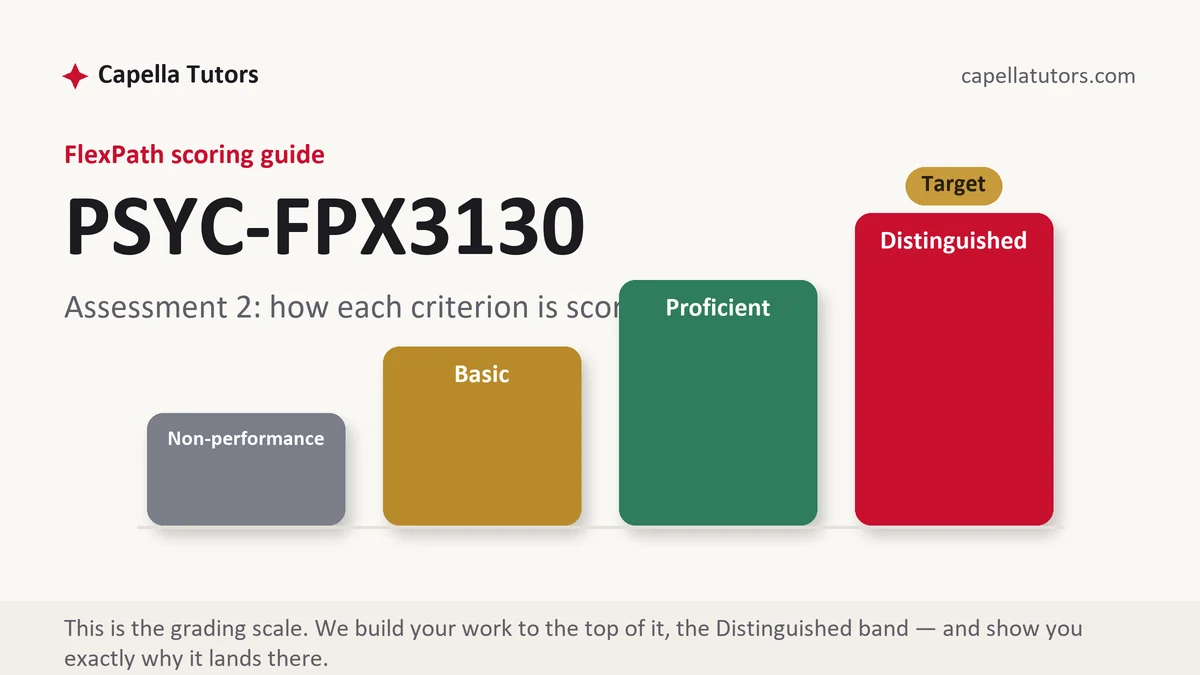
How PSYC FPX 3130 Assessment 2 is scored
Each row of the scoring guide gets its own verdict from four possible levels. Translated for a measurement deliverable, they read like this:
| Level | What it means on a risk and measurement report |
|---|---|
| Distinguished | Each instrument is named with what it measures and who may score it, risk is written as a group rate over a stated follow-up window, the base rate and the direction of error are worked through in the paper, and the fit between this case and the validation sample is examined. |
| Proficient | Correct use of the instrument and accurate reporting of its output. Complete, and short of the top, because the arithmetic of error is described rather than performed. |
| Basic | A risk category reported as a feature of the person, with the comparison group and the time window left out of the sentence. |
| Non-performance | A prediction about the individual, or a legal question answered as though a clinical finding could settle it. |
Two vocabulary rules carry more marks than anything else in this deliverable. A construct scored by trained raters on an instrument is not a diagnosis, and it is not a synonym for dangerous, since most people who score highly are never violent. Competence to stand trial and criminal responsibility are decisions courts make against legal standards, and no score answers either one. Say both out loud in your own sentences and two criteria resolve at once.
The PSYC FPX 3130 Assessment 2 method, step by step
-
Write down the decision your report has to serve
Supervision level, release conditions, treatment allocation, or a court's question. The audience changes what you may claim and how much hedging is useful, and a report addressed to nobody in particular ends up asserting more than its evidence allows.
-
Name the instrument, the construct, and the scorer
State what the tool measures, what training its scoring requires, and who in the file actually scored it. An unnamed instrument cannot be checked, and a score reported without its rater is a number with no chain of custody behind it.
-
Convert the category into a rate with a window
A band is only meaningful as an observed rate in a comparison group over a stated period. Write it that way every time: people who scored in this band were reconvicted at such a rate within so many years. The sentence is longer than high risk and it is the only defensible version.
-
Do the base-rate arithmetic on the page
When the outcome is uncommon, most flags are wrong, and that is arithmetic rather than criticism of the tool. Work it through with the numbers you have, say how many people would be flagged for each one who reoffends, and name which kind of error your recommendation is choosing to accept.
-
Compare your case with the validation sample
Ask who the instrument was built on: which country, which sex, which age at release, which offence types, and how long they were followed. Then say how far your case sits from that group and in which direction the mismatch might push the estimate. This is the check most papers skip.
-
Draw the psychological and legal line, then self-score
Put in writing which conclusions belong to the assessment and which belong to a judge, a board, or a jury. Then mark every criterion yourself, rewrite anything below the top, and submit early in the week so a two-day evaluation still leaves room to respond.
A structure that maps to the criteria
Use the counts below as planning numbers for a report of this scope; where your scoring guide asks for more detail, follow the guide.
| Section | What it must do | Guide |
|---|---|---|
| Purpose and decision | What is being decided, by whom, and what the report is and is not being asked to answer. | ~150 words |
| The case in behavioral terms | History, offences, and circumstances described from the record, with sources and contested points marked. | ~250 words |
| Instruments and constructs | Each tool named with its construct, its scoring requirements, and what its output is. | ~250 words |
| Risk expressed honestly | The band as a group rate with a follow-up window, plus the base-rate arithmetic and the error you accept. | ~350 words |
| Fit, limits, and the legal line | Validation sample compared with this case, and the boundary between assessment and legal finding. | ~250 words |
| References | Federal statistical sources named by report and year, peer-reviewed work in current APA both ways. | as needed |
Annotated sample excerpt
An original model paragraph from our team, written to show a risk band reported in language that survives cross-examination.
On the actuarial instrument the file reports, he falls in the second of four bands.1 Written honestly, that band means the men in the validation samples who scored as he did were reconvicted of a violent offence at a rate near one in eight within five years of release, which is a statement about a group across a period and not a statement about him.2 Two checks follow. The validation samples were drawn from prison populations older at release and serving longer sentences than his, so the comparison is imperfect and the direction of that mismatch is unknown; and at a five-year rate near twelve percent, treating this band as a warning would flag about seven men who do not reoffend for every one who does, which is arithmetic the board is entitled to see.3
- 1Reports the output as a band on a named instrument. A number with no instrument behind it cannot be checked, challenged, or replicated by anyone reading the report.
- 2Turns the band into a rate with a denominator and a follow-up window, then says plainly what the number is not. This is the sentence the measurement criterion is looking for.
- 3Tests the fit with the validation sample and works the false-alarm arithmetic in the open. Performing it rather than gesturing at it separates the two top levels.
The full premium sample for your exact assessment, written fresh to your scoring guide and issue, is free to request. Study it, revise it into your own voice, and submit work you understand.
The five mistakes that cost Distinguished
- A band reported as a personality. High risk is a position in a comparison group, and the group and the window belong in the same sentence as the label.
- Prediction language about one person. Will reoffend is a claim no instrument licenses; a stated rate across a stated period is one it does.
- Base rates left out of the argument. When the outcome is uncommon most flags are false, and a report that hides that misleads whoever acts on it.
- The validation sample never examined. A tool built on one population and applied to a different one carries an error you cannot size, and saying so is the point.
- Clinical language answering a legal question. Competence and responsibility are decided by courts against legal tests, and a score settles neither of them.
Pre-submission checklist
- The decision the report serves is named in the first section
- Every instrument appears with its construct, its scoring requirements, and its scorer
- Each risk statement carries a comparison group and a follow-up window
- The base-rate arithmetic is worked through, with the accepted error named
- The validation sample is compared with this case, and the mismatch is described
- Legal findings are attributed to courts, references matched both ways, criteria self-scored
Risk report due and the numbers will not behave?
Send the prompt, the scoring guide, and the file or scenario you were given. We report each instrument with its construct, convert bands into rates with windows, work the base-rate arithmetic in the open, and keep legal findings on the legal side of the line. Premium original sample in 24 to 48 hours, free revisions until it scores.