This manual is for PSYC FPX 3130 Assessment 3, start to submission. The closing deliverable in Criminal Psychology and Behavior usually asks for judgment about judgment: how an investigation, an interview, or a courtroom decision went wrong, which documented effects on memory and reasoning explain it, and what a real unit could change. Hindsight is the trap the criteria are built to catch, so the analysis has to work from what the decision makers knew at the time. Below is the method, a structure that maps to the criteria, and an annotated excerpt from an original model. Rather hand it off? A premium original sample written to your guide arrives in 24 to 48 hours, revised free until it meets it. Capella's catalog lists the course as PSYC-FPX3130, and some courserooms print PSYC3130; both point to this same Assessment 3.
One honesty note before the manual: Capella revises courses and scoring guides over time, so always write to the exact scoring guide attached to your assessment in the courseroom. The course identity above is verified on capella.edu; the method and structure below are our tutors' approach to it, not Capella's official rubric text.
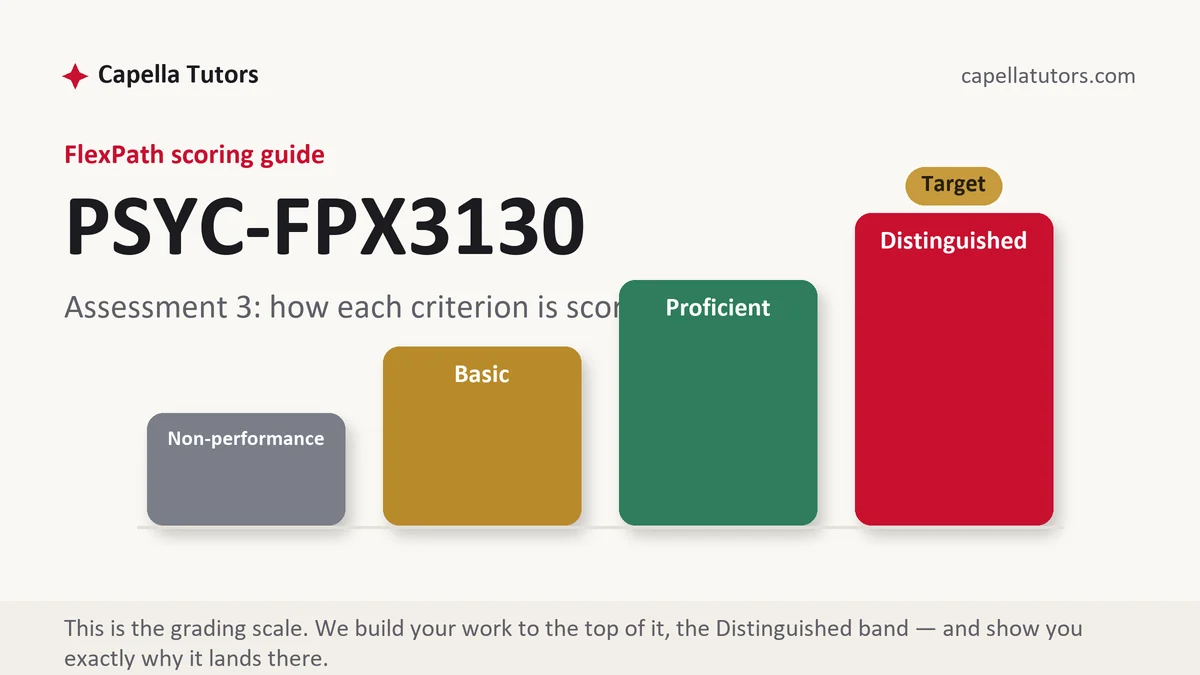
How PSYC FPX 3130 Assessment 3 is scored
Your evaluator marks criterion by criterion against four levels, with no averaging between them. On a decision analysis they mean this:
| Level | What it means on a decision analysis |
|---|---|
| Distinguished | Each decision point is fixed in time with the information available at it, the bias is identified by its mechanism rather than its label, the effect is supported by research whose design you state, and the remedy is one an actual unit could adopt. |
| Proficient | The biases are identified correctly and supported by sources. Solid, and one step short, because the analysis stays at the level of the label. |
| Basic | Definitions of several biases attached to the case wholesale, with hindsight doing the work the evidence should be doing. |
| Non-performance | A required element is missing, usually the research behind the effect claimed, or any account of what was actually known at the time. |
One distinction protects the whole paper. A bad outcome is not evidence that a decision was biased, and a good outcome does not clear one, because the quality of a decision lives in the information that was available and what was done with it. Write the process, then write the outcome, and never let the second one prove the first.
The PSYC FPX 3130 Assessment 3 method, step by step
-
Rebuild the timeline from what was known at each point
List the decisions in order and, beside each one, only the information in hand when it was made. Everything learned later goes in a separate column. That column is what makes the analysis honest, because most claims of bias are really claims of knowing the ending.
-
Name the mechanism, not the label
Tunnel vision explains nothing on its own. Say which information was sought, which was available and not sought, what closed the search, and which alternative was never tested. A named mechanism can be checked against the record; a label can only be asserted.
-
Attach research to every claim about judgment
Claims about memory, confidence, and questioning belong to an experimental literature, so cite it and give the design and the sample with the finding. A laboratory study of undergraduates and a field study of real witnesses support different sentences, and saying which you have is part of the criterion.
-
Count what you can count
Numbers turn an impression into evidence. How many questions were leading, how many alternative suspects were pursued, how long between the identification and the feedback. One count does more for the analysis criterion than three paragraphs of characterization.
-
Test the innocent reading
Before you conclude bias, ask what else produces the same pattern: time pressure, staffing, a policy that rewarded closure, or a genuinely strong early lead. Rule the alternatives out on evidence, or concede that both readings survive. Evaluators reward the paper that tried to disprove itself.
-
Recommend something a unit would actually adopt, then self-score
Procedures beat exhortation. A blind or double-blind identification procedure, recorded interviews, a written record of alternative lines, and a second reviewer are all specific and cheap. Then mark each criterion yourself and rewrite anything below the top level.
A structure that maps to the criteria
Word targets below are planning numbers for an analysis of this scope rather than rules; your scoring guide decides how long each part runs.
| Section | What it must do | Guide |
|---|---|---|
| The decision under review | What was decided, by whom, and why this decision is the one worth analyzing. | ~150 words |
| Timeline of available information | Each decision point with the information in hand at it, and later knowledge kept separate. | ~300 words |
| Mechanisms at work | The reasoning failures named as processes, each tied to specific steps in the record. | ~350 words |
| Evidence for the effects | The research behind each claimed effect, with design, sample, and what it can support. | ~250 words |
| Alternative readings | The non-bias explanations, tested and ruled out or conceded. | ~150 words |
| Remedies and references | Procedural changes a unit could adopt, plus current APA matched both ways. | ~200 words |
Annotated sample excerpt
An original model paragraph from our team, written to show a bias claim carried by counted detail rather than by tone.
By the third day the file names one suspect, and every step after that is built to confirm him.1 The witness who had described the driver as heavyset and in his forties is shown an array in which the suspect is the only man matching either description, and after she picks him the interviewing detective tells her she did well; her recorded confidence moves from unsure to certain between the array and the deposition, while nothing about her memory has changed in between.2 The interview transcript has the same shape, with fourteen of seventeen questions putting a proposition to the suspect for agreement rather than asking him what happened, which is a search for confirmation rather than for information.3
- 1Fixes the decision point and the moment the frame closed. A bias claim needs a date and a piece of information, not an atmosphere.
- 2Shows the mechanism operating in sequence: a suggestive array, then confirming feedback, then inflated confidence with no new memory. The documented effect is the one being cited.
- 3Counts the questions instead of characterizing them. A number converts an impression into evidence, and the analysis criterion pays for the count.
The full premium sample for your exact assessment, written fresh to your scoring guide and issue, is free to request. Study it, revise it into your own voice, and submit work you understand.
The five mistakes that cost Distinguished
- Bias diagnosed from the outcome. The case went wrong, therefore they were biased, is hindsight; name the information at hand and what was done with it.
- Labels standing in for mechanisms. A term from a chapter heading is not an analysis until you say what was sought, what was ignored, and what closed the inquiry.
- Effects asserted without research. Every claim about how memory or confidence behaves needs a study, with its design and its participants named.
- A remedy nobody would adopt. Recommend blind identification procedures and recorded interviews, not more awareness of bias among staff.
- Individuals blamed instead of procedures. The analysis is about the conditions that produced the error, and the recommendation criterion pays for changing the conditions.
Pre-submission checklist
- Every decision point appears with only the information available at the time
- Each reasoning failure is written as a mechanism tied to a specific step in the record
- All claims about memory and judgment carry a study, its design, and its sample
- At least one counted detail supports the central claim
- The non-bias explanation is tested, then ruled out or conceded
- Remedies are procedural and specific, references matched both ways, criteria self-scored
Decision analysis due, hindsight everywhere?
Send the prompt, the scoring guide, and the case record you were given. We rebuild the timeline from what was known at each step, source every claim about judgment to the research that supports it, and recommend procedures rather than attitudes. Premium original sample in 24 to 48 hours, revised at no cost until the guide is satisfied.