This manual is for PSYC FPX 3130 Assessment 1, start to submission. Understanding Forensic Psychology Evaluations asks you to explain the role of forensic psychological evaluations in the legal system: the situations in which they are used, such as competency to stand trial, criminal responsibility and risk assessment, the reliability and validity of the methods, and the American Psychological Association's ethical standards and specialty guidelines that govern the work. The grade turns on accurate explanation of uses, methods and ethics. Specific examples of evaluations, with evidence on their accuracy, score the top column. Below is the method our tutors use, a structure that maps to the criteria, and an annotated sample excerpt. Prefer to hand it off? A premium original sample for this exact assessment comes back in 24 to 48 hours, revised free until it meets the guide. Capella's catalog lists the course as PSYC-FPX3130, and some courserooms print PSYC3130; both point to this same Assessment 1. In current courserooms this assessment typically appears as "Understanding Forensic Psychology Evaluations".
One honesty note before the manual: Capella revises courses and scoring guides over time, so always write to the exact scoring guide attached to your assessment in the courseroom. The course identity above is verified on capella.edu; the method and structure below are our tutors' approach to it, not Capella's official rubric text.
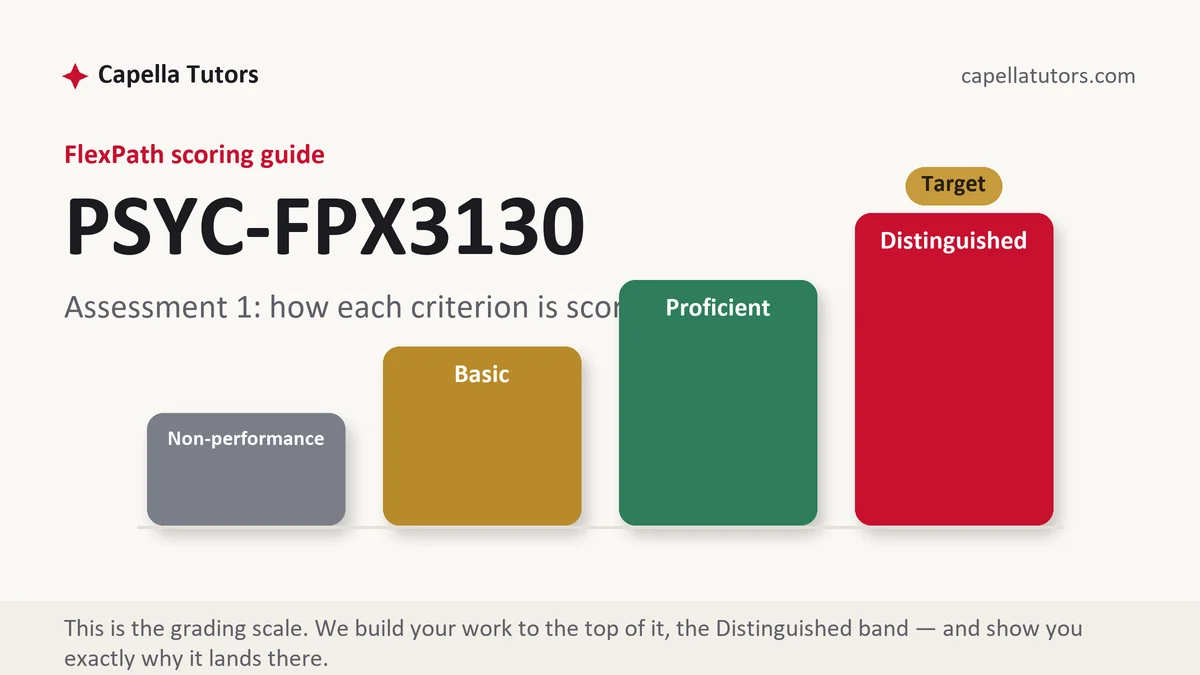
How PSYC FPX 3130 Assessment 1 is scored
FlexPath does not use letter grades. Each criterion in the scoring guide lands on one of four levels, and the level descriptions are the real writing brief:
| Level | What it means on a forensic evaluation paper |
|---|---|
| Distinguished | The forensic evaluation paper is specific to the organization or case, applies course concepts accurately with credible sources, and ends in justified conclusions or recommendations. |
| Proficient | The forensic evaluation paper is accurate, but the application or recommendations are general. |
| Basic | The forensic evaluation paper describes concepts with little application. |
| Non-performance | A required part of the forensic evaluation paper is missing. |
Use forensic psychology sources and the APA Specialty Guidelines for Forensic Psychology.
The PSYC FPX 3130 Assessment 1 method, step by step
-
Explain forensic evaluations
Purpose in the legal system.
-
Give instances
Competency, insanity, risk, custody.
-
Address reliability
Consistency of results.
-
Address validity
Accuracy of conclusions and tools.
-
Apply ethics
Objectivity, role clarity, informed consent.
-
Conclude
Strengths and limits.
A structure that maps to the criteria
Word counts are planning targets our tutors use, not Capella rules; follow the length and format your scoring guide states.
| Section | What it must do | Guide |
|---|---|---|
| Forensic psychology and evaluations | Overview. | ~150 words |
| Instances of when evaluations are used | Examples. | ~250 words |
| Reliability and validity | Evidence. | ~250 words |
| Ethical code and references | Then references. | ~200 words |
Annotated sample excerpt
An original model excerpt from our team, written to show the register that reaches the top of the guide. Learn the moves, then write your own version.
Competency to stand trial evaluations show reasonably good agreement between evaluators when structured instruments are used, but agreement drops when clinicians rely on unstructured interviews.1 Violence risk assessments are more limited: structured tools predict better than chance, yet many people rated high risk do not go on to offend, which matters when liberty is at stake.2 These limits are why the APA's specialty guidelines ask forensic psychologists to state the basis and limitations of their opinions clearly to the court.3
- 1Reports reliability evidence.
- 2Reports validity limits.
- 3Links limits to ethical duties.
The full premium sample for your exact assessment, written fresh to your scoring guide and topic, is free to request. Study it, revise it into your own voice, and submit work you understand.
The five mistakes that cost Distinguished
- Definitions without application. Apply each concept to the organization or case.
- No sources. Cite credible business sources.
- Vague recommendations. Make them specific and justified.
- Uses without evidence. Address reliability and validity.
Pre-submission checklist
- Evaluations explained
- Instances given
- Reliability
- Validity
- Ethics
- References
Want the forensic evaluation paper written?
Send the scoring guide and any materials from your courseroom. Our team returns a premium original forensic evaluation paper in 24 to 48 hours, revised free until it meets the guide.