Send the prompt and the scoring guide for anything this course asks you to write, and a premium original sample comes back inside 24 to 48 hours, aimed at the Distinguished descriptors and read by a second person before it reaches you. On a transcript the course reads PSYC FPX 3110, Abnormal Psychology, worth 3 program points, an upper-division course on the General Psychology specialization menu of the BS in Psychology, delivered in FlexPath, and one of the courses that fills the minimum of 27 points at the 3000 level or above inside the 90-point degree. In Capella's catalog the course code is written PSYC-FPX3110.
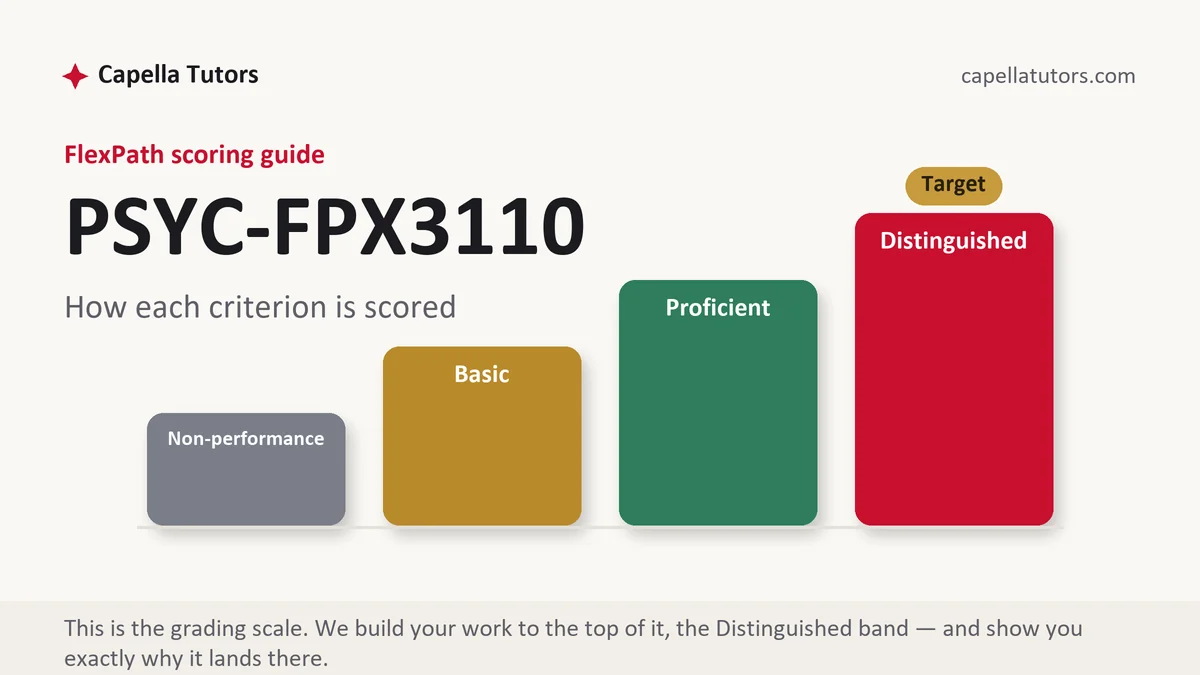
What PSYC FPX 3110 actually grades
This is the course where psychology stops describing ordinary behavior and starts asking when a pattern becomes a clinical concern. In current courserooms the assessments include "Cognitive-Behavioral Perspective: An Analysis", "Diagnosing Using the DSM" and "Living Criteria of the DSM" among others, and your scoring guide decides the exact format of each. A Basic paragraph lists those four features and moves on. Upper-division writing runs each of them against the specific person in front of you, says which ones apply, says which one does not, and explains what that answer changes about the account.
Precision of language is graded harder here than anywhere else in the degree. A diagnosis names a pattern of experience, not a kind of person, so the phrase your scoring guide is waiting for is that the individual meets the criteria for a condition rather than that the individual is one. The criteria sets themselves have three separate requirements that undergraduate papers collapse into one: a symptom count, a duration, and a clause about impaired functioning. Satisfy the count, skip the duration, and a criterion drops a level. The same discipline applies to differential thinking, because low mood, broken sleep, and poor concentration turn up in a dozen places in the manual, so the paragraph that scores names what else could produce this picture and states the detail that would separate the possibilities.
The third strand is explanation. Diathesis-stress gives you a frame that most assessments in this course reward, because a vulnerability that is inherited or acquired, plus a precipitating stressor, lets you write biology, learning history, and social context into one causal account rather than three disconnected lists. Treatment is judged the same way. Name an approach that has published support, attribute the claim to the study rather than asserting it, say which outcome improved and by how much, and then mark your own limit, because an undergraduate paper recommends categories of care and a referral and never prescribes.
How we help in this course
Our 3110 drafts read the case closely before they read the theory. Every reported detail in the vignette gets attached to the criterion it satisfies, the diagnostic language is handled in the careful register the discipline expects, and the parts of the picture that the vignette leaves out are named rather than quietly filled in. Tell us the case document, the criteria, and which edition of the diagnostic manual your course is working from, and the sample will use your course's own vocabulary rather than a generic one.
Terms match the rest of the studio. Each deliverable inside 24 to 48 hours, written to the top column, and passed along an eight-person pipeline on the way out: a research analyst pulls the sources first, a psychology writer drafts, a scoring-guide reviewer marks the draft criterion by criterion the way a Capella evaluator would, an APA and originality pass checks citation symmetry, and an editor takes the last look. Revisions are free until the work meets the guide, and faculty comments come back into the same cycle at no charge.
The assessments, one by one
Assessment 1: Cognitive-Behavioral Perspective: An Analysis
An Analysis: trace the evolution of cognitive-behavioral theory, apply it to a disorder such as anxiety, compare it with a sociocultural view. Read the full Assessment 1 manual.
Assessment 2: Diagnosing Using the DSM
Analyze case studies, apply DSM-5 criteria to reach diagnoses such as major depressive disorder, PTSD or bipolar I disorder, and recommend treatments. Read the full Assessment 2 manual.
Assessment 3: Living Criteria of the DSM
Examine how a disorder's DSM criteria appear in a public figure's documented life, its diagnosis and treatment, and the professional considerations. Read the full Assessment 3 manual.
How to actually write PSYC FPX 3110: where to begin
Open the scoring guide before you open any reading. Each criterion becomes a heading in your document, the Distinguished sentence for that criterion goes underneath it in brackets, and nothing gets written that does not sit under one of those headings. The clusters in this course usually run in the same order: describe what the person is presenting with, frame that presentation against diagnostic criteria, explain how it plausibly developed, place it in the person's culture and circumstances, propose care that has evidence behind it, and handle the ethical limits of what you are doing.
Here is the move that separates the columns, using a hypothetical vignette of the kind these assessments favor. An adult stopped driving after a collision eight months ago, sleeps about four hours, and has turned down a promotion because it required a commute. The Basic version names a trauma-related condition and reproduces the criteria list. The stronger version maps the collision to the index event, the sleep loss to the arousal cluster, and the refused promotion to the impairment clause, then says plainly what the vignette does not tell you, which is prior history, substance use, and whether the avoidance has lasted continuously for the required period. Naming the gap looks like weakness to most students and reads to an evaluator as judgment, because a clinician who does not notice missing information is the one to worry about.
Culture and context carry their own criterion in most versions of this course, and it is the easiest one to lose. Distress is expressed differently across communities, help-seeking is shaped by what care costs and who is trusted to deliver it, and a symptom that looks like avoidance can be a reasonable response to an unsafe environment.
| Section | What goes in it | What Distinguished looks like |
|---|---|---|
| Presenting picture | What the person reports and what an observer would see, in behavioral terms, with onset and duration stated. | Description free of diagnostic labels, so the reader reaches the diagnosis with you rather than before you. |
| Diagnostic framing | The criteria set named and matched item by item to the details the case actually gives you. | Duration and impairment addressed explicitly, and the plausible alternatives ruled in or out. |
| Development of the problem | Vulnerability and precipitant, with the biological, learned, and social contributions kept distinct. | One integrated account rather than three parallel lists, with the mechanism named. |
| Culture and context | How the person's community, resources, and history shape both the expression and the reporting of distress. | A contextual explanation tested against the symptom account instead of appended to it. |
| Care and evidence | Approaches with published support, the outcome each improves, and the referral pathway. | Effects attributed to named studies, with the strength of that evidence characterized. |
| Ethics and limits | Scope of practice, confidentiality, and what a student may and may not conclude, in current APA. | Limits stated in the writer's own voice, not quoted from a code, and applied to this case. |
Developing the synthesis
The reading for this course does not point one way, and saying so is worth a level. Prevalence figures move with the instrument and the sampling frame, so a rate from a specialty clinic and a rate from a household survey describe different populations and should never be quoted side by side as though they competed. Diagnoses are also internally varied, since two people can meet the same criteria set while sharing only a minority of symptoms, which is why average treatment effects can look modest even when a therapy helps some people substantially. If your paper leans on a categorical account, add the sentence that acknowledges dimensional models exist and cut the same symptoms differently, then explain why the categorical frame still serves the case in front of you. That combination, evidence weighed and then a position taken anyway, is what the top column is describing.
Citations that survive faculty review
Four source types do four different jobs in this course. The current diagnostic manual is your classification authority and gets cited as a manual with its edition, never paraphrased from a website that summarizes it. Peer-reviewed clinical psychology and psychiatry research, retrieved through the Capella library, PsycINFO, and PubMed, supports every claim about cause, course, or treatment. Federal sources carry the population numbers, principally the National Institute of Mental Health and the Substance Abuse and Mental Health Services Administration, and you name the survey rather than the agency's homepage. The professional ethics code supports your statements about scope. One journal habit will lift your accuracy immediately: read the method section before the abstract's conclusion, because a cross-sectional survey and a randomized trial license completely different verbs. Give the design and the sample size when you report a finding, then run the two-way check that every citation has a reference and every reference has a citation.
The mistakes that land Basic instead of Distinguished
- Calling a person a diagnosis. The label belongs to the pattern, and rubrics in this discipline check the phrasing directly.
- Meeting the symptom count and ignoring duration and impairment. Those clauses are part of the criteria, and skipping them is a criteria error rather than a style one.
- Diagnosing a real, identifiable person. Public figures, relatives, and coworkers are outside the scope of a course paper, and using them costs the ethics criterion.
- Explaining etiology with a textbook summary. Cite the study or the theorist who made the claim, since a secondary paraphrase cannot be checked.
- Recommending therapy in general. Name the approach, the target, and the source, because an unnamed recommendation is not an evidence-based one.
PSYC FPX 3110 questions students actually ask
Can I write about a real person, a public figure, or a family member?
Use the case your course provides, or a composite you build and label as one. Diagnosing an identifiable person you have not assessed is outside what a student may do, and it appears in scoring guides as an ethics criterion rather than as advice. A relative is worse than a celebrity, because you also hold information that person never consented to have written up. If a prompt invites you to apply the material to your own experience, keep the analysis on the behavior and the theory, drop identifying detail, and say in a sentence that you are describing rather than diagnosing. Faculty read that sentence as competence, and it costs you nothing in the analysis.
Which edition of the diagnostic manual should I use, and do I need to buy it?
Use whichever edition your course materials name, cite it with that edition, and do not mix vocabulary from two of them in one paper. Capella's library carries reference resources that cover current criteria, so check there before purchasing anything, and ask your instructor if the syllabus is silent. Where you are only reporting prevalence or describing a condition in general terms, peer-reviewed articles and federal survey reports do the job without the manual at all. What loses marks is a paper that uses a criteria set from one edition and a diagnostic name from another, because it tells the reader the material was assembled rather than read.
How do I write about causes when almost all the research is correlational?
Match your verb to your design and let the hedge do the work. A study that finds people with an anxiety condition report more childhood adversity than comparison participants supports the sentence that adversity is associated with later anxiety, and it does not support the sentence that adversity caused it. Say which direction the design can support, mention the obvious third variable, and then use the language of risk and vulnerability, which is exactly what a diathesis-stress account is built to express. Reserve causal wording for experimental or strong longitudinal work and name that design when you use it. Graders in this discipline look for that distinction specifically, and finding it in an undergraduate paper is unusual enough to move a criterion.
Case formulation due?
Send the prompt, the scoring guide, and the case your course gave you. We will build the formulation and source every clinical claim. The first premium sample is free.