How to write PSYC-FPX3110 Assessment 2

The short answer

This manual is for PSYC-FPX3110 Assessment 2, start to submission. The middle deliverable in Abnormal Psychology usually stops asking what the pattern is and starts asking how it came about: a causal account that puts inherited or acquired vulnerability, learning history, and social circumstance into one explanation instead of three lists, with care implications that follow from that explanation. Application is the whole grade here, and a factor named without a mechanism earns very little. Below is how our tutors build the account, the sections that satisfy the criteria, and an annotated excerpt from an original model. Prefer to hand it off? A premium original sample matched to your prompt comes back in 24 to 48 hours, with free revision for as long as the guide demands it. Your courseroom may print this as PSYC FPX 3110 Assessment 2 or PSYC3110 Assessment 2; it is the same deliverable, and PSYC-FPX3110 Assessment 2 is what this manual walks through.

One honesty note before the manual: Capella revises courses and scoring guides over time, so always write to the exact scoring guide attached to your assessment in the courseroom. The course identity above is verified on capella.edu; the method and structure below are our tutors' approach to it, not Capella's official rubric text.
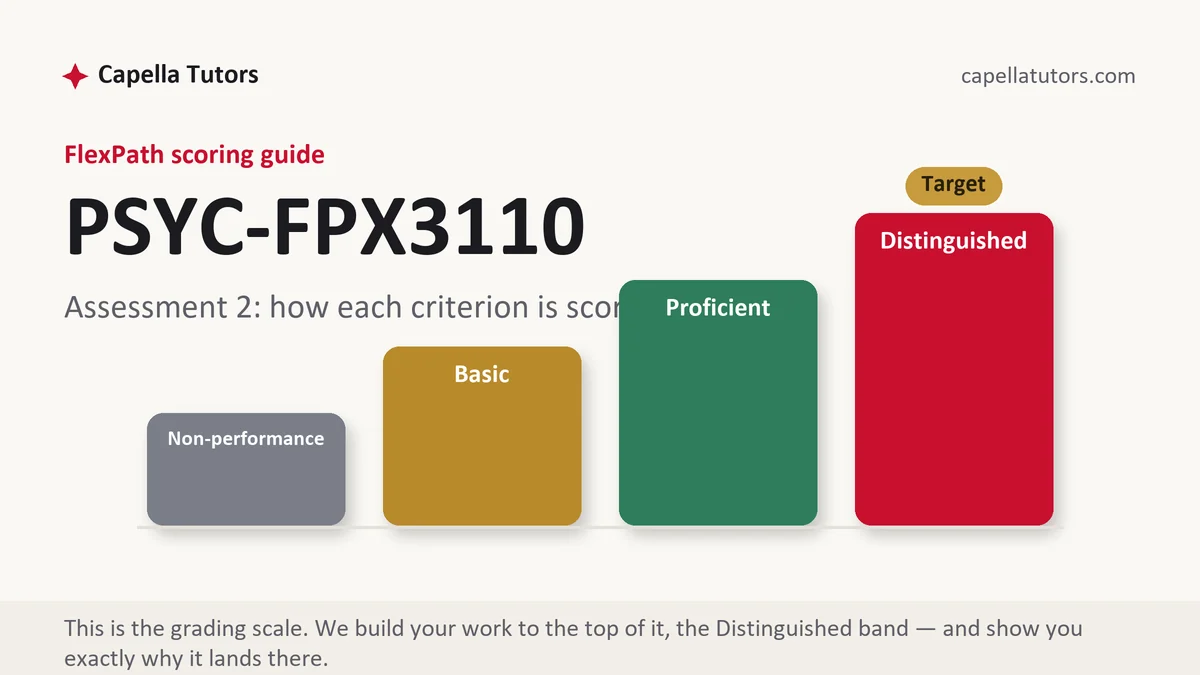
PSYC-FPX3110 Assessment 2 grading scale at Capella FlexPath, the criterion levels this assessment is scored on, from Capella Tutors
How Capella FlexPath grades PSYC-FPX3110 Assessment 2, visualized by Capella Tutors.

How PSYC-FPX3110 Assessment 2 is scored

The grade is a set of criterion judgments, one per row of the guide, each landing on one of four levels. Read the levels as instructions rather than as verdicts:

LevelWhat it means on a causal account
DistinguishedOne mechanism is named and traced, the vulnerability is kept distinct from the trigger, each link is attributed to research whose design you can characterize, and the parts of the account the evidence cannot yet support are marked as such.
ProficientA complete causal account with support behind every contributing factor. Accurate, and still assembled, because the factors sit beside one another rather than acting on one another.
BasicThree separate paragraphs, one biological, one psychological, one social, with nothing crossing between them. The usual landing spot for a first formulation.
Non-performanceA contributor the prompt requires is absent, or the account is asserted with no source standing behind it at all.

One constraint shapes every sentence here. Almost all the etiological evidence available to an undergraduate is correlational, so your verbs have to stay smaller than your explanation: write associated with, name the design that produced the association, and reserve caused for experimental or strong longitudinal work you can identify. A vulnerability plus a stressor is a frame built to carry that hedge.

The PSYC-FPX3110 Assessment 2 method, step by step

  1. Separate the vulnerability from the trigger before you draft

    Two lists on one page. Left: what the person brought with them, including family history, temperament, early adversity, and health. Right: what happened in the months before the pattern appeared. The criteria reward that distinction, and a draft that blurs it cannot be fixed by editing.

  2. Choose one mechanism and put verbs in it

    A mechanism is not a list of factors, it is a claim that something acts on something else. Write it in the form X disturbs Y, which makes Z more likely, then check that every noun appears somewhere in the case. If it needs a factor the case never gave you, you have chosen the mechanism you read about rather than the one in front of you.

  3. Source each link, and read the method before the finding

    Every arrow in your account needs its own citation, pulled through the Capella library rather than a search engine. Open the method section first: a survey of people already unwell and a decade-long study of healthy volunteers license completely different verbs, and the difference decides which verb you get.

  4. Put the account on a timeline

    Order matters more than volume. Date the vulnerability, date each precipitant, date the first appearance of the pattern, and write them in sequence. A factor that arrived after the pattern began cannot have caused it, and noticing that in your own draft is the difference between an argument and a collection of risk factors.

  5. Let the care implication follow the mechanism

    If your account runs through disrupted sleep and hardening interpretations, the approaches you name should target sleep and interpretation, each with a source, an outcome, and a referral pathway. An undergraduate paper recommends categories of care and says so plainly rather than leaving the reader to guess where the writing stops.

  6. Mark the limits, then self-score

    Close with what your account cannot settle: whether the sequence would look the same in someone with a different history, which factor is doing most of the work, and what evidence would change your mind. Then mark each criterion yourself and rewrite anything short of the top.

A structure that maps to the criteria

Treat the counts below as our tutors' planning targets for an account of this scope rather than as requirements; your scoring guide is the authority on length.

SectionWhat it must doGuide
FramingName the pattern being explained, the framework you will use, and the claim your account will make.~150 words
VulnerabilityWhat the person brought with them, each factor sourced, each reported with the size of the risk it carries.~250 words
Precipitants and contextWhat changed in the period before onset, including circumstances that a symptom list would miss.~250 words
The mechanism assembledOne integrated account with the arrows drawn, the timeline stated, and each link cited.~350 words
Care implicationApproaches that target the mechanism you named, with published support, an outcome, and a referral.~250 words
Limits and referencesWhat the account cannot settle, the boundary of a student's role, and current APA both ways.~150 words

Annotated sample excerpt

An original model paragraph from our team, chosen because it shows an account integrating rather than listing.

Sample excerpt: the mechanism Original model · Capella Tutors

The vulnerability here is documented rather than assumed: a first-degree relative with a psychotic illness, which raises risk relative to the general population while leaving the outcome unlikely, since most people with that family history never develop one.1 The precipitants stack up in the six months before the first episode, with an apprenticeship shift pattern that cut sleep to four or five hours on weeknights, near-daily high-potency cannabis use begun at seventeen, and a move to a city where he knew two people.2 The mechanism proposed is sensitization: short sleep and heavy cannabis exposure each disturb the same signalling that the family history has already made less stable, ordinary events begin to be tagged as significant, and the interpretations that follow harden because there is nobody in the new city to contradict them.3

  • 1States the risk factor and its base rate in one breath. A vulnerability reported without its limits reads as a prediction, and a prediction is not what this evidence supports.
  • 2Groups the precipitants and dates them. The criteria want the trigger held apart from the vulnerability, and a timeline does that job better than any adjective.
  • 3Names one mechanism with real verbs, then shows the social circumstance acting on the same process instead of getting a paragraph of its own. Integration is the criterion this sentence satisfies.

The full premium sample for your exact assessment, written fresh to your scoring guide and issue, is free to request. Study it, revise it into your own voice, and submit work you understand.

Get the full sample free

The five mistakes that cost Distinguished

  • The three-list formulation. Biology, then psychology, then society, with no traffic between them, is a table of contents rather than an explanation.
  • Cause claimed from correlational evidence. Name the design in the same sentence as the finding, and keep causal verbs for the studies that earn them.
  • A risk factor with no base rate attached. Doubling a small risk leaves a small risk, and an account that omits the denominator overstates every claim built on it.
  • Heritability read as destiny. An estimate of that kind describes variation across a population and says nothing about whether one person's outcome was fixed in advance.
  • Care recommended from the label instead of the mechanism. If your account runs through sleep and interpretation, a plan that ignores both has abandoned its own argument.

Pre-submission checklist

  • Vulnerability and precipitants appear in separate, clearly labeled sections
  • One mechanism is stated as a sentence with verbs, and every noun in it comes from the case
  • Each link in the account carries its own peer-reviewed citation and its design
  • The timeline is explicit, and nothing is credited with causing something that preceded it
  • The care implication targets the named mechanism, with an outcome and a referral
  • Limits stated in your own voice, references matched both ways, every criterion self-scored at the top

Formulation due and the causes will not line up?

Send the prompt, the scoring guide, and whatever history the case gives you. A research analyst pulls the sources, a psychology writer builds the mechanism, and two reviewers check the criteria and the citations. Premium original sample in 24 to 48 hours, revised at no cost until the guide is satisfied.

Keep going

Online now