How to write PSYC-FPX3110 Assessment 3

The short answer

This manual is for PSYC-FPX3110 Assessment 3, start to submission. The closing deliverable in Abnormal Psychology usually asks you to recommend something and to defend the recommendation with evidence you have weighed rather than collected: which approaches have support, how strong that support actually is, what the person's circumstances allow, and where your own role ends. Synthesis is what the criteria are buying, and the number you report honestly is worth more than the number that flatters your argument. Below is the method, a structure drawn from the criteria, and an annotated excerpt from an original model. Want it handled? A premium original sample written to your scoring guide arrives in 24 to 48 hours, revised free until it meets the guide. Your courseroom may print this as PSYC FPX 3110 Assessment 3 or PSYC3110 Assessment 3; it is the same deliverable, and PSYC-FPX3110 Assessment 3 is what this manual walks through.

One honesty note before the manual: Capella revises courses and scoring guides over time, so always write to the exact scoring guide attached to your assessment in the courseroom. The course identity above is verified on capella.edu; the method and structure below are our tutors' approach to it, not Capella's official rubric text.
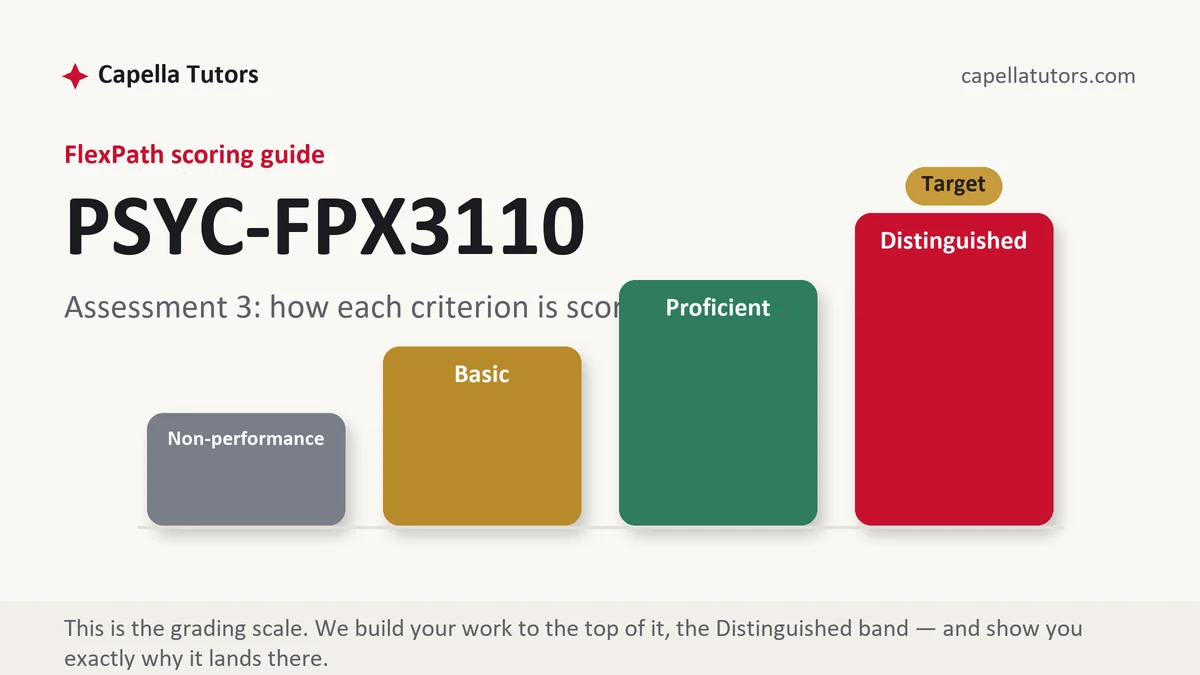
PSYC-FPX3110 Assessment 3 grading scale at Capella FlexPath, the criterion levels this assessment is scored on, from Capella Tutors
How Capella FlexPath grades PSYC-FPX3110 Assessment 3, visualized by Capella Tutors.

How PSYC-FPX3110 Assessment 3 is scored

Nothing here is graded on a curve. Every criterion is judged against four levels, and the language of the levels is what you write toward:

LevelWhat it means on a recommendation
DistinguishedThe recommendation follows from the evidence the paper actually reports, effects arrive with an interval and a denominator, the comparison that weakens the case is named rather than buried, and the limits of the writer's role are stated in the writer's own words.
ProficientA supported recommendation with a source behind every claim. Sound, and one move short, because the evidence is summarized instead of weighed.
BasicA list of things that help, cited but unranked, with no account of how strong the support for any of them is.
Non-performanceA required element is missing, usually the referral pathway or the ethical boundary, or an approach is recommended with no source at all.

The habit that lifts this deliverable is arithmetic honesty, and it is unusual enough in undergraduate writing to move a criterion on its own. Give an effect size with the interval around it, convert the standardized number into people with a denominator and a measurement window, and keep association language wherever the design only supports association. Then write one sentence about what a probability value cannot tell you. Evaluators in this discipline notice all four moves.

The PSYC-FPX3110 Assessment 3 method, step by step

  1. Write the decision the paper has to serve

    One sentence naming the person, the setting, and the constraint: what is being decided, by whom, and what is realistically available. A recommendation written for nobody in particular collects citations and answers nothing, and the application criterion is where that shows up.

  2. Read the method section before the abstract's conclusion

    For each candidate approach, find who was studied, how many, against what comparison, and for how long. An open trial with no control group and a randomized comparison against an active alternative can support the same sentence in an abstract and completely different sentences in your paper.

  3. Report every number three ways

    The effect, the interval around it, and the same result expressed as people over a stated period. Half a standard deviation means little to a reader; roughly five in ten against three in ten over three months means something, and the definition of the outcome word belongs in the same sentence.

  4. Rank the options against the setting, not against the literature

    The best-supported approach that nobody within reach delivers is not the best option for this person. Rank on evidence, then re-rank on access, cost, waiting time, and what the person has already tried, and show both rankings so the evaluator can see the reasoning that produced your answer.

  5. Say what the probability value could not do

    One clean sentence: a small p indicates the data would be unusual if nothing were happening, and it does not tell you the effect is large, that the finding will replicate, or that this person will respond. Students hedge with adjectives instead, and adjectives are not what the criterion is reading for.

  6. State your limits, then self-score

    Name what a student may and may not conclude, in your own voice rather than quoted from a code, and put the referral in writing. Then mark each criterion yourself and revise anything below the top level before you submit, early enough in the week that a two-day evaluation still lands inside your plan.

A structure that maps to the criteria

These lengths are the planning numbers our tutors work to on a recommendation of this size; where your scoring guide asks for more, your scoring guide wins.

SectionWhat it must doGuide
The person and the constraintWho the recommendation is for, what is being decided, and what the setting can actually deliver.~150 words
What the evidence showsEach candidate approach with its design, its effect size and interval, and the outcome it improved.~350 words
What the evidence cannot settleWhere the comparisons disagree, what the designs cannot support, and which questions stay open.~200 words
The recommendation, rankedA first choice and a fallback, each justified by evidence and by what the setting allows.~300 words
Scope, ethics, referralThe limit of a student's conclusion, the referral pathway, and how the person's own preferences enter.~200 words
ReferencesCurrent APA both ways, with the design of each cited study recoverable from your own sentences.as needed

Annotated sample excerpt

An original model paragraph from our team, written to show numbers reported at their real size rather than at their most persuasive.

Sample excerpt: weighing the evidence Original model · Capella Tutors

Across trials comparing a structured psychological therapy with a waiting-list control in adults with recurrent depressive episodes, the pooled difference on clinician-rated scales sits near half a standard deviation, with an interval running from roughly 0.3 to 0.7, which is a real effect and not a large one.1 Expressed as people rather than as a standardized difference, that is closer to five in ten responding on treatment against three in ten in the control condition across 12 to 16 weeks, where responding means a halving of the score rather than being well.2 Trials that used an active comparison produced smaller separations, and the gap between those two sets of comparisons carries more weight in this literature than any single result, so the recommendation below is written to the smaller figure.3

  • 1Effect size first, interval second, and a plain statement of magnitude. A single number invites the reader to treat it as exact, and the interval is the clause that keeps the sentence honest.
  • 2Converts the standardized difference into people, with a denominator and a measurement window attached, then defines the outcome word. Response is a threshold on a scale, not recovery.
  • 3Names the comparison that weakens the case and writes the recommendation to the more conservative number. Arguing against your own best figure is what the top column means by evaluating evidence.

The full premium sample for your exact assessment, written fresh to your scoring guide and issue, is free to request. Study it, revise it into your own voice, and submit work you understand.

Get the full sample free

The five mistakes that cost Distinguished

  • An effect with no interval. One number reads as precision the study never had, and the range takes a single clause to add.
  • Percentages with no denominator or window. Sixty percent improved is unreadable until you say out of how many, measured how, and across what period.
  • A probability value asked to carry magnitude. Statistical significance describes how surprising the data would be under the null, and says nothing about how much anyone improved.
  • Evidence ranked by publication year. Design and sample decide what a study can support; the year decides only where it sits in your reference list.
  • A recommendation the setting cannot deliver. Naming an approach that no provider within reach offers is a literature review wearing the costume of a plan.

Pre-submission checklist

  • The decision, the person, and the constraint are named in the opening section
  • Every effect reported with its interval and restated as people over a stated window
  • Association language held wherever the design supports only association
  • One sentence on what the reported probability value cannot establish
  • A first choice and a fallback, each justified on evidence and on access
  • Scope limit and referral in your own words, references matched both ways, criteria self-scored

Recommendation paper due, evidence in a pile?

Send the prompt, the scoring guide, and the constraints the case gives you. We read the method sections, report the effects at their honest size, rank the options against what the setting can deliver, and mark the boundary of what a student may conclude. Premium original sample in 24 to 48 hours, free revisions until it scores.

Keep going

Online now