Upload the assessment and the guide and a premium original sample returns inside 24 to 48 hours, built so each social psychology finding is applied to a situation with enough detail to test it, and revised free of charge until the criteria are met. Course identity: PSYC FPX 2520, Social Psychology in Action, worth 1.5 program points, one of the named general education requirements inside Capella's FlexPath BS in Psychology, which totals at least 90 program points with at least 27 of them at the 3000 level or higher. The action in the title is the graded part, since these criteria ask for situations rather than summaries. In Capella's catalog the course code is written PSYC-FPX2520.
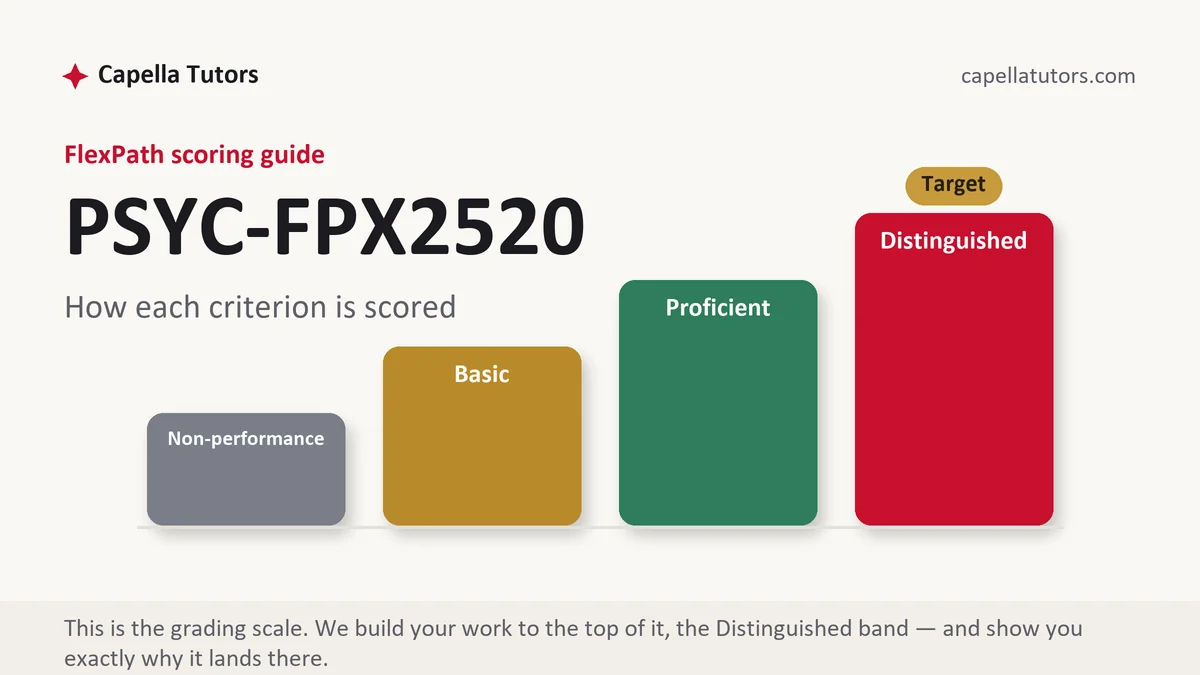
What PSYC FPX 2520 actually grades
The course rests on one finding undergraduates can state and rarely use, which is that behavior tracks the situation more closely than observers expect. The correspondence bias, taught in most texts as the fundamental attribution error, is the habit of reading conduct as a report on character while discounting the pressure the person was under, and the same observer will explain their own identical conduct by the pressure. Criteria here are built to catch a paper that identifies the bias in a textbook example and then commits it two paragraphs later, explaining a coworker's lateness with laziness or a customer's anger with entitlement.
The second strand is influence, where the graded distinction is between kinds. Informational influence changes what you believe because other people appear to know something you do not. Normative influence changes what you do while leaving what you believe intact, which is why someone who went along in a meeting can be sincerely surprised at their own compliance afterwards. Descriptive norms report what people actually do and injunctive norms report what people approve of, and a campaign that confuses them can end up advertising the problem it meant to solve. Group process adds effects of its own, including the way discussion among like-minded people moves the average position further out rather than toward the middle.
The third strand is what happens to individuals inside crowds and categories. The decision path a bystander travels, the way responsibility thins with every additional witness, the specific conditions under which contact between groups reduces prejudice instead of hardening it, and the discomfort that follows acting against a position you have stated publicly. Assessments here tend to be applied by design, so the criteria want a named situation, a named finding, and a defensible claim that the second explains the first.
How we help in this course
Give us the situation your assessment is built around, a workplace, a classroom, a family gathering, a news event or a campaign you were asked to design, and the draft comes back with the finding named, the original study attributed, the effect kept at the size the research reports, and an alternative explanation considered before yours is accepted. Where the assessment asks for a recommendation, our writer builds it from a mechanism rather than from encouragement, because a plan that changes a norm can be tested and a plan that asks people to try harder cannot.
House terms apply without variation. One premium original deliverable per assessment, delivered within 24 to 48 hours, written to the top descriptors of the guide you send, handled by eight people from the evidence pull through the final proofread, with one review devoted to whether the classic studies in the draft are described as their methods allow. Revision is free and unlimited, and faculty feedback after a submitted attempt comes back into the cycle at no cost.
The assessments, one by one
Assessment 1
Assessment 1 in Social Psychology in Action is where the course sets its habit: one episode, one finding, and a match shown detail by detail instead of asserted. Read the full Assessment 1 manual.
Assessment 2
Assessment 2 in this course turns the analysis around: instead of explaining a behavior that already happened, you design something meant to change one and say how you would know whether it worked. Read the full Assessment 2 manual.
Assessment 3
Assessment 3 asks for judgment rather than description. Read the full Assessment 3 manual.
How to actually write PSYC FPX 2520: where to begin
Read the scoring guide first and convert each criterion into a question you could answer in one sentence, because criteria in an applied course are almost always asking for a link rather than a topic. The assessments in this course usually give you a situation or ask you to supply one from your own experience, and your scoring guide decides whether you are explaining behavior, evaluating an intervention, or reporting on something you tried. Then set yourself a rule before drafting: no concept appears in the paper without a specific instance attached, and no instance appears without a concept doing work on it.
Then take a single term from the chapter and drive it into an answer, since that is the move the criteria reward. Say the row reads analyze the situational factors that influenced behavior in the event you selected, and the term you are holding is the bystander effect. The Basic answer is a restatement with a location added: nobody helped because of the bystander effect, since people are less likely to help when others are present. That names a pattern and explains nothing. The Distinguished answer treats the term as a sequence of decisions, which is how Latane and Darley proposed it, then walks your event through each one. A man collapses in a busy transit station and thirty people pass. Step one, notice the event: half the crowd is looking at a phone, so the first filter has already removed them. Step two, interpret it as an emergency: he is sitting upright against a pillar, which reads as fatigue or intoxication rather than as a cardiac event, and ambiguity is the strongest single brake on helping. Step three, take responsibility: with thirty witnesses each person's share of the obligation feels like a thirtieth, and nobody is uniquely on the hook. Step four, decide what to do: most passengers do not know what would help, and uncertainty about competence looks from outside exactly like indifference. Step five, act: the last brake is the audience, since doing the wrong thing in front of thirty people carries its own cost. Then close the loop with the intervention the model implies, which is not a plea for kindness but the removal of step three by naming one person, describing what you see and assigning a task. The finding has now explained an event and produced a recommendation, and both came out of the same five steps.
Then argue against yourself once, in writing, because the criteria separating the top two columns usually ask for evaluation rather than application. Give the best rival account of your event and say what evidence would settle it. In the station example, a crowd that fails to help may be following a norm rather than diffusing responsibility, since regular commuters have seen people sleeping against that pillar every week and have learned that intervention is unnecessary and unwelcome. Both accounts predict inaction, and they predict different things about a station where collapses are rare, which is exactly the kind of test a graded paper should name. One honest comparison of two explanations does more for a criterion than four paragraphs of confident single-cause reasoning.
Then build any recommendation from a mechanism you can state and a measure you could collect. If the assessment asks you to design something, use the norm distinction rather than a poster: report the majority behavior when the majority behavior is the one you want, keep the disapproval message separate from the frequency message, deliver it where the behavior happens rather than where people read about it, and say what number would tell you it worked and over what period. Then state the size of the effect you expect in plain terms, because social psychology interventions that move a behavior by a few percentage points are real and useful, while a paper promising to transform a culture with a single message has failed its evaluation row before anyone reads the details.
| Section | What goes in it | What Distinguished looks like |
|---|---|---|
| The situation | One specific event, setting or campaign, described with the details that make it testable. | A situation narrow enough that a rival explanation can be checked against it. |
| The concept | The finding named, attributed to its original researchers, with the mechanism stated. | Mechanism separated from label, cited to the primary study and to a current review. |
| The application | The concept mapped onto the details of the situation, step by step where the concept has steps. | Each step of the concept matched to an observable feature of the event. |
| The rival account | A second explanation that fits the same facts, and what would distinguish the two. | One competing explanation taken seriously and adjudicated with named evidence. |
| What follows | The intervention or conclusion the mechanism implies, with a measure attached. | A recommendation that follows from the mechanism and states the effect it expects. |
| Evidence quality and references | Method, sample and date for each cited finding, current APA both ways. | Replication status acknowledged wherever the classic result has been contested. |
Developing the synthesis
The honest complication in this course is that several of its most famous studies are weaker than their fame, and a paper that says so carefully reads as informed rather than contrarian. The obedience research is usually summarized as a single obedience rate when the program ran many variations with results spread across a wide range, and archival work on the original recordings shows prodding and improvisation that the published account does not fully capture. The conformity studies were run on small and culturally narrow samples, and they produced independence more often than the standard retelling suggests. Several effects taught confidently for years have failed to reproduce at their published sizes, which is why the replication debate belongs inside an undergraduate paper rather than being kept out of it. The use of this is not to dismiss the classics but to state what each study actually demonstrated, cite a modern review or replication beside it, and reserve strong causal language for findings that have survived independent repetition. A student who writes that a result held under specific conditions, and names the conditions, is doing what the top column describes.
Citations that survive faculty review
Give each claim the source type that can carry it. The classic experiments are primary literature and belong to the original articles by Asch, Milgram, Festinger, Latane and Darley and the rest, cited with year and journal, because these criteria treat a landmark study credited to a textbook chapter as a reading failure rather than a formatting slip. Set a recent peer-reviewed review or meta-analysis beside each classic, pulled through PsycINFO in the Capella library, since that is what tells a reader whether the effect held and at what size. Population statistics, crime figures and survey data belong to the agencies that produce them and are cited to the agency with the collection year, never to a news article about the agency. Your own observation is legitimate evidence in an applied course when it is labeled as observation rather than dressed as research. Media accounts can establish that an event happened and cannot establish why. Then run the reference list against the text both ways, spell the researchers' names correctly, and check every year against the list, since a mismatched date is the error graders find fastest.
The mistakes that land Basic instead of Distinguished
- A concept with no situation attached. A paragraph defining groupthink is a chapter summary rather than an application.
- Committing the bias you just explained. Diagnosing a stranger's character two sentences after describing the correspondence bias is the reliable way to lose an evaluation row.
- Classic studies cited to the textbook. The original articles are short, available through the library, and expected by name.
- One explanation, stated with certainty. Applied criteria ask you to weigh accounts, and a paper with no rival has nothing to weigh.
- An intervention with no measure. Awareness is not an outcome, and a plan that cannot fail cannot be evaluated.
PSYC FPX 2520 questions students actually ask
Can I use something from my own life as the situation?
Yes, and it usually produces a stronger paper than a news story, provided you handle it the way the criteria expect. Write the episode as a factual account first, with the setting, the people involved by role rather than by name, what was said and what happened next, and keep your interpretation out of that section entirely. Then analyze it in a separate section where the concept does the work. Two habits protect the grade. Change identifying details and use roles instead of names, because a paper about a real workplace conflict circulates further than students expect. And resist the pull toward a flattering account, since the analysis is more convincing when the situational pressure you describe also explains your own behavior rather than only everyone else's.
How much do I need to say about whether the classic studies would be allowed today?
Say enough to show you understand why the rules changed, then get back to the finding. The point worth making is specific rather than general: procedures that expose participants to serious distress or that conceal the nature of the study now pass through an institutional review board, informed consent is standard, deception has to be justified and followed by debriefing, and the right to withdraw must be real rather than nominal. Two sentences of that, attached to the feature of the study that would now be redesigned, satisfies the ethics element in most criteria. What loses credit is three paragraphs of condemnation that never return to what the study demonstrated, since evaluation includes reporting what was learned.
The assessment asks me to design an intervention. Where do I start?
Start with the behavior, stated as something countable, and work backwards. Write the behavior you want more or less of, then say who does it now, how often and where, because a target defined as an attitude is not something you can move or measure at this level. Then pick the mechanism you are betting on and name it: making the desirable behavior visible, removing the ambiguity that stalls a decision, assigning responsibility to a specific person, reducing the cost of the first step, or letting people commit publicly to something small. Then design the smallest version that tests the mechanism, decide what you would count and for how long, and state what result would tell you the bet was wrong.
Applied social psychology paper due?
Send the situation and the criteria. First premium sample free, returned in 24 to 48 hours with the finding, the mechanism and the rival account in place.