This manual is for PSYC FPX 2520 Assessment 3, start to submission. Assessment 3 asks for judgment rather than description. By this point the criteria usually want you to weigh explanations of a group outcome against each other, say which one the evidence supports, and be honest about what the research behind it can and cannot settle. Below is the method our tutors use for it, a structure that keeps a comparison from turning into two essays, and an annotated excerpt from an original model. Prefer to hand it off? Send the prompt and the scoring guide and a premium original sample arrives in 24 to 48 hours with the rival accounts already adjudicated. Capella's catalog lists the course as PSYC-FPX2520, and some courserooms print PSYC2520; both point to this same Assessment 3.
One honesty note before the manual: Capella revises courses and scoring guides over time, so always write to the exact scoring guide attached to your assessment in the courseroom. The course identity above is verified on capella.edu; the method and structure below are our tutors' approach to it, not Capella's official rubric text.
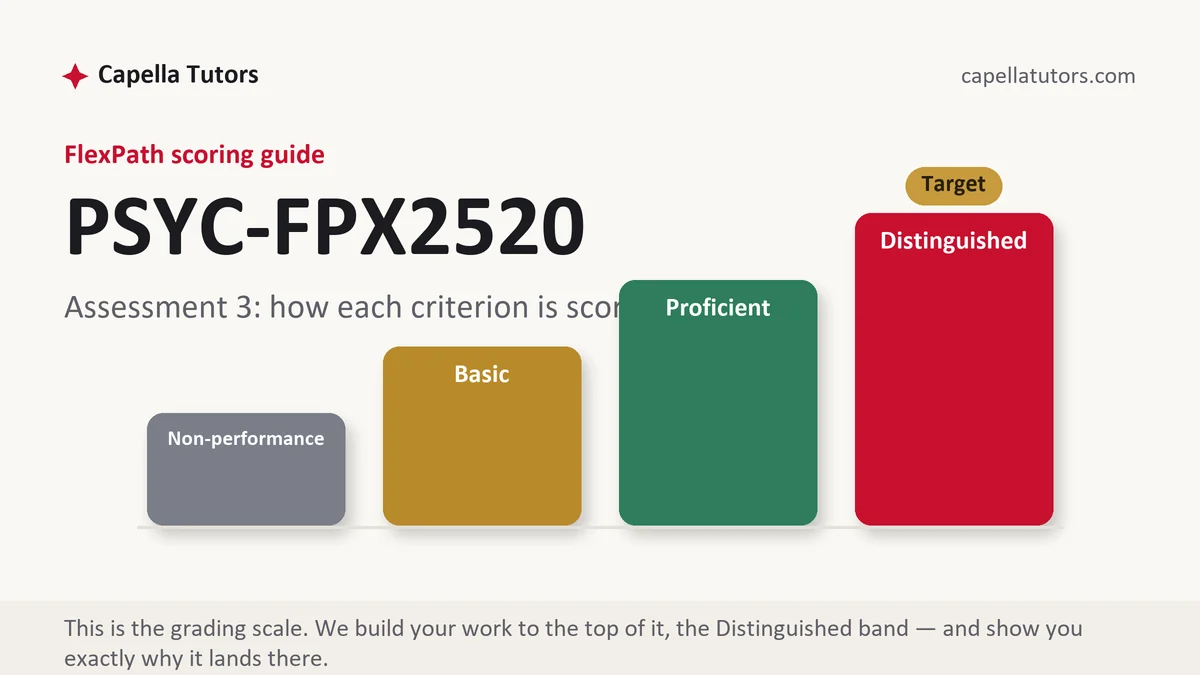
How PSYC FPX 2520 Assessment 3 is scored
The four columns are the whole grade in FlexPath, and a third assessment usually loads its points onto the evaluation rows:
| Level | What it means on an evaluation paper |
|---|---|
| Distinguished | Two or more accounts of the same outcome are stated at full strength, judged against specific features of the case, and the judgment is qualified by what the underlying research cannot establish. The verb in the top column is usually evaluate, and evaluation means one account loses. |
| Proficient | Both accounts explained correctly and applied, with a preference stated but not argued from the details. Accurate, and one degree short of a judgment. |
| Basic | Two accounts described in sequence, each in its own paragraph, with the comparison announced in the conclusion. The most common near miss on a synthesis assessment. |
| Non-performance | Only one account appears, or none of them touches the case, which leaves the comparison criterion with nothing to score. |
The reliable way to lose this assessment is to be fair to everything. A paper that ends in a tie has usually described two theories rather than used them, and the criteria are asking for a decision the case can support.
The PSYC FPX 2520 Assessment 3 method, step by step
-
Fix the outcome you are explaining in one sentence
Write what actually happened, with numbers where you have them, before naming any concept. A group of neighbors whose stated positions moved further apart over two weeks of discussion is an outcome; polarization in online communities is a subject heading. The criteria score the first.
-
Give each explanation its best case
Write each account as its own advocate would: group polarization, where discussion among people already leaning the same way pushes the average position outward; informational influence, where members update because others appear to know more; and reputational pressure, where people restate a stronger version of the group view because it is being watched. Weak versions of rivals are easy to beat and score as though you never had a rival.
-
Test each account against details only one of them predicts
Look for the fact that separates them. If the members who moved furthest were the ones posting most often, reputational pressure gains ground; if positions moved after somebody shared a city ordinance, informational influence explains more; if the drift happened with no new information among people who already agreed, the polarization account fits.
-
Decide, and write the decision as a sentence
Name the account that explains more of the evidence you have, say which specific details it covers that the others do not, and say what it still leaves unexplained. A stated decision with an admitted remainder is what the top column describes, and deciding is not the same as dismissing the alternatives.
-
Report the evidence at the strength the field actually has
Say what the studies behind your chosen account measured, in what samples and when, and note where an effect has been contested or has shrunk in later work. Several standard findings in this literature were built on small and culturally narrow samples, and a sentence acknowledging that reads as informed rather than as hedging.
-
Separate association from cause in your own sentences
Your case is observational, so the language has to match: positions and posting frequency moved together, one preceded the other, this pattern is consistent with the mechanism. Reserve caused for evidence that could support it, and write out the test you would run if you could, since naming the experiment you cannot do is the cheapest way to show you know the difference.
A structure that maps to the criteria
The word figures below are our tutors' planning targets for an evaluation paper in this course rather than a Capella instruction; weight the sections your guide weights.
| Section | What it must do | Guide |
|---|---|---|
| Introduction and the outcome | The outcome stated factually with its numbers, and the question the paper will decide. | ~150 words |
| The case in detail | Who was involved, what was said, in what order, and which details are documented rather than remembered. | ~250 words |
| Account one, at full strength | The first explanation, attributed and stated as a mechanism its advocates would recognize. | ~200 words |
| Account two, at full strength | The rival explanation given the same care, with the prediction that distinguishes it. | ~200 words |
| The adjudication | The details each account covers and misses, the decision, and what the decision leaves open. | ~300 words |
| Evidence quality and references | Sample, method and date for each finding, replication status where it is contested, current APA both ways. | ~150 words |
Annotated sample excerpt
An original model excerpt from our team, written at the point where most drafts go quiet. Learn the move, then make it on your own case.
Over fourteen days the association's message board moved from eight of nineteen participants favoring a cap on short term rentals to fifteen of nineteen favoring a full ban, with no document, ordinance or cost estimate posted in that period.1 That absence is what makes the group polarization account fit better than informational influence here, because the positions hardened among people who already agreed and nothing entered the thread that could have justified the shift.2 The account is a fit rather than a finding: fourteen days of posts from nineteen self-selected neighbors is an association between discussion and position change, not evidence that the discussion produced it, and the study that would settle it, assigning comparable groups to discuss or not discuss, is not available to me.3
- 1The outcome arrives as counts over a stated window, and the sentence records what did not happen as carefully as what did.
- 2The adjudication turns on a detail only one account predicts, which is what separates an evaluation from a summary of two theories.
- 3States the claim at the strength the evidence carries, keeps causal language out, and names the study that would decide the question instead of pretending the case already has.
The full premium sample for your exact assessment, written fresh to your scoring guide and issue, is free to request. Study it, revise it into your own voice, and submit work you understand.
The five mistakes that cost Distinguished
- Two accounts, no verdict. A paper that treats fairness as the goal answers a comparison criterion with a description.
- The straw rival. An alternative written weakly so that it can lose is scored as though the alternative were missing.
- A verdict with no detail behind it. Preferring one explanation because it seems more likely is an opinion; preferring it because it predicts the fourteen day pattern is an argument.
- Caused, in an observational case. Reading a thread cannot establish direction, and a research-literate criterion notices the verb.
- Contested findings quoted as settled. Where a classic effect has shrunk in later samples, saying so costs one sentence and earns the evaluation row.
Pre-submission checklist
- The outcome is stated with counts and a window before any concept is named
- Each competing account written at the strength its own advocates would use
- At least one case detail identified that the accounts predict differently
- A decision stated in one sentence, with what it leaves unexplained
- Association language throughout, with the experiment you cannot run named
- Sample, method and date given for each cited finding, and replication noted where it is contested
Need the evaluation to actually decide something?
Send the case and the criteria. A premium original sample comes back in 24 to 48 hours with both accounts stated fairly, one of them chosen on the details, and the causal language kept where the evidence can support it. Revisions are free until the rows clear.