This manual is for PSYC FPX 2520 Assessment 1, start to submission. Assessment 1 in Social Psychology in Action is where the course sets its habit: one episode, one finding, and a match shown detail by detail instead of asserted. The assessment usually asks you to explain behavior in a situation you either observed or were handed, so the paper stands on how narrowly you can describe what happened. Below is the method our tutors use for it, a structure that answers the criteria in order, and an annotated excerpt from an original model. Prefer to hand it off? Send the prompt with the guide attached and a premium original sample returns in 24 to 48 hours, revised free until the guide is satisfied. Capella's catalog lists the course as PSYC-FPX2520, and some courserooms print PSYC2520; both point to this same Assessment 1.
One honesty note before the manual: Capella revises courses and scoring guides over time, so always write to the exact scoring guide attached to your assessment in the courseroom. The course identity above is verified on capella.edu; the method and structure below are our tutors' approach to it, not Capella's official rubric text.
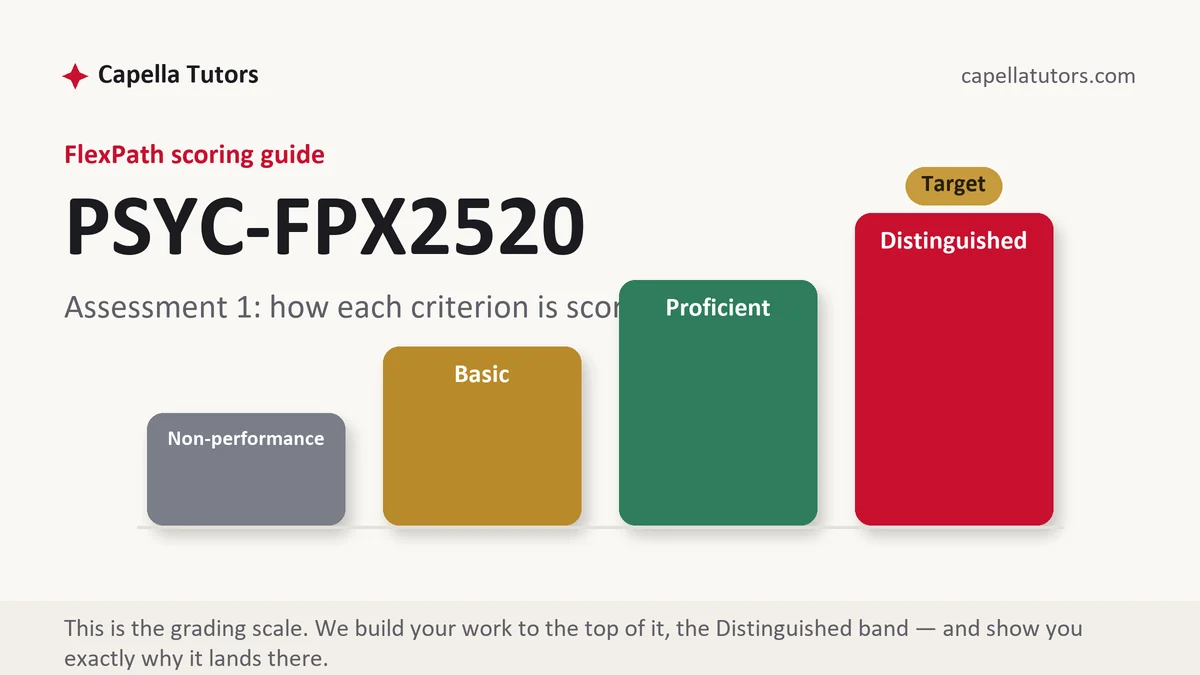
How PSYC FPX 2520 Assessment 1 is scored
FlexPath awards no letter grades. Each criterion in your scoring guide lands in one of four columns, and the column language is the writing brief:
| Level | What it means on a situation analysis |
|---|---|
| Distinguished | The finding is stated as a mechanism, each part of the mechanism is matched to something observable in the episode, and one rival explanation is weighed and settled on the evidence. The top column carries an extra verb, usually evaluate; find it and do it. |
| Proficient | The concept is applied to the situation accurately and in full, with nothing missing and nothing weighed. Clean work that stops one move short of the column that pays. |
| Basic | A definition of the concept followed by a retelling of the episode, with the link between them left for the reader to make. This is where most first submissions in an applied course settle. |
| Non-performance | A required element is gone, most often the situational detail or the evaluation. Absent scores lower than thin, every time. |
Assessment 1 is worth more than its own row set, because the evaluator habits it trains carry into every later criterion in this course. A writer who learns here to hang a concept on observable detail spends much less of the term rewriting.
The PSYC FPX 2520 Assessment 1 method, step by step
-
Turn every criterion into a question you can answer in one sentence
Applied criteria almost always ask for a link rather than a topic, so rewrite each row as a question and put the answer under it before you draft. Analyze the situational factors becomes which pressures in this episode changed what people did. If a row will not convert into a question, you have misread it, and that is cheaper to find in an outline than in a revision.
-
Choose an episode small enough to count
One place, one span of minutes, one behavior you could tally. A campus, a shift or a whole news story is too large to test, while eleven adults in a food court and one spilled folder is exactly the size a criterion can be answered on. Write the episode down as a record before you know what it means, since detail collected after the theory tends to arrive already shaped to fit it.
-
State the mechanism, not the label
Name the finding, attribute it to the researchers who published it, then write out how it is supposed to work. Latane and Darley proposed helping as a sequence of decisions rather than a single reflex, and the sequence is the part that does analytic work. A label tells the evaluator you read the chapter; a mechanism lets you make a claim that could be wrong.
-
Run the episode through the mechanism one step at a time
Take each step in turn and attach the feature of your episode that satisfies it or blocks it: what made the event ambiguous, how the number of witnesses split the obligation, what a helper would have risked looking like. Any step you cannot attach evidence to gets named as unattached rather than smoothed over, and saying so reads as control instead of a gap.
-
Hire the strongest rival account and settle it
Write the best competing explanation of the same facts, not the weakest one, then say what evidence would separate the two. A crowd that ignores a spill may be diffusing responsibility or following a local norm about minding your own business, and those accounts predict different things in a quieter setting. One honest adjudication outperforms four confident paragraphs.
-
Report the counts honestly, then self-score
Give every number its denominator and its window: how many people were within a stated distance, over how many minutes, on how many separate occasions. One observation of one episode supports a description and an application, not a general claim about people, and writing that limit yourself protects the evaluation row. Then mark each criterion D, P, B or N against the guide and rewrite anything under D.
A structure that maps to the criteria
The word targets are planning numbers our tutors use for a typical situation analysis in this course, not Capella rules; stretch any section your scoring guide asks more of.
| Section | What it must do | Guide |
|---|---|---|
| Introduction | Name the episode in a sentence, say which finding you will use on it, and state the claim the paper will defend. | ~120 words |
| The episode as record | The setting, the time, the people by role, the counts and the sequence, written before any interpretation enters. | ~250 words |
| The finding and its mechanism | The concept named, attributed to its original researchers, and explained as a process with parts. | ~250 words |
| The application | Each part of the mechanism matched to a feature of the episode, including the parts that do not match. | ~350 words |
| The rival account, settled | A second explanation of the same facts taken seriously, and the evidence that would decide between them. | ~200 words |
| Limits, conclusion and references | What one episode cannot show, the claim restated at its defensible size, current APA both ways. | ~150 words |
Annotated sample excerpt
An original model excerpt from our team, written in the register the top column describes. It is study material: take the moves and write your own.
At 1:15 on a Saturday afternoon a woman leaving the food court counter caught her bag on a chair and spilled a folder of loose paper across roughly four meters of tile; eleven adults were standing or seated within three meters, and fifty one seconds passed before anyone crouched to gather a sheet.1 Two of the eleven looked and kept walking, six were facing a tray or a phone, and the person who eventually helped had entered the area after the papers were already down.2 Latane and Darley (1968) described helping as a sequence of decisions rather than a single impulse, which explains this delay without appealing to indifference, since dropped paper is not read as an emergency and eleven unassigned witnesses leave each person holding an eleventh of an obligation.3
- 1Opens with the episode as data. A time, a distance, a count and an interval are on the page before any interpretation, which is what lets a reader check the analysis instead of trusting it.
- 2Reports the detail that complicates the reading rather than the detail that flatters it, and keeps description separate from inference.
- 3Names the mechanism, attributes it to the original study, and stops at what the mechanism can explain instead of turning eleven strangers into a claim about character.
The full premium sample for your exact assessment, written fresh to your scoring guide and issue, is free to request. Study it, revise it into your own voice, and submit work you understand.
The five mistakes that cost Distinguished
- A topic where an episode belongs. Helping behavior in modern society cannot be analyzed on two pages; eleven adults and a spilled folder can.
- The mechanism collapsed into its label. Writing that the bystander effect occurred explains nothing until the decision steps are on the page and matched.
- Counts with no denominator. One person helped is a fact about nothing until the reader knows out of how many, within what distance, across what window.
- The bias you just explained, committed. Diagnosing a stranger's character a paragraph after describing the correspondence bias loses the evaluation row on its own.
- Landmark studies credited to a chapter. The original article is short, sits in the Capella library, and is what the evidence criterion expects to see.
Pre-submission checklist
- Every criterion in the guide has its own labeled section
- The episode is recorded with a time, a place, a count and an interval before any interpretation
- The finding is attributed to the researchers who published it and written as a mechanism
- Each step of the mechanism matched to something a second observer could have seen
- One rival explanation stated fairly and settled with named evidence
- Every count carries its denominator and its measurement window, and the limits of one episode are stated
Want the first one done with backup?
Send the prompt, the scoring guide and the episode you have in mind. Eight people, including a research analyst and two quality reviewers, return a premium original sample written to the top column in 24 to 48 hours, revised free until it lands there. It is the first graded piece in the course; start it the way you want the rest of the term to go.