This manual is for PSYC FPX 2520 Assessment 2, start to submission. Assessment 2 in this course turns the analysis around: instead of explaining a behavior that already happened, you design something meant to change one and say how you would know whether it worked. The assessment usually asks for a small intervention built on a named social influence mechanism, aimed at a behavior you can count. Below is the method our tutors use for it, a structure the criteria can be scored against directly, and an annotated excerpt from an original model. Prefer to hand it off? Upload the prompt and the guide and a premium original proposal comes back in 24 to 48 hours, revised free until every row clears. Capella's catalog lists the course as PSYC-FPX2520, and some courserooms print PSYC2520; both point to this same Assessment 2.
One honesty note before the manual: Capella revises courses and scoring guides over time, so always write to the exact scoring guide attached to your assessment in the courseroom. The course identity above is verified on capella.edu; the method and structure below are our tutors' approach to it, not Capella's official rubric text.
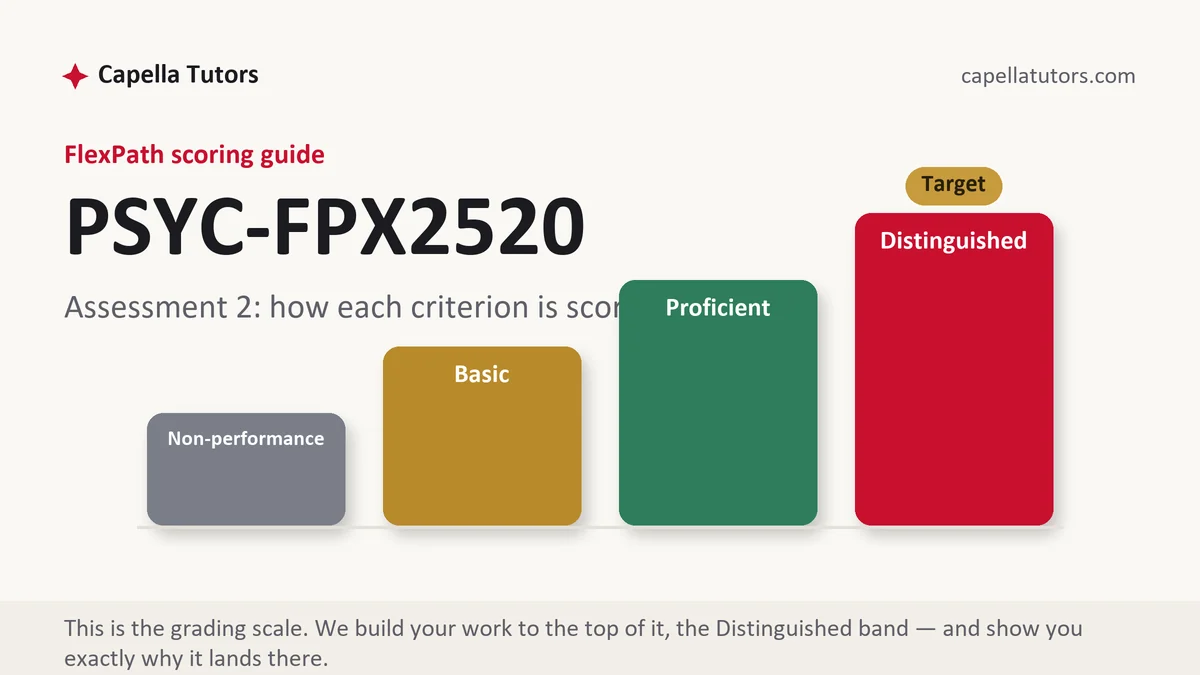
How PSYC FPX 2520 Assessment 2 is scored
There is no curve and no letter grade in FlexPath. Your scoring guide sorts each criterion into one of four columns, and the words in the column are the instructions:
| Level | What it means on an intervention proposal |
|---|---|
| Distinguished | The behavior is defined as something countable, the mechanism doing the work is named and sourced, the design is the smallest version that tests it, and the proposal states what result would show the bet was wrong. The row usually asks you to justify, and the justification is the mechanism. |
| Proficient | A workable plan with a mechanism behind it and a measure attached, complete but never put at risk. Solid, and short of the column that asks you to try to falsify your own idea. |
| Basic | An awareness campaign with good intentions, a poster, and success defined as people caring more. It cannot fail, which is why it cannot reach the top. |
| Non-performance | The measure or the mechanism is missing outright, so the evaluation criterion has nothing to grade. |
Assessment 2 is the row set where students who write well still lose points, because good prose cannot rescue a plan with no denominator in it. Decide what you will count before you decide what you will say.
The PSYC FPX 2520 Assessment 2 method, step by step
-
Write the behavior as something you could tally
Not attitudes, not awareness, not culture. Name the act, who performs it now, how often, and where you would stand to count it. A target written as residents will care more about recycling has no measurement attached, while glass jars left in the paper bin, counted per audit, has one.
-
Pick one mechanism and put its name on the page
Choose the lever you are betting on and say which literature it comes from: making the wanted behavior visible as a descriptive norm, removing the ambiguity that stalls a decision, assigning responsibility to one named person, cutting the cost of the first step, or securing a small public commitment. One mechanism defended beats four mentioned.
-
Separate what people do from what people approve of
Descriptive norms report frequency and injunctive norms report approval, and mixing them produces the sign that advertises the problem it meant to fix. If most residents already sort correctly, say so and say it where the sorting happens; if most do not, lead with approval and keep the frequency out of the message.
-
Design the smallest version that tests the bet
One building, one entry point, one message, one month. A small clean test that could fail is worth more to the criteria than a program you could not run, and it lets you name the comparison you would use, whether that is the weeks before the change or an untouched second location.
-
Fix the measure, the denominator and the window before you launch
Define the outcome as a rate rather than a count, say who audits it and how often, and write the window down: four weekly audits before the sign goes up and four after, contaminated bins divided by bins audited. A rate without a denominator cannot move, and a window chosen after the fact is the oldest way to find an effect that is not there.
-
State the size you expect, and what would refute you
Norm interventions move behavior by a few percentage points far more often than they transform anything, and a proposal promising to change a building's culture with one sign has failed its evaluation row before the details are read. Name the change you would call a success, name the result you would call a failure, and admit that a before and after comparison in one building cannot separate your sign from the season, the notice board or a turnover of tenants.
A structure that maps to the criteria
Treat the word figures as our tutors' planning targets for a proposal of this kind rather than as a Capella requirement, and expand whichever section your guide weights most.
| Section | What it must do | Guide |
|---|---|---|
| Problem and behavior | The setting, the current behavior stated as a countable rate, and the evidence that it is worth moving. | ~200 words |
| The mechanism | The influence process you are betting on, attributed to its literature, with the reason it fits this behavior. | ~250 words |
| The design | Who does what, where, when, and in what smallest testable form, with the comparison named. | ~300 words |
| Measurement | The outcome as a rate, the denominator, who collects it, and the window before and after. | ~200 words |
| Expected effect and limits | The size you predict in plain terms, the result that would refute the bet, and what the design cannot rule out. | ~200 words |
| Ethics and references | Consent and disclosure where residents are involved, no deception, current APA matched both ways. | ~120 words |
Annotated sample excerpt
An original model excerpt from our team, showing how a proposal reads when the mechanism and the measure are both on the page. Study the moves, then build your own.
Across four weekly audits of the recycling room in a sixty unit building, 23 of 48 bin checks contained glass or food waste in the paper stream, a contamination rate of 48 percent with no week in which it fell below a third.1 The proposal tests one mechanism rather than several: a laminated card fixed at eye level on the paper bin reporting that most households in this building sort correctly, which is a descriptive norm statement and is deliberately kept apart from any claim about what neighbors approve of.2 Success is defined in advance as contamination falling below a third of checks across four post-installation audits, and the honest limit is that a before and after comparison in one building cannot separate the card from a change of tenants or a change in the collection schedule.3
- 1The problem arrives as a rate with its denominator and its window, so the reader knows what was counted, how many times and over how long.
- 2One mechanism, named and isolated, with the norm distinction handled explicitly rather than left for the evaluator to guess at.
- 3Sets the success criterion before the data exist and admits what the design cannot rule out, which is the move the evaluation column pays for.
The full premium sample for your exact assessment, written fresh to your scoring guide and issue, is free to request. Study it, revise it into your own voice, and submit work you understand.
The five mistakes that cost Distinguished
- Awareness as the outcome. A plan whose success is measured in caring cannot be evaluated, and a plan that cannot fail cannot reach the top column.
- Four mechanisms, none defended. Listing every influence process in the chapter reads as coverage; one process with its literature reads as a bet.
- A frequency message that advertises the problem. Telling residents that most people contaminate the bins is a descriptive norm working against you.
- A measure with no denominator or window. Twelve contaminated bins is not a rate, and a window drawn after the numbers are in is not a test.
- A promise the literature will not carry. Interventions of this size move behavior modestly, and overstating the expected effect loses the row that asks you to evaluate.
Pre-submission checklist
- The behavior is stated as a countable rate with its denominator
- One named mechanism, sourced to the literature it comes from
- Descriptive and injunctive messages kept separate and delivered where the behavior happens
- The measurement window fixed before the intervention starts, with the comparison named
- The expected effect stated at a size the research supports, plus the result that would refute it
- Consent, disclosure and the limits of a single site addressed in the paper
Designing the intervention this week?
Send the guide and the behavior you want to move. Our team returns a premium original proposal with the mechanism, the measure and the falsification condition already in place, inside 24 to 48 hours, and revises it free until the evaluation rows clear.