Upload the prompt with its scoring guide attached and a premium original sample is back with you inside 24 to 48 hours, written so that every claim about a counseling approach names the theory it came from and the change mechanism it depends on, with free revisions until the criteria clear. The identity for your records: PSYC FPX 2320, Introduction to Counseling and Psychotherapy, worth 1.5 program points, one of the General Psychology specialization courses in Capella's FlexPath Bachelor of Science in Psychology, a degree that asks for at least 90 program points with no fewer than 27 of them earned at the 3000 level or above. In Capella's catalog the course code is written PSYC-FPX2320.
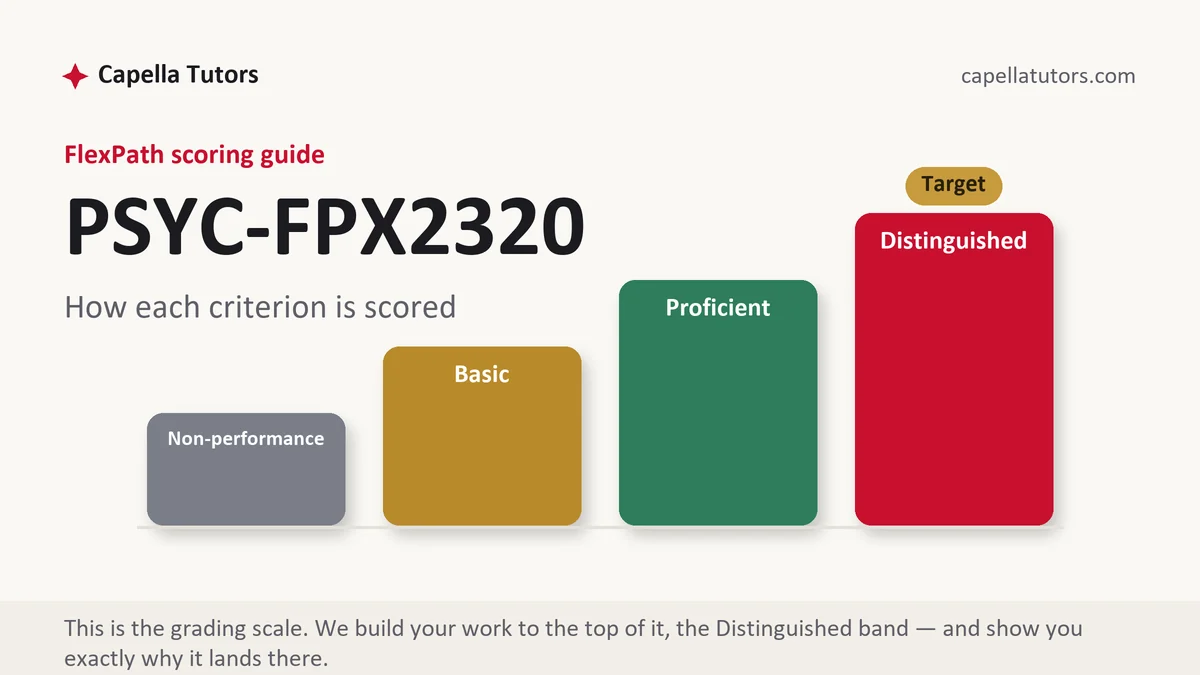
What PSYC FPX 2320 actually grades
What gets graded first is whether you can tell the orientations apart on the only question that matters at an introductory level, which is what each one thinks is wrong and what each one thinks repairs it. Psychodynamic work locates the trouble outside awareness and treats insight as the agent of change. Person-centered work assumes the client already carries the direction of growth and treats the counselor's conditions as what releases it. Cognitive behavioral work treats learned thought patterns and avoidance as the machinery that maintains distress and treats practice between sessions as the lever. Family systems work moves the unit of analysis off the person and onto the pattern that keeps repeating between people. Existential work reads distress as the price of avoiding freedom, isolation, meaning and mortality. The criteria reward a writer who can set those mechanisms side by side without blurring them into general advice about listening carefully.
The second strand is the relationship, which undergraduate papers praise often and define rarely. The working alliance has parts you can name and evidence for each: agreement on goals, agreement on the tasks that pursue them, and the bond that carries the pair through disagreement about either. Empathy in this context is a communicated inference rather than a private feeling, which is why it can be done badly by a warm person and well by a reserved one. Criteria notice whether you write the alliance as something built and repaired or as a trait the counselor happens to possess.
The third strand is what a counselor may and may not do, and it is where a Basic score is easiest to earn. Confidentiality is a rule with named exceptions rather than a promise, informed consent is a document and a continuing conversation, competence has boundaries the counselor is obliged to state out loud, and a dual relationship is a structural risk rather than a bad intention. This course also grades whether you know what a survey course does not make you. An introduction to counseling and psychotherapy teaches you to read a session rather than to run one, and a paper written in the voice of the treating clinician is answering a question nobody asked.
How we help in this course
Tell us the scenario your assessment supplies, the orientation you have been asked to work in, and which criteria mention culture or ethics, and the draft comes back with the theory named, the mechanism stated, sample counselor language written out where the row asks for application, and the limits of the approach acknowledged rather than hidden. Where an assessment asks you to compare two approaches, our writer holds a single client detail fixed and runs both across it, so the comparison has something to bite on instead of two summaries in sequence.
The terms are the studio's usual ones. One premium original deliverable per assessment, back inside 24 to 48 hours, aimed at the Distinguished column of the guide you upload, through eight people from the research pull to the final read, with one pass reserved for checking that every idea is attributed to the person who proposed it. Revisions stay free and uncapped, and anything faculty send back after an attempt is absorbed at no charge until the criteria are met.
The assessments, one by one
Assessment 1: Counseling Career
Explore a counseling or mental health profession, its role, education, licensure and professional requirements, and how it fits your goals. Read the full Assessment 1 manual.
Assessment 2: Psychotherapeutic Skills
Explain how the therapeutic alliance is formed, the skills and therapist qualities that strengthen it, the evidence for its effectiveness, and your own skills. Read the full Assessment 2 manual.
Assessment 3
Assessment 3 usually puts a professional pressure inside the scenario and asks what the counselor does next. Read the full Assessment 3 manual.
How to actually write PSYC FPX 2320: where to begin
Open the scoring guide before the readings and copy each criterion into your document as its own heading, because the criteria here are verbs and the verbs are not interchangeable. Describe, compare, apply and evaluate ask for four different amounts of work, and the most common way to lose a row in this course is to describe a theory beautifully when the row asked you to apply it. In current courserooms the assessments include "Counseling Career" and "Psychotherapeutic Skills" among others, and your scoring guide decides the exact format of each.
Then take one textbook term and walk it all the way to an answer, because that is the whole skill being tested. Say the criterion reads apply a humanistic approach to the client in the scenario, and the term in front of you is unconditional positive regard. The Basic version of that answer is a definition with a compliment attached: the counselor should show unconditional positive regard, meaning acceptance without judgment, which helps the client feel safe. Nothing in that sentence required reading the chapter. The Distinguished version does four things the Basic version skips. It attributes the term, since Carl Rogers proposed it as one of three conditions alongside congruence and empathic understanding, offered as a set rather than as a menu. It states the mechanism, which in Rogers's account is that a person valued only on conditions has learned to distort experience in order to stay acceptable, so regard that is not conditional removes the reason to keep distorting. It lands the term on the actual detail of your scenario, so if the client says he has not told his wife he was fired three weeks ago, the concept becomes a specific counselor response that receives the concealment without excusing it and without moralizing about it, and you write that response out as a line of dialogue. Then it names the limit, because regard for the person is not agreement with the person's plan, and a paper that cannot hold that distinction has quietly converted a clinical stance into permissiveness. Four moves on one term, and the criterion is satisfied instead of circled.
Then handle comparison the way the criteria intend it, since a comparison is one client detail examined twice rather than two profiles placed end to end. Hold the concealed job loss fixed and ask what each orientation does with three weeks of silence. A cognitive behavioral counselor treats the silence as avoidance maintained by short-term relief and builds a graded plan toward the disclosure, with a task attached to the week between sessions. A psychodynamic counselor asks what the silence protects and whose voice the client hears when he imagines telling her. A family systems counselor asks what work the secret is doing inside the marriage and who else already knows. One detail, three different first sessions, and a comparison row now has evidence in it.
Then write the ethics section as a decision rather than as a list of principles. Name the specific rule at stake, name the person it protects, say what the counselor does next, and say what the counselor writes down. If the scenario contains a threat, a minor, an impairment, or a relationship the counselor already has outside the room, that is the criterion the assessment is really about, and a paragraph reciting autonomy, beneficence, nonmaleficence and justice without touching the vignette reads as filler. Say who you would consult, since consultation is the professional answer to an unclear case rather than an admission of confusion, and say what you would do if the client refused the recommendation.
| Section | What goes in it | What Distinguished looks like |
|---|---|---|
| The client scenario | The presenting problem, what the client says brought them in now, and only the details the assessment supplies. | The scenario restated without added facts, with the report separated from your interpretation of it. |
| The approach you are working in | The orientation named, its proposer, its account of what is wrong, and its account of what changes. | Cause and mechanism written as two separate claims, both attributed to a primary source. |
| Application to this client | What the counselor would say and do in early sessions, tied to details from the vignette. | Sample counselor language written out and matched to a quoted detail from the scenario. |
| The counseling relationship | Goal agreement, task agreement, the bond, and how a rupture would be repaired. | The alliance treated as work with named parts rather than as natural rapport. |
| Culture and context | What in the client's situation would change the plan, and what you do not yet know. | One specific adjustment to the plan, plus the question you would ask before assuming. |
| Ethics, limits and references | The rule at issue, the exception that applies, consultation, documentation, current APA both ways. | One decision defended in full, with the limits of an undergraduate role stated plainly. |
Developing the synthesis
Synthesis in this course means putting the outcome literature next to the theory chapter and reporting what it says, which is more interesting than most drafts allow. Decades of comparative trials keep producing the same awkward result: bona fide therapies delivered competently tend to perform similarly on average, and the variance attributable to the alliance and to the individual therapist is not smaller than the variance attributable to the brand of therapy. That does not make the theories interchangeable, and the strong claim that only common factors matter goes past the evidence, since particular techniques hold clear advantages for particular presentations. The move that earns the top column is to hold both facts at once, cite a review rather than a single trial, then say what follows for the client in the vignette: choose an approach the client will accept, deliver it with fidelity, and monitor whether it is working instead of assuming that it must. Mark which claims come from controlled trials and which come from theory, because that line is the one faculty read for.
Citations that survive faculty review
Four kinds of source do different work here and mixing them costs points. Original theoretical statements belong to the people who made them, so Rogers on the therapeutic conditions and Beck on cognitive therapy are cited to Rogers and Beck rather than to the textbook paragraph summarizing them, and where the summary is all you read, cite it as a secondary source and say so. Peer-reviewed outcome and process research from the Capella library, through PsycINFO in particular, carries any claim that an approach works or that the alliance predicts outcome. Professional ethics codes are primary documents and are cited by organization, edition and standard number rather than paraphrased, since the value of an ethics citation is its exact wording. Your assigned textbook is a legitimate source for definitions and a weak one for any empirical claim, so use it where it belongs. Then run current APA both ways and reread once for the tense habit that gives undergraduate drafts away, which is describing a completed study in the future.
The mistakes that land Basic instead of Distinguished
- Describing a theory when the criterion said apply it. A definition with the client's name inserted is still a definition.
- Theory credited to the textbook. The people who proposed these ideas are named in the chapter, and the criteria expect you to use their names.
- The alliance treated as niceness. Warmth with no goal agreement and no task agreement is not a working relationship.
- Ethics written as four principles in a row. The scenario contains one specific pressure, and that is what the row is asking about.
- Writing as the treating clinician. An introductory course asks you to reason about counseling, not to prescribe treatment for a person.
PSYC FPX 2320 questions students actually ask
How do I pick an approach when the assessment does not tell me which one to use?
Pick from the scenario rather than from preference, and defend the pick in two sentences. Look at what the vignette gives you most of. Concrete avoided situations, rituals, or a symptom the client can count point toward a cognitive behavioral plan, because there is something measurable to work on between sessions. A client who cannot name what he wants but has plenty of feeling about it suits a person-centered start, since the first task is getting the direction into words. A problem that only appears around particular people is a systems problem however it was introduced. Patterns repeating across unrelated relationships invite a psychodynamic reading. Then say why you chose it and name one approach you rejected, which satisfies a criterion most students answer by asserting that their favorite theory is comprehensive.
The scenario is only a paragraph. How am I supposed to write a full paper about it?
Write about what the paragraph does not say, in the right way. An assessment vignette is deliberately thin, and the criteria are not asking you to invent a history; they are asking you to show what you would need. Split the paper into what the client reported, what you would ask next and why each question would change your plan, and what you would hold as a hypothesis until it is confirmed. Naming missing information is a graded skill rather than a confession, since a counselor who proceeds as though one paragraph settled the case is the counselor the ethics chapter warns about. Two rules keep this safe: do not add facts and then reason from them as though the assessment supplied them, and do not diagnose, because assigning a disorder to a paragraph is the most common overreach in this course.
Do I have to include a diagnosis or a treatment plan?
Only if a criterion asks for one, and read that row twice before deciding it does. Most introductory assessments want an approach and a rationale, which is not a diagnostic formulation, and volunteering a label usually costs credit because it asserts something the scenario cannot support. If the row does ask for a plan, keep it at the level the course teaches: goals stated so that someone could tell whether they were met, the first few sessions described in order, the approach that justifies that order, a note on how you would know it was not working, and the point at which you would refer the client to someone with training you do not have. That last item is the one graders look for and the one students leave out.
Counseling scenario paper due?
Upload the vignette and the scoring guide. Your first premium sample is free, back in 24 to 48 hours with the theory named and applied line by line.