This manual is for PSYC-FPX2320 Assessment 1, start to submission. The first graded piece in Introduction to Counseling and Psychotherapy usually gives you a short client account and asks you to work inside one counseling approach, so the paper stands on whether the approach touches the client or only gets defined near him. Below is the method our tutors use for it, a structure that answers the rows in the order a guide lists them, and an annotated excerpt from an original model. Want it handled instead? Send the prompt with the scoring guide attached and a premium original sample comes back in 24 to 48 hours, revised free until the criteria clear. Your courseroom may print this as PSYC FPX 2320 Assessment 1 or PSYC2320 Assessment 1; it is the same deliverable, and PSYC-FPX2320 Assessment 1 is what this manual walks through.
One honesty note before the manual: Capella revises courses and scoring guides over time, so always write to the exact scoring guide attached to your assessment in the courseroom. The course identity above is verified on capella.edu; the method and structure below are our tutors' approach to it, not Capella's official rubric text.
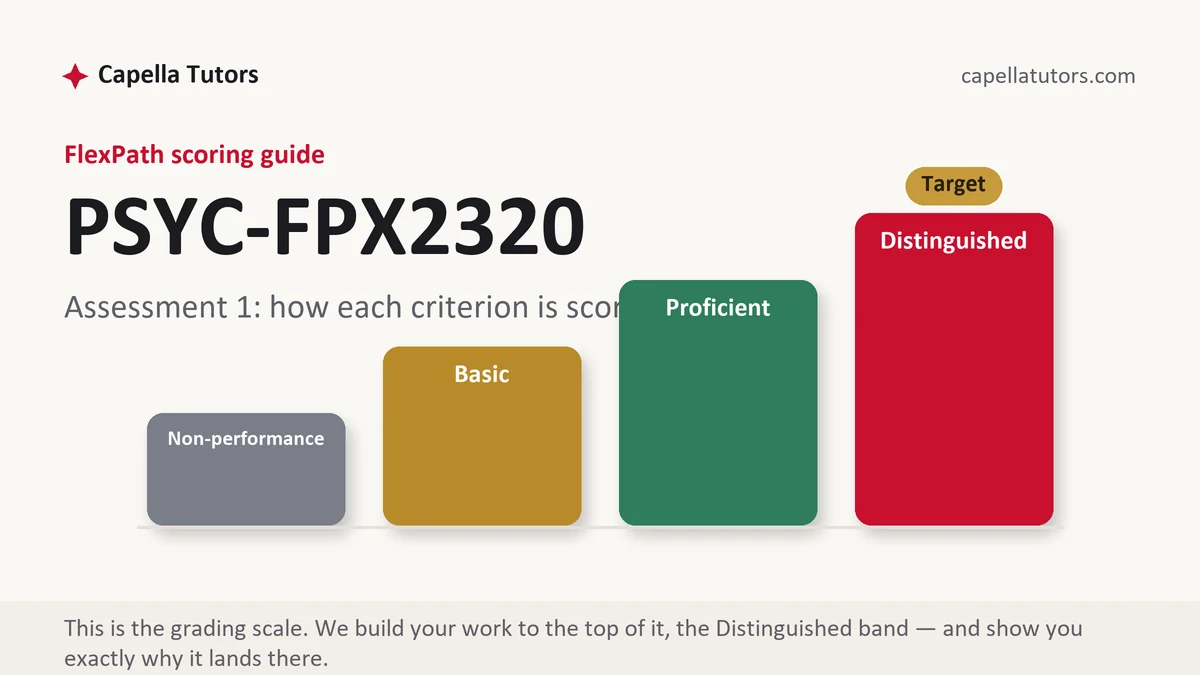
How PSYC-FPX2320 Assessment 1 is scored
FlexPath hands out no letter grades. Every row of your scoring guide lands in one of four columns, and the wording of those columns is the brief you write to:
| Level | What it means on an applied approach paper |
|---|---|
| Distinguished | The orientation is attributed to the person who proposed it, what maintains the problem and what changes it are written as two separate claims, and each claim is landed on a detail the scenario actually supplies, with the limit of the approach said out loud. The top column usually carries a second verb past apply; find it and do it. |
| Proficient | The approach is explained accurately and used on the client in full, with nothing missing and nothing weighed. Clean work, one move short of the column above it. |
| Basic | The approach is explained well and the client turns up at the end of the paragraph as an example. Most first submissions in this course settle here, and they settle there for one reason, which is that no sentence in the draft could only have been written about this client. |
| Non-performance | A required element is gone, most often the application row or the statement of limits. Absent scores lower than thin, and it scores lower every time. |
Treat this one as the habit-setting assessment. The reading you do here on what an orientation claims, and the practice of quoting the scenario back before interpreting it, is what the later rows in this course keep asking for in different words.
The PSYC-FPX2320 Assessment 1 method, step by step
-
Copy the verbs out of the guide before you open the chapter
Every row begins with a verb, and describe, apply and evaluate are three different amounts of work priced differently. Write the verbs in a column down the side of your outline, then write beside each one what a reader would have to see in order to agree the verb was performed. Your scoring guide decides which verbs appear. A row misread at this stage turns into two hours of rewriting after the attempt comes back.
-
Let the scenario choose the approach
The assessment usually either names the orientation or leaves the choice to you. If it leaves it to you, read the client account for what it gives you most of, because a person who can count the situations he steers around hands you something workable between sessions, while a person with a great deal of feeling and no stated direction hands you something else entirely. Then write one sentence saying why this approach fits these details, since that sentence is itself scored.
-
Split what maintains the problem from what repairs it
Each orientation carries two claims, not one: an account of what keeps the trouble in place and an account of what produces change. Undergraduate drafts fuse them into a single sentence about helping the client cope better. Write them as two labeled claims and attribute each to the theorist who proposed it rather than to the chapter that summarized him. Once the claims stand apart, the application section is close to written, because the second claim tells you what the counselor does.
-
Land the mechanism on quoted detail
Application means the mechanism touching something the scenario says in its own words. Pull three details out of the account, restate them exactly rather than loosely, and show what the approach does with each one. Then write the counselor's words as lines of speech instead of describing them from a distance, because the sentence saying the counselor would build rapport and explore feelings appears in every Basic paper ever submitted in this course.
-
Say what the approach cannot do, and where you stop
Two boundaries belong in the draft. One sentence on what this orientation handles poorly, since a paper that presents an approach as complete has stopped evaluating it. One sentence on what an introductory course does not qualify you to do, which covers attaching a diagnosis to a paragraph and writing in the voice of the person treating this client. Both sentences earn credit in the ethics row and cost nothing anywhere else.
-
Self-score the draft one row at a time
Read the draft against the guide with a single row visible, and mark it yourself at the column you honestly think an evaluator would reach. Anything below the top column gets one more pass plus a note naming the sentence that is supposed to earn it. Submit early in the week, because FlexPath evaluation can take two business days and a Friday upload waits out the weekend before anyone opens it.
A structure that maps to the criteria
These lengths are planning targets our tutors use for a paper of this kind rather than Capella requirements, so stretch any row your scoring guide weights more heavily.
| Section | What it must do | Guide word target |
|---|---|---|
| Introduction | Open on the client's situation as the scenario reports it, then name the approach the paper works in and the reason it fits these details. | ~150 words |
| The client as reported | What the client said and what happened, kept apart from your reading of it, with the missing information named rather than filled in. | ~200 words |
| The approach, stated properly | The orientation, its proposer, its account of what maintains the problem, and its separate account of what changes. | ~250 words |
| Application to early sessions | The mechanism landed on three quoted details, with counselor language written out and the first tasks described in order. | ~400 words |
| Limits, context and role | What this approach handles poorly, what you would ask before assuming anything about the client's context, and where an undergraduate role ends. | ~200 words |
| References | Current APA matched both ways, primary sources for the theory, the ethics code cited by standard where a row asks for it. | as needed |
Annotated sample excerpt
An original model excerpt from our team, showing the register that reaches the top of a guide. It is study material: take the moves, then write your own.
The account reports that the client, twenty-six, has not driven on the interstate since a rear-end collision eight months ago, and now takes a surface route that adds about forty minutes to each direction of his commute.1 A cognitive behavioral reading treats the detour as the machinery rather than as the symptom, because the relief that arrives when he takes the exit is immediate and reliable, and Beck's account holds that a behavior followed by dependable relief is being trained rather than merely tolerated.2 Applied to him, the early sessions produce a list of driving situations he ranks himself and one task he agrees to before he leaves the room, so the counselor says: you told me the frontage road frightens you a little and the interstate frightens you a great deal, so can we start on the frontage road Tuesday and Thursday, and can you tell me what you notice by the third mile.3
- 1The supplied detail restated with its numbers and nothing added. Every later sentence is anchored to something the scenario can be checked against.
- 2What maintains the problem is stated as a claim with an owner, not as a label. The word machinery is doing work: the detour is the target, not the evidence.
- 3Counselor language written out, matched to a phrase from the account, and the task agreed rather than issued. This is what the application row means by apply.
The full premium sample for your exact assessment, written fresh to your scoring guide and issue, is free to request. Study it, revise it into your own voice, and submit work you understand.
The five mistakes that cost Distinguished
- A definition with a client attached. If the paragraph would read the same with any client's details swapped in, the application row has not been answered.
- Cause and change collapsed into one sentence. An orientation makes two claims, and a guide that asks you to explain the approach is asking for both.
- A counselor with no lines. Describing what the counselor would explore is not the same as writing the two sentences the counselor would say.
- Facts invented and then used as evidence. Adding a childhood to a two-paragraph vignette and reasoning from it is the fastest way to lose a row you had already earned.
- An approach presented as complete. Every orientation is poor at something, and naming that something is the difference between describing a theory and evaluating one.
Pre-submission checklist
- Every criterion has its own labeled heading, in the order the guide prints them
- The approach is credited to the person who proposed it, with a year, not to the textbook chapter
- What maintains the problem and what changes it appear as two separate claims
- Three details from the scenario are quoted or restated exactly and carry the application
- Counselor language written out for the early sessions, with the first task agreed rather than assigned
- One limit of the approach and one boundary on your own role stated in plain sentences
First counseling paper due this week?
Send the client scenario and the scoring guide. Eight people, including a research analyst and two quality reviewers, return a premium original sample aimed at the top column in 24 to 48 hours, revised free until it lands there. This is the assessment that teaches you the register the rest of the course grades.