This manual is for PSYC-FPX2320 Assessment 2, start to submission. Assessment 2 in this course usually stops asking you to work inside one approach and starts asking you to choose between two, which is a different job: the paper has to defend a decision rather than describe a method. Below is the method our tutors use for it, a structure built so both approaches answer the same question, and an annotated excerpt from an original model. Rather hand it over? Upload the scenario and the guide and a premium original sample arrives in 24 to 48 hours, revised free until every row is satisfied. Your courseroom may print this as PSYC FPX 2320 Assessment 2 or PSYC2320 Assessment 2; it is the same deliverable, and PSYC-FPX2320 Assessment 2 is what this manual walks through.
One honesty note before the manual: Capella revises courses and scoring guides over time, so always write to the exact scoring guide attached to your assessment in the courseroom. The course identity above is verified on capella.edu; the method and structure below are our tutors' approach to it, not Capella's official rubric text.
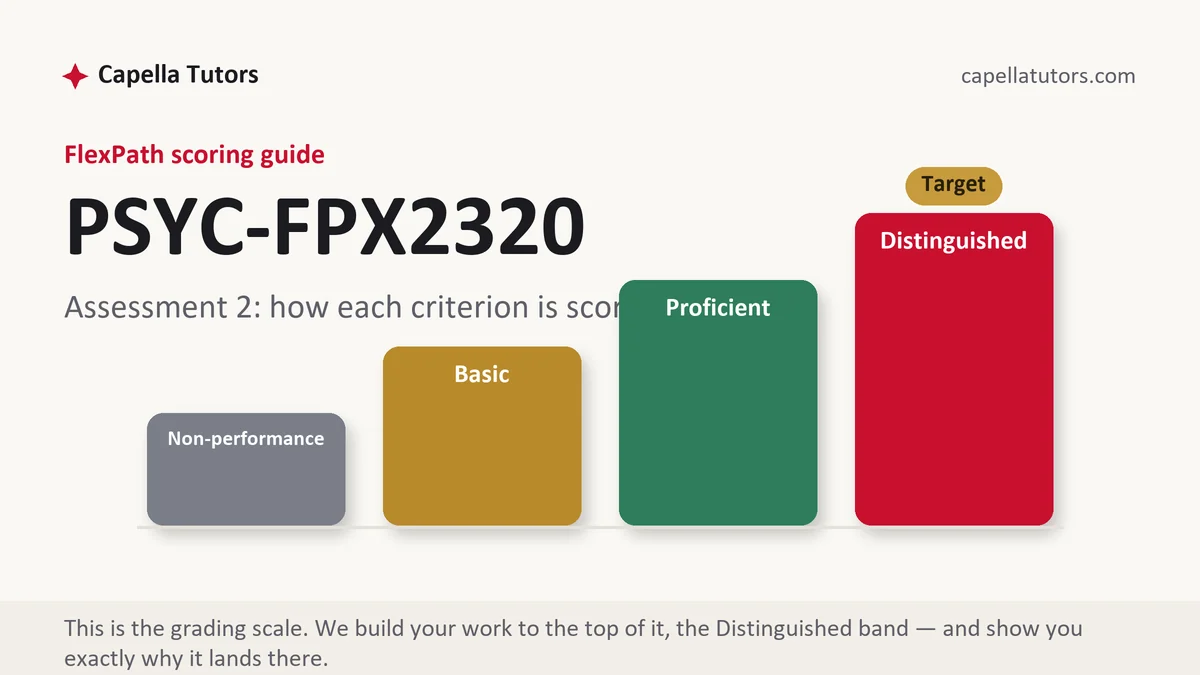
How PSYC-FPX2320 Assessment 2 is scored
No letter grade is ever entered in FlexPath. Each row on your guide is placed in one of four columns, and the column wording tells you what the paragraph has to contain:
| Level | What it means on a comparison paper |
|---|---|
| Distinguished | Both approaches are run across the same fixed detail from the scenario, the choice between them is made and defended on that detail, and the writer names what would have changed the decision. The row that pays here almost always contains a verb past compare, such as justify or evaluate. |
| Proficient | Two approaches accurately described and correctly matched to the client, with a preference stated. Complete, and the defense is thin enough that a reader could substitute the other choice without disturbing the paper. |
| Basic | Approach one for three paragraphs, then approach two for three paragraphs, with nothing shared between them and the client mentioned in both. Two summaries side by side is not a comparison, and this is where most attempts on this deliverable land. |
| Non-performance | Something the row required is not there, usually the justification or the second approach in any real form. A row cannot be scored on a paragraph that does not exist. |
The skill this deliverable trains is worth more than the points on it. Choosing between explanations that both fit the same facts, then saying what evidence would settle the question, is the move every later criterion in this course rewards in one wording or another.
The PSYC-FPX2320 Assessment 2 method, step by step
-
Read the comparison row twice and find out what it is asking for
Compare, contrast, and justify a selection are not the same instruction. Compare wants similarity and difference on stated dimensions. Contrast wants difference only. Justify wants a decision with reasons attached, which means the paper needs a loser as well as a winner. Your scoring guide decides which one you owe, and the number of paragraphs you can safely spend on description follows from that answer rather than from preference.
-
Fix one detail from the scenario before you pick the approaches
Choose a single concrete thing the client did or said and write it at the top of your working document. A detail with a count or a date in it works best, because both approaches then have to explain the same measurable thing. Everything in the paper points back at that line. Comparisons collapse when each approach is allowed to bring its own favorite evidence, and holding one detail still is what stops that from happening.
-
Build a three-question grid and answer it twice
Down the side put three questions: what keeps this going, what changes it, and what the first session looks like. Across the top put the two approaches. Fill in all six cells before you write a sentence of prose, and attribute each answer to the theorist who proposed it. The grid does the comparing, and it makes gaps visible at a stage where filling them is cheap.
-
Write the two accounts against the same line, not in sequence
Turn the grid into paragraphs organized by question rather than by approach, so a reader meets both answers to what keeps this going before either approach reaches the first session. That arrangement is the single strongest signal to an evaluator that a comparison happened. Write counselor language in both accounts, since the difference between two orientations shows up in what gets said far more clearly than in what gets summarized.
-
Choose, then say what would have changed your mind
Name the approach you would start with, give the reason in terms of the fixed detail, and add one sentence describing the observation that would send you to the other one. That sentence is where the top column usually lives. A defense with no conditions attached reads as loyalty to a theory, and loyalty is not evidence.
-
Report the outcome research in plain English before the numbers
Where a row asks whether one approach works better, say the finding in words first, then give the figure: competently delivered therapies tend to perform similarly on average, and the average hides a wide spread of individual outcomes. A mean with no spread beside it invites a claim about this client that the study cannot support. Cite a review rather than one trial, then self-score every row before you submit.
A structure that maps to the criteria
Lengths below are our planning numbers for a paper of this shape, not Capella rules, so grow whichever section your own guide loads with the most criteria.
| Section | What it must do | Guide word target |
|---|---|---|
| Introduction and the fixed detail | State the client's situation as reported, then name the one detail the whole paper will explain and the two approaches that will try. | ~175 words |
| What keeps this going, twice | Both accounts of what maintains the problem, side by side on the same detail, each credited to its proposer. | ~300 words |
| What changes it, twice | Both change mechanisms stated as separate claims, with the difference between them made explicit rather than implied. | ~300 words |
| Two first sessions | What each counselor would actually say and do in the opening weeks, written as language and tasks rather than intentions. | ~300 words |
| The decision and its conditions | The approach you would begin with, the reason tied to the fixed detail, and the observation that would move you to the other. | ~200 words |
| Evidence, limits and references | What the comparative outcome literature supports, stated in words before figures, plus current APA matched both ways. | ~200 words |
Annotated sample excerpt
An original model excerpt from our team, written at the level a top column describes. Read it for the moves, then build your own version around your own scenario.
The detail this paper holds still is one line from the intake summary: the client, thirty-eight, has written a letter to her father four times in two years and has never sent one.1 A person-centered counselor reads the four drafts as her own direction becoming visible, works to get into words what she wants from her father rather than from the letter, and offers regard that does not depend on which choice she reaches, since Rogers (1957) proposed his conditions as a set rather than as techniques to be selected from.2 A cognitive behavioral counselor reads the same four drafts as a cycle that ends in relief every time the envelope stays on the table, asks her to predict out loud what her father will do when he reads it, and opens with a graded task, reading one draft aloud in the room, which produces a prediction that can be checked against an outcome; the person-centered account needs no such prediction and could not generate one.3
- 1One detail fixed and quoted, with a count in it, so both approaches are made to answer the same question rather than their favorite one.
- 2The first account carries its proposer, a year, and a claim about mechanism. The set rather than menu point is the kind of accuracy these rows reward.
- 3The second account arrives on the same line and produces something the first cannot, which is the difference a comparison row is paying for.
The full premium sample for your exact assessment, written fresh to your scoring guide and issue, is free to request. Study it, revise it into your own voice, and submit work you understand.
The five mistakes that cost Distinguished
- Two summaries stacked. Three paragraphs on one approach followed by three on another shares no evidence between them, and a reader has to do the comparing.
- A choice announced and never defended. Saying which approach you would use is the easy half; the reason has to point at a detail in the scenario.
- Both approaches praised equally. A paper that will not prefer either one has avoided the row rather than answered it.
- The rival taken in its weakest form. Beating a caricature of an orientation is worth nothing, and evaluators in this course recognize the caricatures.
- Similar average outcomes read as proof the choice is arbitrary. Averages across many clients say nothing certain about one, and specific approaches hold specific advantages.
Pre-submission checklist
- One detail from the scenario is quoted at the top and explained by both approaches
- The paper is organized by question rather than by approach, so both answers meet on the page
- Each mechanism is credited to the person who proposed it, with a year
- Counselor language written out for both first sessions, not just for the one you prefer
- The decision stated, defended on the fixed detail, and given one condition that would reverse it
- Any outcome claim written in plain words before any number, cited to a review and matched in the reference list
Stuck choosing between two approaches?
Send the client scenario and the guide, and say which two orientations your row names. A research analyst and two quality reviewers sit inside the eight-person pipeline that returns a premium original sample in 24 to 48 hours, written to the top column and revised free until it gets there.