This manual is for PSYC FPX 2320 Assessment 3, start to submission. Assessment 3 in this course usually puts a specific professional pressure inside the scenario, a request the counselor cannot simply grant, and asks what happens next, which makes it a paper about a decision rather than about a theory. Below is the method our tutors use for it, a structure that keeps the decision in front of the principles, and an annotated excerpt from an original model. Prefer to have it built for you? Send the scenario and the guide and a premium original sample lands in 24 to 48 hours, revised free until the rows are satisfied. Capella's catalog lists the course as PSYC-FPX2320, and some courserooms print PSYC2320; both point to this same Assessment 3.
One honesty note before the manual: Capella revises courses and scoring guides over time, so always write to the exact scoring guide attached to your assessment in the courseroom. The course identity above is verified on capella.edu; the method and structure below are our tutors' approach to it, not Capella's official rubric text.
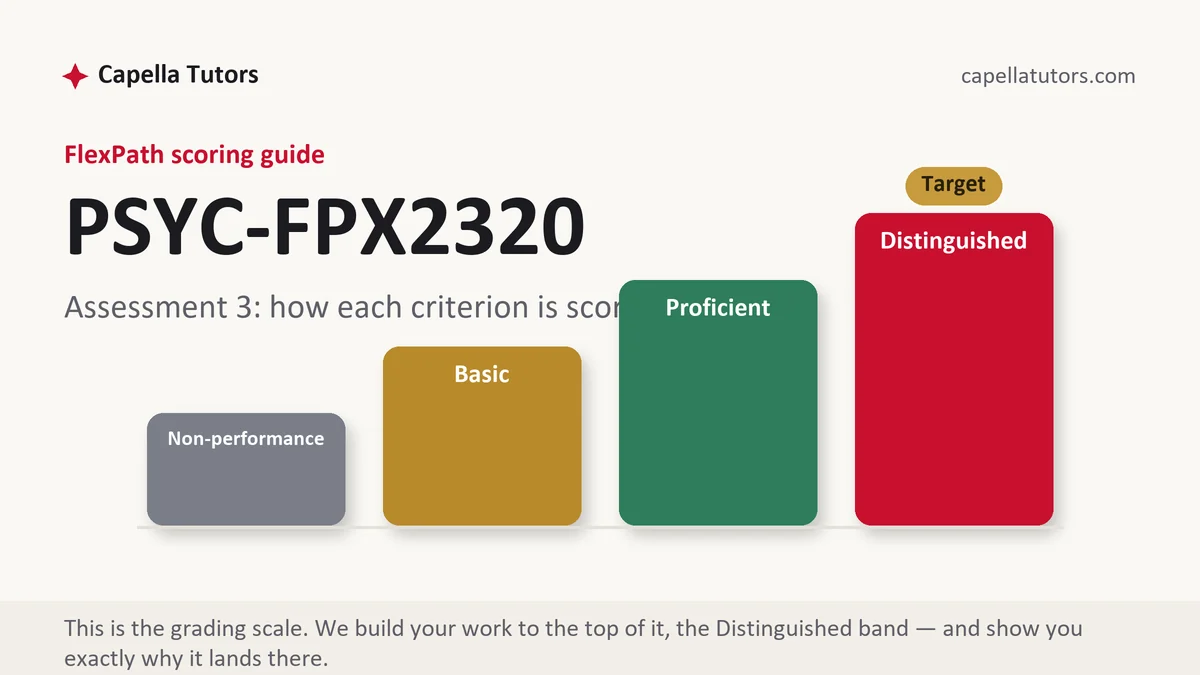
How PSYC FPX 2320 Assessment 3 is scored
FlexPath scores rows, not papers, and never issues a letter. Each row on your guide is placed in one of four columns, and the language in the column is the instruction you write to:
| Level | What it means on an ethics and scope analysis |
|---|---|
| Distinguished | The pressure in the scenario is named as an event, the specific standard is cited rather than paraphrased, two obligations are held side by side before either is resolved, and the decision is written as actions with the counselor's words in them, including what happens if the client says no. The top column here usually asks you to justify, not to identify. |
| Proficient | The right rule is found, applied correctly, and a defensible decision reached. Accurate work in which the competing obligation is mentioned rather than weighed. |
| Basic | The ethical principles are defined in order and the scenario is retold nearby, with no sentence saying what the counselor does on Tuesday. This is the most common submission on this deliverable, and it is the most avoidable. |
| Non-performance | A required element is missing, usually the consultation, the documentation, or the point at which the case leaves the counselor's competence. Silence on a required element scores below a weak answer to it. |
The habit this deliverable is really grading is restraint. An introductory course teaches you to reason about counseling rather than to conduct it, and the strongest papers here say where their own authority stops before an evaluator has to.
The PSYC FPX 2320 Assessment 3 method, step by step
-
Find the row that names the pressure, and take it literally
Ethics rows in this course are specific rather than general, so read for the noun: confidentiality, informed consent, competence, a relationship the counselor already has outside the room, a third party in the session. That noun is the paper. Your scoring guide decides which pressure you owe an answer on, and a draft that answers a different one accurately still scores as though the row were blank.
-
Cite the standard, do not summarize it
A professional ethics code is a primary document, and its value in a paper is the exact wording. Name the organization, the edition and the standard number, quote the clause the situation actually touches, and then say what it obliges in this scenario. A paragraph reporting that the code emphasizes client welfare has cited nothing, because no reader can check it and no row can be scored on it.
-
Separate what the client is asking for from what the client needs
Most of these scenarios contain a request, and the request is usually reasonable from where the client sits. Write both halves down: what she has asked for in her own words, and what the professional obligation covers whether she asks or not. Holding those two apart on the page is what an ethics row means by analysis, and collapsing them into agreement is what a paper does when it has decided to be kind instead of careful.
-
Write the next three moves as actions, with the words in them
A decision that cannot be performed is not a decision. Write the counselor's next three actions in order, each with what gets said, what gets written and when it happens. Then check that a reader could recognize each one as something an actual person does in an actual room. This is the section that separates the top two columns, and it is usually shorter than the paragraph students spend on principles.
-
Consult, and say who and why, then name the referral
Consultation is the professional answer to an unclear case and appears in these guides as a graded element rather than as an aside, so name the supervisor or the colleague, say what question you would bring, and say what you would do with an answer you disagreed with. Then say where the case goes if it needs training you do not have, which means naming the kind of clinician, not gesturing at a referral in the abstract.
-
Answer the refusal, then self-score
Finish with the sentence most drafts skip: what the counselor does if the client declines the recommendation. Autonomy is not a synonym for agreement, and a paper that has no plan for a no has not tested its own reasoning. Then read each row on its own, mark the column you would honestly award, and submit early in the week so a two-day evaluation window does not become a weekend.
A structure that maps to the criteria
The lengths here are our planning targets for a paper of this kind rather than Capella requirements, so expand whichever section your own guide covers with more rows.
| Section | What it must do | Guide word target |
|---|---|---|
| The pressure, as an event | What happened and when, in the scenario's own terms, with no principles named yet and nothing added to the facts. | ~150 words |
| The standard, quoted | Organization, edition and standard number, the clause that applies, and the obligation it creates here. | ~200 words |
| The two obligations | Both duties in tension stated fully before either is resolved, with the person each one protects named. | ~250 words |
| The decision, as actions | Three moves in order, with the counselor's words, what gets documented, and when each happens. | ~300 words |
| Consultation, referral and role limits | Who you would consult and what you would ask, where the case goes if it exceeds your competence, and what an undergraduate role does not include. | ~250 words |
| The refusal, limits and references | What follows if the client declines, what your reasoning cannot settle, current APA matched both ways with the code cited by standard. | ~200 words |
Annotated sample excerpt
An original model excerpt from our team, pitched at the register a top column describes. Study the moves, then write your own version around your own scenario.
Near the end of the fourth session the client asks that what she has just described be left out of the file, and adds that she will stop attending if it appears there.1 Two obligations meet at that sentence and the paper is stronger for holding both open: the record exists to serve her care and is disclosable only under the conditions she was told about at intake, and the request itself is now information about how much the file frightens her, which belongs to the work rather than to the paperwork.2 The counselor's next three moves are all sayable out loud, which is the test of a decision: revisit consent in plain language, naming who can read the file and in what circumstances; write the clinically necessary content at the level of detail her care requires rather than the level of detail the story invites; and bring the request to supervision that week as a documentation question rather than as a difficult client.3
- 1The pressure arrives as an event with a time attached and no principle named yet. Nothing has been added to the scenario in order to make it dramatic.
- 2Two duties stated before either wins, and the request reread as clinical information. That second reading is the sentence a Basic paper never contains.
- 3The decision written as three performable actions, with consultation named as routine practice rather than as a confession of confusion.
The full premium sample for your exact assessment, written fresh to your scoring guide and issue, is free to request. Study it, revise it into your own voice, and submit work you understand.
The five mistakes that cost Distinguished
- The principle tour. Autonomy, beneficence, nonmaleficence and justice defined one after another, with the client's actual situation nowhere in the paragraph.
- The code paraphrased. An ethics citation is worth what its exact wording is worth, so a standard without an edition and a number is decoration.
- Confidentiality written as a promise. It is a rule with named exceptions, and a paper that presents it as absolute has misread the chapter it is citing.
- No consultation, or consultation as weakness. Bringing an unclear case to a supervisor is the professional move, and guides in this course score it as one.
- Deciding for the client and calling it advocacy. Overriding a competent adult's choice needs a stated legal or safety basis, and where there is none, the answer is a conversation.
Pre-submission checklist
- The pressure is named as an event, with what happened and when, before any principle appears
- The standard is cited by organization, edition and number, with the applicable clause quoted
- Both obligations in tension are stated in full before one is preferred
- Three next actions written with the counselor's words, what gets documented, and when
- Consultation named with a question attached, and the referral described by the kind of clinician needed
- One sentence on what happens if the client refuses, and one on where your role ends
Ethics scenario due and the rows look identical?
Send the scenario and the scoring guide, and say which pressure your rows keep circling. The eight-person pipeline, research analyst and two quality reviewers included, returns a premium original sample in 24 to 48 hours with the standard cited, the decision written as actions, and revisions free until the guide is met.