Send the prompt and the scoring guide and a premium original sample comes back inside 24 to 48 hours, written to the Distinguished descriptors with every claim about platform effects sized honestly, and revisions free until the criteria clear. The identity of the course: PSYC FPX 2210, Introduction to Psychology of Social Media, worth 1.5 program points, a specialization course on the General Psychology menu inside Capella's FlexPath BS in Psychology. At 2000 level it does not count toward the 27 points the degree requires at the 3000 level or above, so read it as specialization breadth rather than progress against that particular ceiling. In Capella's catalog the course code is written PSYC-FPX2210.
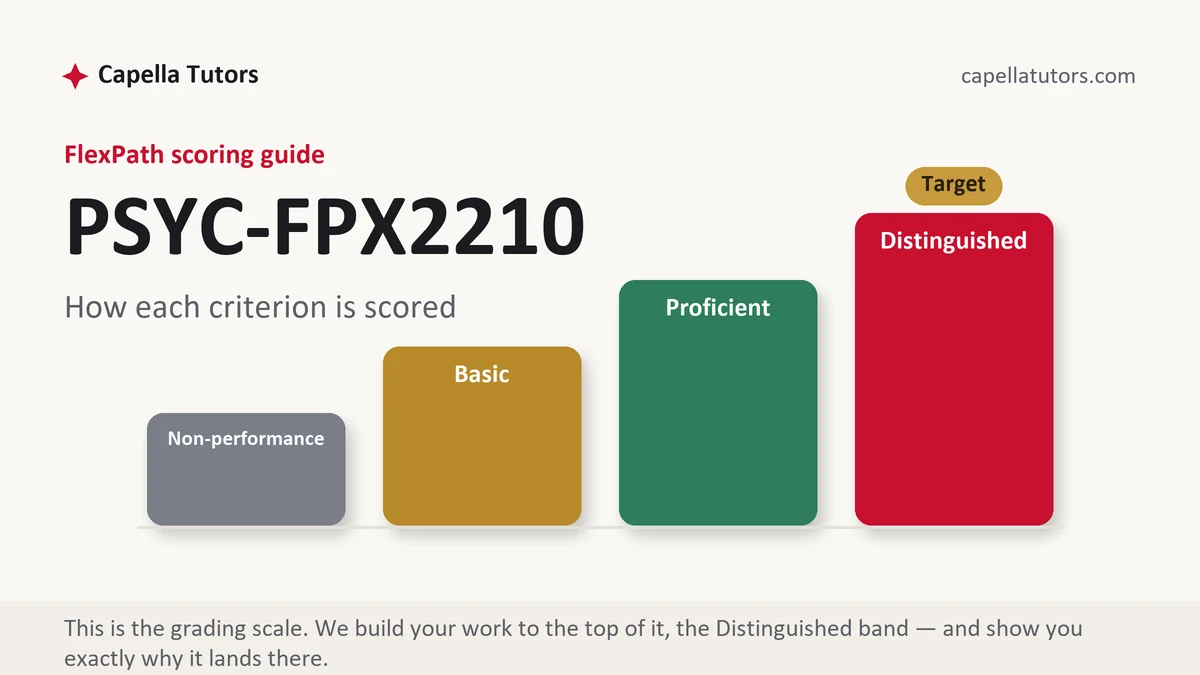
What PSYC FPX 2210 actually grades
This course grades psychology applied to a platform mechanic. It does not grade opinions about phones, and the distance between those two things is most of the mark. The criteria here typically ask you to name a construct, tie it to something a platform actually does, support the tie with research, then bound the claim. A paper arguing that social media is bad for people has answered none of that, however sincerely it argues.
So learn to name mechanics precisely, because a named mechanic is what makes a construct testable. Quantified feedback means the visible count sitting beside a post. Algorithmic ranking means the order was chosen for you by a model optimizing something. Infinite scroll removes the stopping cue a page break used to supply. Ephemerality puts a clock on content and therefore on the obligation to look. Variable timing means the reward arrives unpredictably. Each maps onto a construct psychology already studies, and the mapping is the paper. Self-presentation explains the curated profile. Upward social comparison explains the mood cost of a feed full of other people's best days. Parasocial relationship explains the sense of knowing someone who does not know you. Online disinhibition explains the comment nobody would make out loud.
The third strand is evidence quality, and this course rewards knowing the literature is contested. Large analyses of adolescent well-being datasets have reported associations so small that technology use accounted for a fraction of one percent of the variation, while other researchers working with similar data argue the effect is real and concentrated in particular groups. Two methodological facts sit underneath the dispute and both belong in your paper. Self-reported screen time diverges substantially from logged use, so a study measuring the first is measuring a memory. And direction is not settled by a correlation, since feeling low is itself a reason to scroll.
Ethics arrives sooner than students expect, because the data is lying around in public. A public post has an author who never agreed to be a case study, and a platform's terms permitting collection is not the same thing as a psychologist's obligation being satisfied. Assessments that ask you to analyze real content generally reward de-identification and a stated boundary on what you looked at.
How we help in this course
Drafts for 2210 are written platform-specific and construct-first. Tell us which platform the assessment names, or which one you actually use, and the sample comes back describing that platform's real features instead of a generic feed, with each claim attached to a construct that has literature behind it. Where the evidence is contested the draft says so and reports the size of the effect, because in this subject a hedged claim outscores a confident one every time.
The terms are the studio standard with one addition that matters here. Every source in a 2210 draft is checked for what it measured, so a study of self-reported use is never quoted as though it logged behavior. Delivery is inside 24 to 48 hours, criterion by criterion against your own guide, through the eight-person pipeline with both quality passes, revised free until the score lands.
The assessments, one by one
Assessment 1
The opening deliverable in Introduction to Psychology of Social Media usually asks for the smallest complete piece of work this subject has: one platform mechanic described precisely, one psychological construct fastened to it, and research behind the fastening. Read the full Assessment 1 manual.
Assessment 2
The second deliverable in this course usually moves from describing research to judging it: take a study, or a pair of studies, about platform use and some outcome, and report what the design can support and what it cannot. Read the full Assessment 2 manual.
Assessment 3
Assessment 3 usually stops asking what the research says and starts asking what you would do about it: a design change, an intervention or a piece of advice, aimed at a named group, carrying the outcome it is supposed to move. Read the full Assessment 3 manual.
How to actually write PSYC FPX 2210: where to begin
Choose one platform and one feature before writing anything else. The scoring guide will name the parts and they are usually the same set: describe the phenomenon, connect it to theory, support it with research, apply or recommend, then state the limits. Breadth is the trap. A paper covering five platforms and four constructs cannot develop any of them to the depth a criterion is scored at, while a paper about one metric on one platform can.
Here is the contrast. The Basic paragraph says social media causes comparison and lowers self-esteem, then cites something that agrees. The stronger paragraph names the feature, a count displayed next to every post, names the construct, upward social comparison, explains the mechanism, that a visible metric converts an ambiguous social situation into a ranked one, points at the designs supporting it, experiments that manipulate exposure and experience-sampling studies that catch mood in the moment rather than in retrospect, reports the size as modest, then bounds the claim by noting that the pattern looks different for people who post than for people who only scroll.
Then get the numbers right, because this is a course where students quote statistics they have not sized. A percentage about teenagers means nothing without the sample, the country and the year, so supply all three or drop the figure. Prevalence estimates from a survey organization such as the Pew Research Center are citable and appropriate, with the fieldwork year attached, since usage shifts fast enough that a four-year-old figure describes a different population. Numbers from a platform's own reporting describe accounts rather than people, and accounts include duplicates, automated ones and abandonments, so label them as company-reported wherever you use them.
| Section | What goes in it | What Distinguished looks like |
|---|---|---|
| Introduction | The platform, the feature, and the question the paper answers. | One platform and one feature named in the opening, with a question sized to the paper. |
| The feature described | What the mechanic does, in enough detail for a reader who avoids the platform. | A description precise enough to be tested, naming what the user sees and when. |
| The construct and its theory | The psychological construct, where it came from, and the mechanism it proposes. | Attribution to the construct's own literature, with the mechanism written as a sequence. |
| The evidence | The studies, with design, sample and measure given before the finding. | Design named, self-report separated from logged use, and effect size reported rather than implied. |
| Application or recommendation | The use case, the intervention or the design change, and who it is for. | Something specific enough to act on, with the outcome it is supposed to move. |
| Limits, ethics and references | What the evidence cannot show, the ethical constraint, current APA. | A named alternative explanation, reverse causation included, and de-identified examples. |
Developing the synthesis
What passes for synthesis here is the reconciliation of a small average effect with a strong personal experience, and both halves can be true at once. An average across tens of thousands of adolescents can be tiny while a subgroup inside it is genuinely harmed, because averages hide distributions and the tails are where the serious cases live. Write that reconciliation explicitly, then take a position on which claim your own evidence supports. The second half of the synthesis is direction. Whenever you report an association, name the reverse path out loud, that low mood produces scrolling as readily as scrolling produces low mood, and say which design would separate them, usually a longitudinal or experimental one. A paper that names its own confound before an evaluator does is performing the top column while it writes.
Citations that survive faculty review
Media psychology is a young field with good journals, so use them. Peer-reviewed work in the outlets covering computer-mediated communication, cyberpsychology and media effects carries any claim about behavior on platforms, and preregistered studies deserve more weight than the rest because their hypotheses were fixed before the data arrived. For how many people use what, survey organizations that publish their methodology are the right source, with the year of fieldwork given. For the constructs themselves, cite the original literature rather than a media-effects summary, so comparison processes point at Festinger and parasocial interaction points at Horton and Wohl. Platform documentation is a legitimate source for what a feature does and a weak one for what it achieves. Press coverage of a study is not the study, and in this field the coverage routinely upgrades a correlation into a cause somewhere between the paper and the headline.
The mistakes that land Basic instead of Distinguished
- A verdict about social media rather than a claim about a feature. The theory criterion needs a specific mechanic to attach itself to.
- Screen time treated as one behavior. Posting, scrolling and messaging behave differently, and that distinction is often the entire finding.
- Self-report quoted as measured use. Remembered use and logged use diverge, and a study that asked is not a study that measured.
- A statistic with no sample, country or year. An unsized percentage is decoration, and evaluators here strike it out.
- Real posts reproduced without de-identification. The person who wrote it is a participant, and treating them as one is part of the grade.
PSYC FPX 2210 questions students actually ask
Can I use my own accounts as the example?
Usually yes, and it is often the best material available, provided your own feed is the case rather than the evidence. Describe what you observed concretely, the feature, the sequence, your reaction, then explain it with a construct and a cited source, and state that an account of one user establishes nothing on its own. Two cautions. Anything quoted from other people belongs de-identified, with names, handles and identifying detail removed. And check the criterion wording, because some prompts ask for observation of public content rather than introspection, and the two are graded differently.
Does social media cause depression?
The honest answer is also the one that scores. Associations between general social media use and depressive symptoms are reported consistently and are consistently small, small enough that some analyses put the shared variance below one percent, and that kind of data does not establish a direction. What the better evidence supports is narrower and more useful: particular uses, such as passive scrolling and appearance-focused comparison, track worse mood more closely than use in general, and the pattern looks stronger for some groups than others. Write that, cite it, and name the design that would settle the causal question.
How do I cite a post, a screenshot or an influencer?
Current APA has a format for social media posts, and it wants the author or account name, the date, the opening portion of the post standing in as the title, the platform, and the URL, with the content reproduced only as far as your point requires. A screenshot is an image you are reproducing, so it takes the same attribution plus a caption saying what it illustrates. Influencer content is cited as whatever it actually is, a video, a post or a page, and a follower count is evidence of reach and nothing else. Cite what you saw yourself rather than somebody's summary of it, and check the ethics expectation in the assessment before reproducing anyone's content.
Social media assessment due?
Send the prompt, the criteria and the platform it names. The draft comes back with the feature described and the evidence sized. First premium sample free.