This manual is for PSYC FPX 2210 Assessment 3, start to submission. Assessment 3 usually stops asking what the research says and starts asking what you would do about it: a design change, an intervention or a piece of advice, aimed at a named group, carrying the outcome it is supposed to move. A recommendation nobody could carry out is where this deliverable is lost. Below is the sequence our tutors use to build a proposal that survives its own limits section, the structure the criteria reward, and an annotated excerpt. Prefer to hand it over? A premium original sample matched to your scoring guide arrives in 24 to 48 hours, revised free until every row clears. Capella's catalog lists the course as PSYC-FPX2210, and some courserooms print PSYC2210; both point to this same Assessment 3.
One honesty note before the manual: Capella revises courses and scoring guides over time, so always write to the exact scoring guide attached to your assessment in the courseroom. The course identity above is verified on capella.edu; the method and structure below are our tutors' approach to it, not Capella's official rubric text.
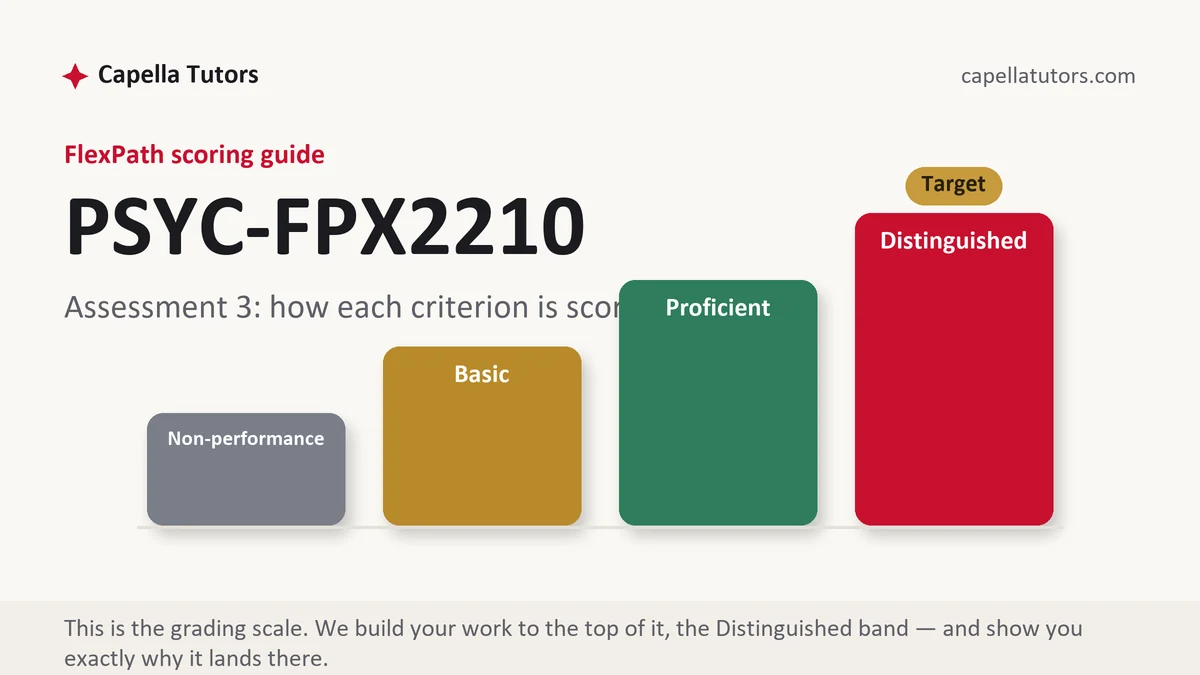
How PSYC FPX 2210 Assessment 3 is scored
Nothing here is graded on a letter or a curve. Each criterion is placed at one of four levels, and the level text is what you write toward:
| Level | What it means on an application or recommendation |
|---|---|
| Distinguished | The change is small enough for a named person to make, the mechanism it depends on is borrowed from a construct with research behind it, and the writer states the outcome that would show it worked along with the cost if it backfires. |
| Proficient | A sensible recommendation supported by theory. Workable, and offered with no way to tell whether it worked. |
| Basic | Advice about using social media less, addressed to nobody in particular. The most common ending written in this course. |
| Non-performance | A required element is missing, most often the link running from the recommendation back to the evidence. |
The row students underrate is the one about limits. A proposal that names the way it could go wrong reads as thought through, and the guide usually pays for that sentence twice, once in the recommendation row and once in the evaluation row.
The PSYC FPX 2210 Assessment 3 method, step by step
-
Start from an outcome somebody actually wants moved
Sleep, attendance, replies after midnight, whether new members post at all. Name the outcome and the person who cares about it before choosing a construct, because a recommendation with no owner has nowhere to land.
-
Pick the mechanic you could realistically change
Some features are settings and some are business models. A read receipt, a notification schedule and a pinned post can be changed by a moderator this afternoon; the ranking model cannot be, and saying which is which is part of the analysis rather than an aside.
-
Borrow the mechanism, then predict the direction
Say why the change should work in the construct's own terms, then commit to the direction of the effect before you go looking for support. A prediction made in advance can be tested, while a prediction assembled afterward reads as decoration.
-
Write the change as an instruction
Who does what, to which setting, starting when, and for how long. If the sentence cannot be handed to somebody without translation, what you have written is still a wish.
-
Name the measure and the counter-effect
State the number that should move, where it comes from and over what period, then name what the change might cost. Turning receipts off may calm a thread and also hide who has seen an urgent message, and the writer who says that first keeps the evaluation row.
-
Hold the ethics line, then self-score
Keep other people's messages out of the paper unless names and handles are stripped, and say what you deliberately did not look at. Then self-score every criterion D, P, B or N, and fix whatever falls short before you submit.
A structure that maps to the criteria
The targets below are planning figures our tutors use for a proposal of this length rather than Capella rules; give the extra words to whichever row your guide weights hardest.
| Section | What it must do | Guide word target |
|---|---|---|
| Introduction | The group, the outcome, and the recommendation itself stated plainly in the opening. | ~150 words |
| The situation described | What happens now, in observable detail, and which mechanic is doing the work inside it. | ~200 words |
| The construct behind the change | The mechanism the recommendation depends on, credited to the literature it came from. | ~250 words |
| The evidence and its size | What research supports the mechanism, how large those effects were, and what the studies actually measured. | ~300 words |
| The recommendation | The instruction, the owner, the period, the measure that should move, and the cost of being wrong. | ~300 words |
| Limits, ethics and references | What the proposal cannot fix, the de-identification you applied, current APA matched both ways. | as needed |
Annotated sample excerpt
An original model closing from our team, written to show a recommendation that carries an owner, a measure and an honest cost.
The recommendation is narrow: the officers turn read receipts off in the club's 40-member group thread for six weeks and move announcements to a pinned post they control.1 The mechanism is obligation rather than distraction. A visible confirmation that a member has seen a message converts an unanswered question into a refusal, and the members who feel that most are the ones already checking the thread after midnight.2 Two numbers should move inside the six weeks, the count of messages sent between midnight and four and the number of distinct members who post at least once, and if the second falls while the first does the change has bought quiet at the price of participation, which the officers deserve to hear before they vote rather than after.3
- 1Names the owner, the setting, the group and the period in one sentence. An evaluator can picture somebody doing this on Monday morning.
- 2States the mechanism in the construct's own terms and points it at the people most exposed to it, which is where the theory row is won.
- 3Commits to two measurable outcomes and volunteers the trade-off before anybody asks for it. Predicting how your own proposal could fail is the top-level move.
The full premium sample for your exact assessment, written fresh to your scoring guide and issue, is free to request. Study it, revise it into your own voice, and submit work you understand.
The five mistakes that cost Distinguished
- Use social media less, offered as the recommendation. It carries no owner, no measure and no mechanism, and the row it answers asks for all three.
- A mechanism assumed rather than named. The change has to work through something, and that something belongs to a construct with research standing behind it.
- A measure with no source and no period. If nobody could collect the number, the recommendation cannot be evaluated, and the guide will say exactly that.
- Effects promised at a size no study reported. The research in this area is full of modest effects, and inflating them costs the evidence row outright.
- The trade-off left for the reader to notice. Every change takes something away, and naming the loss yourself is worth more than pretending there is not one.
Pre-submission checklist
- The outcome and the person who wants it moved are both named
- The mechanic being changed is one somebody has the authority to change
- The mechanism traced to a construct and to the researchers who proposed it
- Effect sizes reported at the modest scale the studies actually found
- One measure with a source and a period, plus the trade-off stated out loud
- Examples de-identified, references matched both ways, every criterion self-scored D
Recommendation due and the advice still sounds like a poster?
Send the criteria, the group you are writing for and the outcome you want to move. We build the proposal around a mechanic somebody can actually change, size the evidence to what the research found, and put the trade-off in the draft. Premium original sample in 24 to 48 hours, free revisions until it clears.