This manual is for PSYC FPX 2210 Assessment 2, start to submission. The second deliverable in this course usually moves from describing research to judging it: take a study, or a pair of studies, about platform use and some outcome, and report what the design can support and what it cannot. Retelling the abstract is what the Basic column looks like. Below is how our research desk reads a method section, the sections that satisfy the criteria, and an annotated excerpt with the numbers reported honestly. Prefer to hand it over? A premium original sample built around the study your prompt names returns in 24 to 48 hours, with free revision until the criteria clear. Capella's catalog lists the course as PSYC-FPX2210, and some courserooms print PSYC2210; both point to this same Assessment 2.
One honesty note before the manual: Capella revises courses and scoring guides over time, so always write to the exact scoring guide attached to your assessment in the courseroom. The course identity above is verified on capella.edu; the method and structure below are our tutors' approach to it, not Capella's official rubric text.
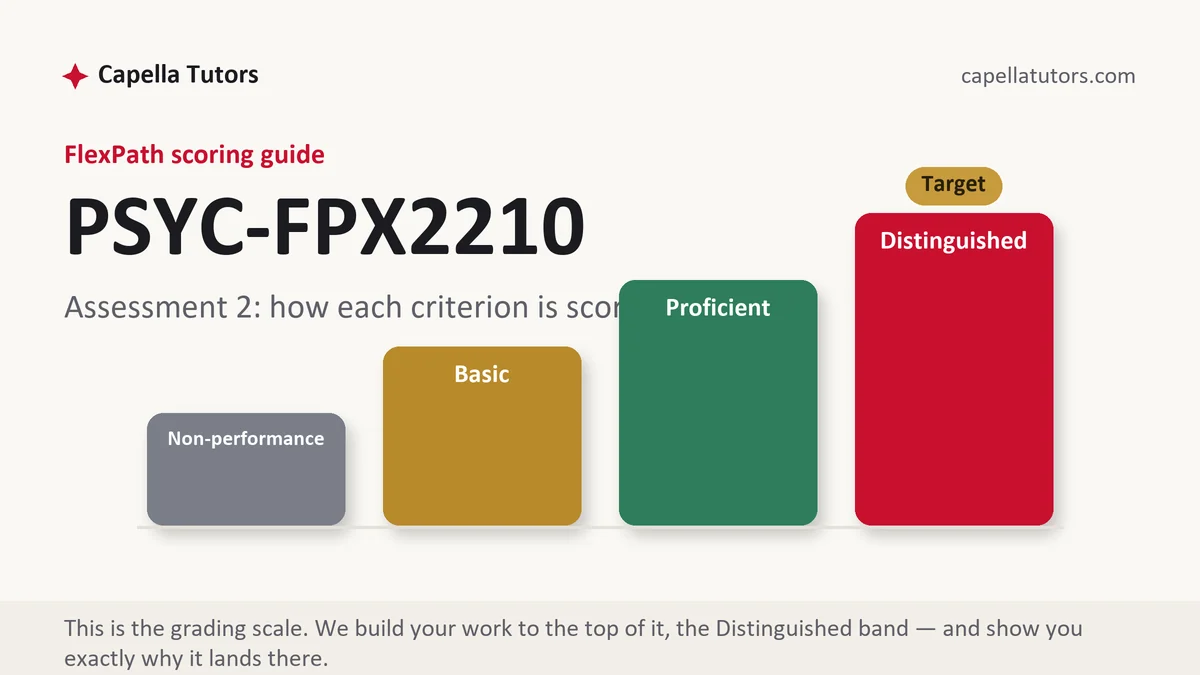
How PSYC FPX 2210 Assessment 2 is scored
There are no letter grades to chase here. Each criterion is scored at one of four levels, and the wording of the level is the instruction:
| Level | What it means on a research appraisal |
|---|---|
| Distinguished | Design, sample and measurement are audited before any finding is quoted, the effect is reported with the interval around it, and the causal sentence the study earned is written no larger than that. |
| Proficient | The study reported accurately and evaluated in general terms. Correct, with the appraisal stopping where the summary ends. |
| Basic | The abstract retold, significance treated as importance, and the authors' own limitations copied rather than examined. |
| Non-performance | A required element is missing, most often the measurement audit or any statement of what the design cannot show. |
One habit earns more in this row than extra reading ever will: write the sentence your design permits, then stop. Your scoring guide decides how much appraisal it wants, and a modest claim with its interval attached reads as competence rather than as caution.
The PSYC FPX 2210 Assessment 2 method, step by step
-
Read the criterion verbs, then read the method section
Evaluate, critique and compare all ask for judgment, and judgment lives in the method rather than in the discussion. Mark the design, the sample, the measures and the analysis first, and save the authors' conclusions for last so their confidence does not quietly become yours.
-
Separate what was measured from what was asked
A study that asked people how many hours they spend has measured a memory, and remembered use diverges widely from logged use. Say which one your study used in the sentence where you first mention it, because that single distinction is often the entire appraisal.
-
Copy every number out with its denominator and its window
A percentage needs the base it was computed on and a behavioral measure needs the period it was collected over. Twenty minutes in a laboratory and three weeks on somebody's own phone are different windows, and a conclusion built on the first cannot be stretched across the second.
-
Report the effect with an interval, not the p value alone
Give the size of the difference in the unit it was measured in, put the confidence interval beside it, then say what that interval permits. A p value tells you the result would be unlikely if nothing were going on. It does not tell you how large the effect is, whether it matters to anyone, or how probable your hypothesis has become.
-
Write the causal sentence you are entitled to
Random assignment buys a causal claim about the manipulation that was actually delivered, and nothing else buys one. Everywhere else use tracked, predicted, or was associated with, and keep caused for the design that paid for it.
-
Name the study that would settle it, then self-score
Close by describing the design that could answer the question, an experiment or a within-person series running over weeks, and say what stands in the way of running it. Then score yourself against each criterion, D, P, B or N, and rewrite anything short of D before the file goes in.
A structure that maps to the criteria
Treat these targets as our research desk's planning figures for an appraisal, not as Capella requirements; expand the section your own criteria weight most.
| Section | What it must do | Guide word target |
|---|---|---|
| Introduction and the claim under review | The claim in one sentence, where it came from, and how this paper will test whether the evidence carries it. | ~150 words |
| The study described | Design, participants, what was manipulated or observed, and how long the observation lasted. | ~250 words |
| Measurement audit | Each variable, the instrument or log it came from, and whether it captured behavior or a report of behavior. | ~250 words |
| Results reported honestly | The size of the effect, the interval around it, the denominators behind every percentage, and what the p value does not say. | ~300 words |
| What follows and what does not | The causal language the design permits, the rival explanations, and the people the sample does not represent. | ~250 words |
| Limits, ethics and references | The design that would settle the question, the ethical constraint on the data, current APA matched both ways. | as needed |
Annotated sample excerpt
An original model paragraph from our research desk, written to show how numbers get reported by somebody who is not trying to win.
The study randomly assigned 128 undergraduates to read a 900-word passage for twenty minutes either with their own phone notifications live or with the phone silenced in a locker, then tested recall of the passage a day later.1 Recall averaged 61 percent correct in the silenced condition and 54 percent with notifications live, a gap of 7 percentage points with a 95 percent confidence interval running from 2 to 12, and the reported p of .01 says the gap would be unlikely if nothing were happening while saying nothing about how large or how durable it is.2 Random assignment earns one causal sentence, that notification exposure lowered next-day recall in this sample of students, and it does not earn a sentence about heavy users, because the study watched a single twenty-minute window and never logged anybody's ordinary use.3
- 1Gives the design, the sample size and the measurement window in one sentence, so a reader can weigh the finding before meeting it.
- 2Reports the difference in the unit it was measured in, attaches the interval, and states what the p value is silent about. This is the sentence the evidence row is hunting for.
- 3Takes the causal claim the design paid for and refuses the larger one, naming the window as the reason. Restraint written out scores better than a paragraph of hedging.
The full premium sample for your exact assessment, written fresh to your scoring guide and issue, is free to request. Study it, revise it into your own voice, and submit work you understand.
The five mistakes that cost Distinguished
- Significance read as importance. A small p value can sit on a difference too slight to matter to anybody, and pointing that out is the appraisal.
- A finding quoted without its measure. Asked and logged are different variables, and no reader can tell which one you meant unless you say so.
- Percentages with the base left out. Seven points of what, out of how many, over how long. Without those three the number cannot be checked by anyone.
- Caused standing where associated belongs. A design without random assignment cannot deliver that verb, and swapping it in is the fastest way to lose a row.
- A sample stretched past its own edges. Undergraduates in a laboratory are not adolescents on their own phones, and the paper has to say so before an evaluator does.
Pre-submission checklist
- Design, sample and measurement written down before any finding is quoted
- Self-report distinguished from logged behavior everywhere both appear
- Every number carries its denominator and the window it was collected over
- The effect reported with an interval, and the limits of the p value stated
- Causal verbs used only where random assignment supports them
- The study that would settle the question named, and every criterion self-scored D
Appraisal due on a study you have already read four times?
Send the prompt, the criteria and the article. Our research analyst audits the method line by line, then two quality passes check that every number in the draft carries its interval and its window. Premium original sample in 24 to 48 hours, revised free for as long as the guide asks.