This manual is for PSYC FPX 2210 Assessment 1, start to submission. The opening deliverable in Introduction to Psychology of Social Media usually asks for the smallest complete piece of work this subject has: one platform mechanic described precisely, one psychological construct fastened to it, and research behind the fastening. Writing about social media in general is the trap, and the criteria are built to catch it. Below is the order our tutors work in, the sections that satisfy the criteria, and an annotated excerpt from an original model. Prefer to hand it over? A premium original sample written to your own scoring guide comes back in 24 to 48 hours, revised free until the criteria clear. Capella's catalog lists the course as PSYC-FPX2210, and some courserooms print PSYC2210; both point to this same Assessment 1.
One honesty note before the manual: Capella revises courses and scoring guides over time, so always write to the exact scoring guide attached to your assessment in the courseroom. The course identity above is verified on capella.edu; the method and structure below are our tutors' approach to it, not Capella's official rubric text.
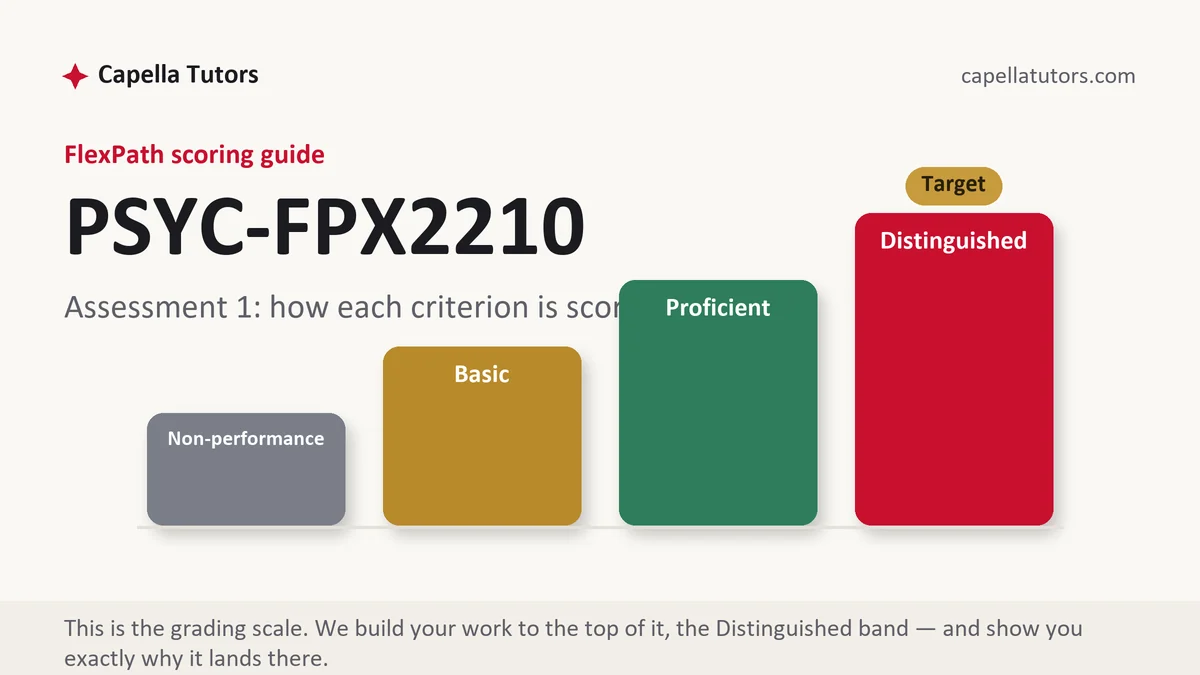
How PSYC FPX 2210 Assessment 1 is scored
FlexPath hands out no letter grades. Every criterion lands on one of four levels, and the wording of the level is your writing brief:
| Level | What it means on a feature and construct analysis |
|---|---|
| Distinguished | The mechanic is described precisely enough that a reader who avoids the platform could picture it, the construct is credited to its own literature, and the claim is bounded by what the cited studies actually measured. |
| Proficient | Feature and construct correctly paired and supported. Accurate, and asserted with more confidence than the evidence carries. |
| Basic | A verdict about social media with a construct mentioned on the way past. The usual landing spot for a first attempt in this course. |
| Non-performance | A required element is absent, most often the research support or any account of what the feature actually does. |
Your scoring guide decides which criteria carry the most weight, so read the evidence row before anything else. It is where careful students give marks away, because a sized claim looks less impressive on the page than a confident one and scores higher.
The PSYC FPX 2210 Assessment 1 method, step by step
-
Turn the criteria into headings before you pick a topic
Copy each criterion into an empty document as its own heading and park the Distinguished wording underneath it. The assessment usually asks for description, theory, evidence and limits, and those four words name four different jobs. Whatever sits outside those headings earns nothing.
-
Name one mechanic, not a platform
A platform is a bundle of features and cannot be analyzed all at once. Choose a single thing the interface does and write it as a rule: what the user sees, when it appears, and what changes the moment they act. A mechanic written as a rule can be tested, and a platform written as a mood cannot.
-
Borrow a construct that already owns a literature
Choose the construct because its mechanism matches your mechanic, then credit it to the researchers who proposed it rather than to the chapter that summarized them. Comparison processes, self-presentation, parasocial attachment and intermittent reinforcement each arrive with decades of work attached, and that attached work is what your evidence row is graded against.
-
Write the mechanism as a sequence
Put the steps in order: the feature does this, the user notices that, the noticing produces this response. A mechanism written as a sequence can be checked at every joint, which is what an evaluator does while reading your theory section. An adjective cannot be checked at all.
-
Size the evidence before you lean on it
For every study, write down the design, who was in the sample and how the behavior was captured, then put the size of the finding inside the sentence that reports it. Hours people remember and hours a device logged are two different variables, and a draft that treats them as one has lost the row it was trying to win.
-
Bound the claim, then self-score
Finish by naming what your evidence cannot settle, the direction included, since low mood is a reason to open an app as readily as a result of having opened one. Then grade yourself against the guide one criterion at a time, D, P, B or N, and rewrite anything under D. Submit early in the week, because an evaluation can take two business days.
A structure that maps to the criteria
These word targets are our tutors' planning figures for an analysis of this size, not Capella rules; stretch whichever section your own guide weights hardest.
| Section | What it must do | Guide word target |
|---|---|---|
| Introduction | The platform, the one mechanic, and the question this paper answers, with the answer previewed in the closing sentence. | ~150 words |
| The mechanic described | The feature written as a rule a stranger could follow, including what the user sees and the moment they see it. | ~200 words |
| The construct and its mechanism | The construct, the people who proposed it, and the steps by which it says the feature produces the effect. | ~300 words |
| The research | Each study with its design, sample and measure stated before the finding, and the size of the finding given rather than implied. | ~350 words |
| Bounds and alternatives | What the evidence cannot show, the reverse direction, and the groups the pattern may not describe. | ~250 words |
| Ethics and references | Any real content de-identified, a stated boundary on what you looked at, current APA matched both ways. | as needed |
Annotated sample excerpt
An original model opening from our team. It is study material rather than a submission: take the moves it makes, then write the version that belongs to your own platform.
A streak counter is a small number beside a contact's name that rises by one on any day the two of you exchange a message and drops to zero the moment a day closes without one.1 Two details make it worth a psychologist's attention: the number is shown to both people, so letting it lapse is visible to the one person who would notice, and the app warns the pair as the day runs out.2 This paper treats that counter as a commitment device, explains it with intermittent reinforcement and with the asymmetry between losing something and gaining it, and reports how little of the well-being research speaks to a feature this specific.3
- 1Writes the mechanic as a rule instead of as a mood. A reader who has never opened the app now knows what the feature does and when it does it.
- 2Adds the two details that give a construct something to hold, visibility to another person and a deadline. Specific beats broad in every row of this guide.
- 3Names the constructs and concedes the evidence gap in the same breath. Volunteering the gap early is the move the top level pays for, and it costs nothing.
The full premium sample for your exact assessment, written fresh to your scoring guide and issue, is free to request. Study it, revise it into your own voice, and submit work you understand.
The five mistakes that cost Distinguished
- An opinion about phones dressed as a thesis. The theory row needs one named feature to fasten itself to, and a verdict about social media in general gives it nothing to hold.
- Screen time treated as a single behavior. Posting, scrolling and messaging come apart in the data, and collapsing them is how a real finding disappears.
- A construct credited to the course text. The people who proposed these ideas are named in your chapter, and the citation row expects their names in yours.
- A number carried in without its sample or its year. A percentage with nothing behind it earns nothing in the evidence row, however striking it looks on the page.
- Somebody's post quoted with the account attached. The author never volunteered as a participant, and stripping the identifying detail is part of what is being graded.
Pre-submission checklist
- Every criterion from the guide has its own heading in the draft
- One platform and one mechanic named inside the opening paragraph
- The construct attributed to the researchers who proposed it
- Design, sample and measure stated for each study before its finding
- The reverse direction named out loud, plus one group the pattern may not fit
- Quoted examples de-identified, references matched both ways, every criterion self-scored D
First social media analysis due this week?
Send the criteria and tell us which platform you actually use. A research analyst picks the mechanic and the construct with you, then the eight-person pipeline returns a premium original sample with every claim sized to what the studies measured. Back in 24 to 48 hours, revised free until the guide is satisfied.