Send the prompt and the scoring guide and a premium original sample comes back inside 24 to 48 hours, built criterion by criterion, with a walkthrough showing where each Distinguished move was placed, and revisions free until the score lands. The identity of the course: PSYC FPX 2002, The Skillful Psychology Student, worth 3 program points, a core course in Capella's FlexPath BS in Psychology that the catalog places in the first quarter and closes to transfer credit and prior learning assessment. It is the one requirement you cannot bring with you into a degree that otherwise takes transfer credit toward its 90-point minimum. In Capella's catalog the course code is written PSYC-FPX2002.
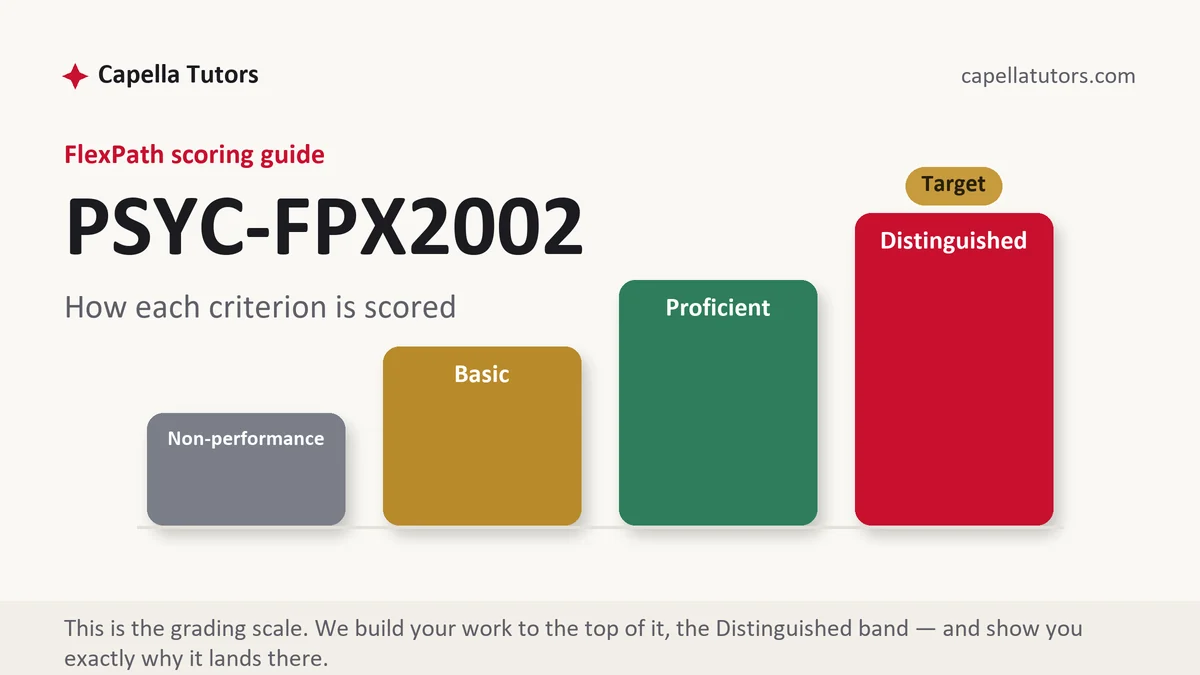
What PSYC FPX 2002 actually grades
This course grades the habits every later course assumes you already have, which is why it sits where it sits. A degree that lets general education and elective points arrive from other transcripts keeps this one in the first quarter and off the transfer list, and that placement tells you the school treats it as the course that makes everything after it gradable. From here on, assessments are scored as though you can already find a study, read it, represent it accurately and format the result.
Three families of skill carry the criteria. The first is source work: searching the library rather than the open web, telling a peer-reviewed empirical article from a magazine feature or a marketing page, and judging whether a source sits close enough to your question to earn a place in the paper. The second is reading: getting the argument out of an article efficiently and without distortion. The third is production, meaning paraphrase, citation, reference construction and the formatting rules that carry their own line on the guide.
Around those sit the professional foundations, and they are graded as content rather than as filler. Expect the ethics code treated as a working document, a realistic account of what a bachelor's degree in psychology does and does not qualify you to do, and a self-assessment or goal element where the marks go to specificity. A plan to improve time management scores Basic. A plan that names the writing stage where you lose the time, the change you will make, and the date you will check it scores well above that.
The scoring guide itself is course content here, which students tend to discover late. Four levels sit behind every criterion, Non-performance, Basic, Proficient and Distinguished, and the wording moves in a predictable direction across the row. Learn to read that movement in this course and the rest of the degree gets measurably cheaper, because the same table shape is waiting in every course after it.
How we help in this course
A 3 point first-quarter course is worth doing properly, so work here comes with the method attached. The sample arrives with a walkthrough written as a lesson in criterion anatomy, showing which sentence answers which criterion and which sentence exists only to satisfy the extra act the top column names. Students who read that walkthrough beside the draft need visibly less help by the time the upper-division courses arrive, which is the right outcome to buy in a course whose entire purpose is transferable skill.
Pacing advice belongs here too, since this is the first quarter. FlexPath bills in flat 12-week sessions, allows up to two courses at a time, and lets you submit when the work is ready rather than on a calendar date. A student who clears this course early in a session has effectively bought the remainder of that session for the next one, while a student who lets it sit has paid for weeks that produced nothing. Each deliverable comes back inside 24 to 48 hours through the eight-person pipeline with both quality passes, revised free until the criteria clear.
The assessments, one by one
Assessment 1
The opening deliverable in The Skillful Psychology Student usually asks you to find sources and then prove you can tell them apart: a search somebody else could repeat, a handful of entries in current APA, and an annotation for each that says what the study did, what job it does in your paper, and. Read the full Assessment 1 manual.
Assessment 2: CRAAP Test and Library Worksheet
Evaluate an internet source with the CRAAP test, then find and evaluate a scholarly source through the Capella library. Read the full Assessment 2 manual.
Assessment 3
The closing deliverable in The Skillful Psychology Student usually turns the course back on you: a short reflective paper about your own skills, your professional standards, or where this degree can and cannot take you, marked by criteria that pay for specifics and have nothing to give for sincerity. Read the full Assessment 3 manual.
How to actually write PSYC FPX 2002: where to begin
Read the guide as a table rather than as prose. Copy the criteria into a document, one per line, and underline the verb in each one. Then read across the row from Basic to Distinguished and find the word that changes, because that word is the whole difference in score. Usually Basic describes, Proficient explains and applies, and Distinguished adds one further act: an evaluation, a comparison, a justification, or a stated limitation. Write the changing word at the top of the section you are about to draft. It is the paragraph you would otherwise forget, and the one the criterion is paying for.
Then work out which kind of deliverable you are being asked for, because psychology assessments come in a small number of shapes and each wants a different opening. A summary wants the study's question, design and finding in that order. An application wants a construct, a case, and the mapping between them. An appraisal wants your criteria stated before your verdicts. A reflection wants evidence about yourself handled with the same discipline as evidence about anyone else. Identify the shape from the verb in the criterion rather than from the title of the assessment, because the title is usually the friendlier of the two and the criterion is the one being scored.
The reading skill has a fixed order that saves hours. Read the abstract for the question and nothing else. Then go to the method section rather than the results and settle three things: who the participants were, what design was used, and how the outcome was measured. Only then read the results, because a finding means something different depending on all three. Read the discussion last and treat it as the authors' interpretation rather than as their data, since a discussion routinely reaches further than a design allows. The limitations paragraph is the most useful part of most articles and the part students skip, and quoting a study's own stated limitation is the cheapest way to show you actually read it.
APA at the bachelor's level is a short list of decisions you make once. A student paper takes the student title page, carrying the title, your name, the department and school, the course, the instructor and the due date, and it needs no running head unless your instructor asks for one. Body text is double spaced with a first-line indent, and the reference list starts on its own page with hanging indents. Article and book titles take sentence case while journal names take title case and italics, and a DOI is given as a full https link. In the text, the choice between the two citation shapes follows the job of the sentence: the author's name belongs inside your own syntax when you are describing what researchers did, and the whole citation belongs in parentheses at the close when the sentence is your claim and the source is only its warrant. Three or more authors collapse to the first surname and et al. from the very first mention rather than from the second, a rule students often carry in wrongly from an older edition. A paraphrase does not require a page number, though offering one is a courtesy, and a direct quotation always does.
| Section | What goes in it | What Distinguished looks like |
|---|---|---|
| Title page and format | The student title page, spacing, and headings at the levels your guide names. | Formatting correct before the first read, so the communication criterion is banked early. |
| The question or goal | The question the paper answers, or the goal the plan sets, in one sentence. | A question answerable with sources you can actually reach, or a goal with a date attached. |
| Search and appraisal | The databases searched, the terms used, and why each source survived the cut. | Search decisions made visible, including one source rejected for a stated reason. |
| What the sources say | Each source represented in its own terms, with design and sample before findings. | Accurate representation, including a finding that complicates your own position. |
| Application to your work | The skill, plan or judgment applied to your actual coursework or career step. | A specific change to a specific practice, plus how you will know it worked. |
| Integrity and references | Paraphrase in your own syntax, citations matched both ways, current APA throughout. | Paraphrase that restructures rather than reworded phrases, and a reference list with no orphans. |
Developing the synthesis
Synthesis in this course usually means turning a list into a relationship, and the trap has a name. The annotated summary reads as three paragraphs, one per source, each accurate and none connected, and it collects Basic every time because the criterion asked for integration and received an inventory. The repair is structural: organize by idea instead of by source. Give the paragraph a claim, bring in whichever sources bear on it, and state the bearing. Two sources that agree are worth one sentence saying they converge and why that matters. Two that disagree are worth a paragraph, because the disagreement is where your judgment becomes visible, and judgment is what the top column keeps asking for. Close the section by saying which source you would trust if forced to choose, with the reason given in terms of design or sample rather than preference.
Citations that survive faculty review
Search where the sources actually are. The Capella library carries the psychology databases, PsycINFO and PsycArticles among them, and one filtered search there returns what an open-web search never will. Peer-reviewed empirical articles and peer-reviewed reviews carry research claims, and a review or meta-analysis is the stronger citation whenever your claim is about a body of work rather than about one study. The American Psychological Association supplies the ethical principles and code of conduct along with the style rules, and both are citable in their own right. For the career material this course tends to include, the Occupational Outlook Handbook from the Bureau of Labor Statistics is the appropriate source, with its year given, since projections date quickly. Cite what you read and nothing else. Where a source is genuinely unavailable and reachable only through another author's description, the as-cited-in construction exists for that case, and using it honestly beats implying a reading you did not do.
The mistakes that land Basic instead of Distinguished
- Patchwriting. A sentence carrying the author's structure and your synonyms is not a paraphrase, and it is the originality problem this course exists to prevent.
- The scoring guide opened after drafting. A finished paper reorganized to fit criteria shows the seams, and one criterion always ends up unanswered.
- A discussion section cited as a finding. What the authors concluded and what their data showed are different claims, and merging them costs the accuracy criterion.
- A reference list with orphans. An entry nobody cited, or a citation with no entry, is the most common revision trigger in a skills course.
- A goal with no date and no measure. Self-assessment criteria pay for specifics, and improve my writing is not a specific.
PSYC FPX 2002 questions students actually ask
Can I transfer PSYC FPX 2002 in, or test out of it?
No. The catalog places this course in the first quarter of the BS in Psychology and closes it to both transfer credit and prior learning assessment, so it has to be taken inside the program even if you arrive with a full transcript and years of professional writing behind you. Plan around it rather than against it. It is a 3 point course, it runs in FlexPath, and clearing it early in a billing session leaves the rest of that session for whatever you pair with it. Confirm the detail against your own catalog year and enrollment agreement, since requirements are published per catalog.
What actually counts as a scholarly source?
Four tests, and a source has to pass all of them. It reports or reviews research rather than opinion. It went through peer review, which the database will tell you. It names its methods, so you can see who was studied and how. And it is close enough to your question that you can state in one sentence what job it does in your paper. A trade magazine article about a study is not the study. A textbook is a good source for definitions and a weak one for findings. A .org address is a publisher rather than a category, so judge the organization and the document instead of the domain.
How do I paraphrase without triggering an originality flag?
Change the structure, not the words. Read the passage, close it, write what it said from memory in your own sentence order, then check the result against the original for accuracy rather than for overlap. If your version still tracks the author's clause order, you have reworded instead of paraphrased, and a similarity report will say so. Cite the paraphrase either way, because the citation is owed to the idea and not to the wording. Where the author's exact phrasing genuinely matters, quote it, keep it short, give the page, and explain why that phrasing was worth preserving.
First quarter and already behind?
Send the prompt with the scoring guide attached. The sample arrives with the criterion walkthrough beside it, so the method transfers to the next course. First premium sample free.