This manual is for PSYC FPX 2002 Assessment 1, start to submission. The opening deliverable in The Skillful Psychology Student usually asks you to find sources and then prove you can tell them apart: a search somebody else could repeat, a handful of entries in current APA, and an annotation for each that says what the study did, what job it does in your paper, and why it survived the cut. The criteria mark your search and your judgment rather than your interest in the topic. Below is the method our tutors use on it, a structure pulled from the criteria, and an annotated excerpt. Want this one handled for you? A premium original sample for your exact prompt is ready within 24 to 48 hours, revised free until the criteria are met. Capella's catalog lists the course as PSYC-FPX2002, and some courserooms print PSYC2002; both point to this same Assessment 1.
One honesty note before the manual: Capella revises courses and scoring guides over time, so always write to the exact scoring guide attached to your assessment in the courseroom. The course identity above is verified on capella.edu; the method and structure below are our tutors' approach to it, not Capella's official rubric text.
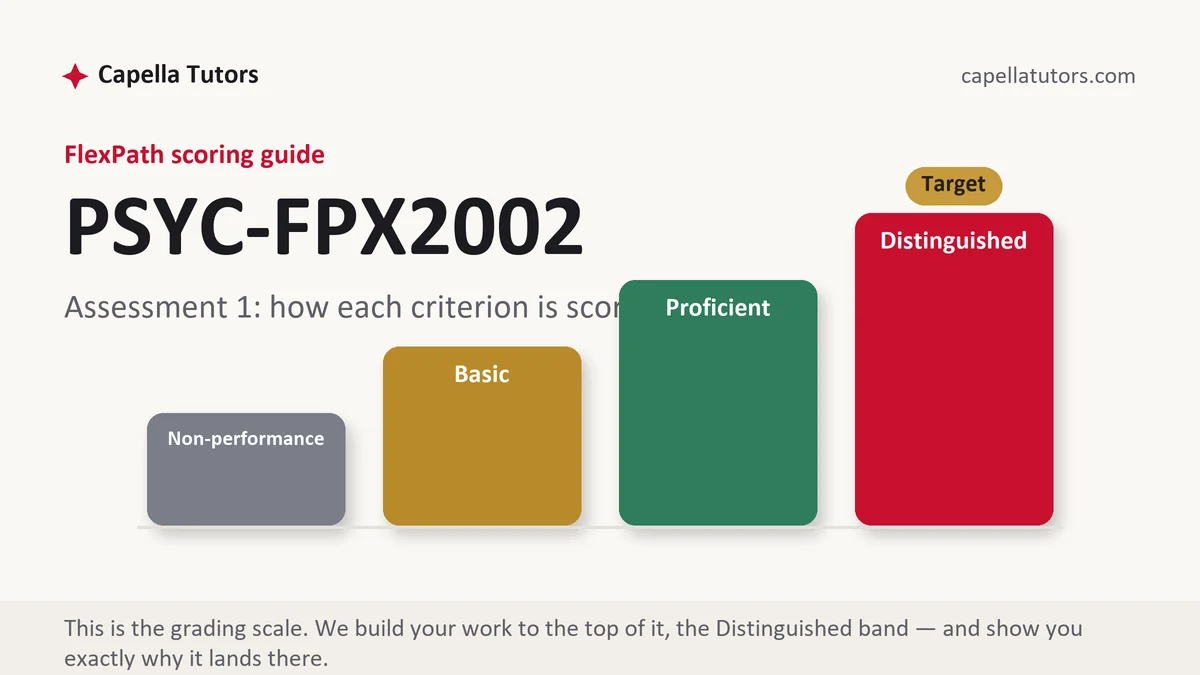
How PSYC FPX 2002 Assessment 1 is scored
The guide is a table, not an essay prompt. Each criterion is marked at one of four levels, and reading across the row shows you which act the level above yours is paying for:
| Level | What it means on an annotated bibliography |
|---|---|
| Distinguished | The search is visible, databases, terms and limits included; each annotation opens on design and participants; each entry states the job it does; and at least one rejected source is reported with the reason it was rejected. |
| Proficient | The sources are appropriate and annotated accurately in correct APA. Complete work, quieter than the column above about how any of it was chosen. |
| Basic | Abstracts reworded underneath correct-looking entries, with nothing said about design, fit, or why these sources rather than others. |
| Non-performance | A required part is missing, most often the appraisal or the description of the search itself. |
Placement is a hint about purpose. This is a first-quarter requirement the catalog closes to transfer credit, so the deliverables inside it are the ones the school wants done in-house, with the source habits installed rather than assumed. Write this one as though the next twelve courses were watching, because their criteria will take for granted that you can already do it.
The PSYC FPX 2002 Assessment 1 method, step by step
-
Write the question before you search anything
A question decides which sources count. Whether writing notes by hand supports later recall better than typing them is answerable; note-taking is not. Put the question in one sentence at the top of the document, then let it do the rejecting for you, because a search with no question behind it returns everything and settles nothing.
-
Search where the psychology actually is
The Capella library carries the psychology databases, PsycINFO and PsycArticles among them, and one filtered search there returns what a general web search never will. Record the database, the exact terms, the limits and the number of records at each step, because the criterion usually wants that record rather than your assurance that you looked.
-
Put every candidate through four tests
A source stays if it reports or reviews research rather than opinion, if it went through peer review, if it names its methods so you can see who was studied, and if you can say in one sentence what job it does in your paper. The fourth test is the one that fails most candidates, and it is the one students argue with hardest.
-
Lead each annotation with the design
Open on what was done and to whom: assigned or surveyed, how many people, measured how. The finding belongs after that, because what a finding means depends entirely on the sentence in front of it. Two or three sentences of design and participants is not padding, it is the part being marked.
-
State the job, then state the limit
Give each entry one sentence naming its function, establishes the problem, carries the mechanism, supplies the evidence against you, and one sentence naming what it cannot do. An annotation that admires a study has told an evaluator nothing they are allowed to score.
-
Build the entries by rule, then letter the guide
Reference formatting is a short list of decisions made once: sentence case for article titles, title case and italics for journal names, hanging indents, three or more authors collapsing to et al. from the first mention, and a DOI written as a full https link. Check each entry against that list, then letter every criterion before you upload.
A structure that maps to the criteria
Planning targets from our tutors for an undergraduate bibliography of five or six sources. Your guide sets the source count; these numbers only budget the words.
| Section | What it must do | Guide word target |
|---|---|---|
| The question | One sentence naming what these sources were gathered to answer. | ~60 words |
| The search, described | Databases, search terms, the limits applied, and how many records survived each one. | ~200 words |
| Entry and annotation | The APA entry, then design and participants, the finding, the job the source does, and its limit. | ~150 words each |
| The source you rejected | One candidate you did not keep, with the reason given in terms of design or fit rather than taste. | ~120 words |
| Synthesis note, where asked | Where the sources agree, where they part company, and which you would trust if forced to choose one. | ~200 words |
| Format | Current APA throughout, alphabetical order, hanging indents, entries and annotations consistent with each other. | as needed |
Annotated sample excerpt
One annotation of ours, written the way the top column describes. The topic is a placeholder; the sequence of sentences is the lesson.
The search that produced this entry ran in PsycINFO with the terms note-taking AND (longhand OR laptop) AND recall, limited to peer-reviewed work from the last fifteen years, which returned 41 records; a further limit to studies that measured recall rather than student satisfaction left nine.1 Entry three of those nine is an experiment that assigned undergraduates to take notes on a laptop or by hand during the same recorded lecture, then tested them thirty minutes later on factual items and on conceptual ones.2 It belongs in this bibliography because it varied the medium rather than surveying students who had already chosen one, which is the design my question needs; its limit is that a single lecture and a same-day test say nothing about a term of coursework, and the candidate I rejected reported the same comparison from a satisfaction survey with no memory measure in it at all.3
- 1The search is visible: database, terms, limits, and how many records survived each one. This is the criterion most students try to answer with the word research.
- 2The annotation opens on design and participants, so a reader knows what kind of claim this source is able to make before they are told what it found.
- 3The job the source does is stated in one clause, the limit in another, and a rejected candidate arrives with its reason. That last move is usually the extra act the top column is describing.
The full premium sample for your exact assessment, written fresh to your scoring guide and issue, is free to request. Study it, revise it into your own voice, and submit work you understand.
The five mistakes that cost Distinguished
- The abstract, reworded. An annotation that follows the author's clause order with your synonyms in it is patchwriting with a citation attached, and preventing that is part of why this course exists.
- No design in the annotation. Without the sample and the method, a finding is a rumor, and the appraisal criterion has nothing to take hold of.
- Sources with no stated job. Six entries in a row with nothing said about function read as a list somebody collected rather than a set somebody chose.
- Peer review assumed. The database answers that question in one click, and a trade magazine's write-up of a study is not the study.
- Entries formatted from memory. Italics, sentence case and hanging indents each carry part of the communication criterion, and they are the cheapest marks on the page to collect.
Pre-submission checklist
- The question written in one sentence before the first source appears
- Database, search terms, limits and record counts all reported
- Every annotation opens with design and participants
- Every entry names the job it does in the paper, plus one limit
- One rejected candidate reported with the reason it was rejected
- APA entries checked item by item, alphabetical, hanging indents, each criterion self-lettered D
First quarter, and the library is new?
Send the prompt and the scoring guide. A team of eight, including a research analyst and two QA reviewers, returns a premium original sample in 24 to 48 hours with the search recorded and every annotation leading on design, plus a walkthrough showing which sentence answers which criterion, revised free until the criteria clear.