This manual is for PSYC FPX 2002 Assessment 3, start to submission. The closing deliverable in The Skillful Psychology Student usually turns the course back on you: a short reflective paper about your own skills, your professional standards, or where this degree can and cannot take you, marked by criteria that pay for specifics and have nothing to give for sincerity. Most of this manual walks the scoring guide itself, because reading the guide is the skill the deliverable is quietly testing. Want a model to work from? A premium original sample built to your own criteria is with you inside 24 to 48 hours, revised free until every line lands. Capella's catalog lists the course as PSYC-FPX2002, and some courserooms print PSYC2002; both point to this same Assessment 3. In current courserooms this assessment typically appears as "College Planning Reflection".
One honesty note before the manual: Capella revises courses and scoring guides over time, so always write to the exact scoring guide attached to your assessment in the courseroom. The course identity above is verified on capella.edu; the method and structure below are our tutors' approach to it, not Capella's official rubric text.
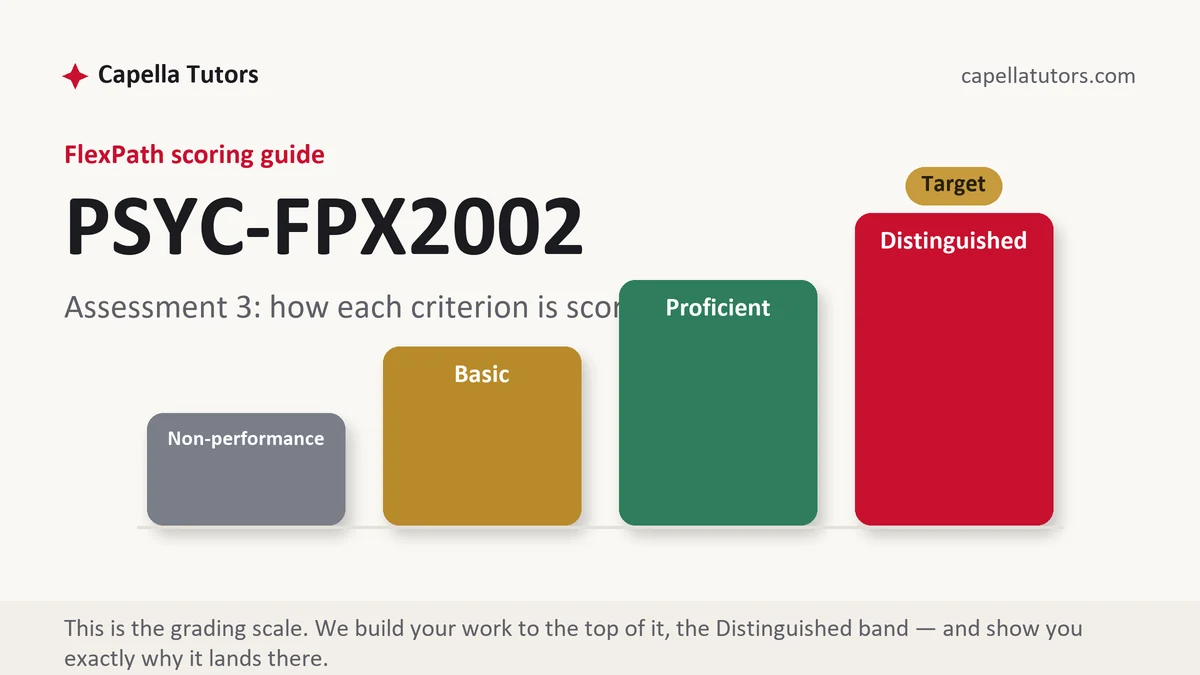
How PSYC FPX 2002 Assessment 3 is scored
Every criterion is marked on its own, at one of four levels, and on a reflective paper the levels sort almost entirely by specificity:
| Level | What it means on a reflective paper |
|---|---|
| Distinguished | Evidence about you is handled with the discipline you would give evidence about anyone else: an observation you can point at, a claim it supports, a goal carrying a date and a measure, and a source wherever the criterion asks for one. |
| Proficient | Honest, specific reflection with a plan attached. Complete, and missing the means of evaluating progress the column above names. |
| Basic | Sincere general statements, manage my time better, become a stronger writer, with nothing dated and nothing measurable underneath them. |
| Non-performance | A required part is absent, most often the plan, the source, or the professional standards element. |
A reflective paper is where students discover that sincerity is not a criterion. What gets marked is whether the evidence about you is treated as evidence: something you can point at, a claim it supports, and a way to tell later whether anything changed. Read across your own row, find the act the top column adds, and make that act on purpose in a sentence you could point to afterward.
The PSYC FPX 2002 Assessment 3 method, step by step
-
Read across the row before you write down the page
Copy the criteria into a document, one per line, then read each row left to right until you find the word that changes. That word is the assignment. A criterion whose top column adds justify wants a reason for a decision; one that adds evaluate wants a judgment with a standard behind it. Put the word above the section and draft toward it.
-
Turn the prompt's shape into the outline
A reflection wants evidence about yourself, an appraisal wants standards stated before verdicts, and a plan wants a change with a date. Work out which shape you are being asked for from the criterion's verb rather than from the assignment's title, because the title is the friendlier of the two and the criterion is the one carrying the marks.
-
Diagnose before you resolve
A goal is worth only as much as the observation behind it. Where does the time actually go, which stage of the writing collapses, which week did the late attempts fall in. One diagnosed sentence outscores a paragraph of intentions, because a diagnosis is something a criterion can check and an intention is not.
-
Give the plan a change, a measure and a date
Name the single thing you will do differently, the number you will watch, and the day you will look at it. Submission dates logged for every remaining deliverable this session, reviewed on its last Friday, is a plan. Do better next time is not, and self-assessment criteria are unusually blunt about the difference between them.
-
Treat the code and the career data as sources
Where the paper touches professional conduct, cite the ethical principles and code of conduct instead of paraphrasing your impression of them, and where it touches what a bachelor's degree qualifies you to do, use the occupational figures with their year attached. Reflective papers still carry a source criterion, and that is where the easy marks go missing.
-
Read it back as an evaluator, then letter the guide
Ask of every paragraph which criterion it answers. Anything answering none of them is prose you enjoyed writing, and cutting it usually strengthens what is left. Then letter each criterion honestly and submit early in the session rather than at the end of it, since a flat twelve-week bill rewards finishing and pays nothing for waiting.
A structure that maps to the criteria
Word targets our tutors plan with for a short reflective paper. They are not requirements, and any criterion asking for more takes the space it needs.
| Section | What it must do | Guide word target |
|---|---|---|
| Introduction | What this paper is about in your own work, and the question it answers about it. | ~120 words |
| The observation | What you actually did, with dates, counts, or the stage where the trouble reliably appears. | ~220 words |
| The claim it supports | What that evidence lets you say about your own skills, sourced wherever the criterion asks. | ~250 words |
| The goal | One change, written so somebody else could tell whether you made it. | ~200 words |
| The plan and the measure | What you will do, when you will do it, and how you will know it worked, with a date attached. | ~250 words |
| Standards, integrity and references | The professional standard the work sits under, current APA, entries matched to citations both ways. | ~200 words |
Annotated sample excerpt
A model passage of ours, written with the criterion open beside it. That is the habit worth taking, more than the wording.
The criterion asks for a professional development goal with a plan for meeting it, and its top-column wording adds a means of evaluating progress, so this paragraph has three jobs rather than one.1 The goal is to cut the gap between finishing a draft and submitting it from four days to one, because those four days are spent rereading rather than revising, and rereading is where two of my three late attempts last session disappeared.2 The plan names the change, one revision pass against the scoring guide with a printed copy beside the draft, then submission the same evening; the measure is the submission date logged against the date each draft was finished, for every remaining deliverable this session, reviewed on the last Friday of it.3
- 1The criterion is read to itself before the drafting starts, and the extra act in the top column is identified as a third job. That identification is the whole method this course teaches.
- 2The goal is specific and it is diagnosed, so a reader learns where the time actually goes rather than that the writer would like to improve.
- 3A change, a measure and a date. Self-assessment criteria pay for those three and rarely announce it in those words, which is why most first attempts supply none of them.
The full premium sample for your exact assessment, written fresh to your scoring guide and issue, is free to request. Study it, revise it into your own voice, and submit work you understand.
The five mistakes that cost Distinguished
- An undated goal. A plan nobody could check next month is an intention, and intentions have no criterion to land on.
- Sincerity in place of evidence. How much the work matters to you is not on the guide; what you did last week and what you will do differently is.
- A reflection with no sources. Where a criterion mentions professional standards or career prospects, the marks are sitting inside a citation that takes ten minutes to add.
- Paragraphs answering no criterion. Well-written material with no line on the guide to land on is unpaid work, and it usually crowds out something that would have scored.
- The guide consulted last. Retrofitting a finished draft onto the criteria leaves visible joins, and something the guide asked for always turns up in the wrong section.
Pre-submission checklist
- Each criterion's top-column act identified and written above its own section
- One observation with dates or counts standing behind every claim about yourself
- A goal somebody else could tell whether you had met
- A plan naming the change, the measure, and the date you will check it
- Professional standards and career figures cited rather than recalled
- No paragraph without a criterion to land on, APA current, each criterion self-lettered D
Reflective paper that has to score, not just sound honest?
Send the prompt and the scoring guide. A team of eight, including a research analyst and two QA reviewers, returns a premium original sample in 24 to 48 hours with a dated goal, a measure attached to it, and every paragraph pointed at the criterion it answers, revised free until the criteria clear.