This manual is for PSYC-FPX2002 Assessment 2, start to submission. The second deliverable in The Skillful Psychology Student usually hands the searching back and asks for accuracy instead: take an empirical article and represent it in your own words without bending it, in an order that makes the finding readable, with the authors' interpretation kept clearly apart from their data. Reading efficiently is half of what is being marked and paraphrasing honestly is the other half. Our tutors' method follows, with a structure mapped onto the criteria and an annotated excerpt. Rather not gamble on it? Send the article and the guide, and a premium original sample is with you in 24 to 48 hours, with free revisions until each criterion clears. Your courseroom may print this as PSYC FPX 2002 Assessment 2 or PSYC2002 Assessment 2; it is the same deliverable, and PSYC-FPX2002 Assessment 2 is what this manual walks through.
One honesty note before the manual: Capella revises courses and scoring guides over time, so always write to the exact scoring guide attached to your assessment in the courseroom. The course identity above is verified on capella.edu; the method and structure below are our tutors' approach to it, not Capella's official rubric text.
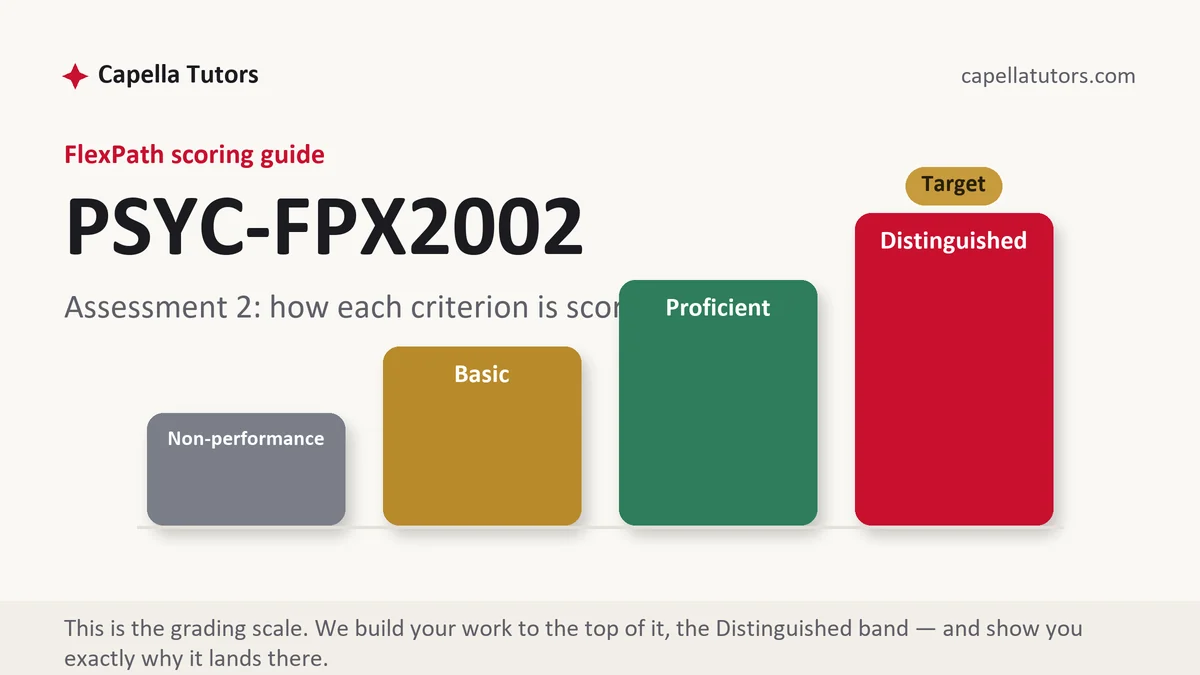
How PSYC-FPX2002 Assessment 2 is scored
Four levels sit behind every criterion, and the word that changes between your level and the one above it is the whole difference in score:
| Level | What it means on an article representation |
|---|---|
| Distinguished | The article is rebuilt in the writer's own structure, participants, design and measure arrive before the result, every number carries its scale, and the discussion is labeled as the authors' interpretation rather than borrowed as evidence. |
| Proficient | An accurate summary, correctly cited, with an appraisal attached. Complete, without the separation of data from interpretation the column above wants. |
| Basic | A walk through the article in the article's own order, with reworded sentences standing in for paraphrase. |
| Non-performance | A required element is absent, most often the appraisal or the description of who took part. |
The reading order that produces an accurate summary is not the order the article was printed in. Abstract for the question, method next, results after that, and the discussion last and treated as argument. Students who read front to back end up summarizing the authors' conclusions instead of their study, which is the accuracy problem evaluators in this course write up most often.
The PSYC-FPX2002 Assessment 2 method, step by step
-
Read in the order that produces accuracy
Abstract once, for the question. Then the method, where three facts live: who the participants were and how they were recruited, what design was used, and how the outcome was measured. Results next. Read the limitations paragraph twice, because the authors have usually already written the appraisal sentence you were about to go looking for.
-
Close the article before you write the paraphrase
Read the passage, shut the file, and write what it said in your own sentence order from memory. Then reopen it and check your version for accuracy rather than for overlap. If your sentences still track the author's clause order, you have reworded rather than paraphrased, and a similarity report will notice before your evaluator does.
-
Put the participants in front of the finding
Who was studied, how they were recruited, how many there were, and how many stayed to the end, all of it ahead of the result. A finding from volunteers on a staff mailing list is a different fact from the same finding in a national sample, and this criterion is scored on whether your reader can tell which one they are holding.
-
Give every number its scale and its direction
A rise of 2.8 points means nothing until the sentence says out of how many, against what comparison, and whether it survived to follow-up. Report the effect size where the authors give one, and where they do not, give the scale so a reader can size it themselves. The plain English sentence goes first and the figures follow it.
-
Separate what they found from what they concluded
The results section is the data. The discussion is the authors arguing about the data, and discussions reach further than designs allow with some regularity. Attribute conclusions to them in your prose, the authors suggest, and keep your own verbs inside what the design can license.
-
Appraise in the study's own terms, then letter the guide
Name the limits that follow from this design, a self-report outcome, volunteers who agreed to a schedule, a short follow-up, rather than the limits that would fit any study anywhere. Then read the criteria one line at a time, letter each honestly, and confirm every citation has an entry and every entry a citation.
A structure that maps to the criteria
Tutor planning targets for a short undergraduate article analysis. They budget words; your scoring guide decides sections.
| Section | What it must do | Guide word target |
|---|---|---|
| Introduction | The article, the question it set out to answer, and what your paper concludes about the weight it carries. | ~130 words |
| Participants and design | Recruitment, sample size, assignment or comparison, and how long the study ran. | ~220 words |
| The measure | What the outcome actually was, and what it is standing in for. | ~180 words |
| The results, in plain English | The finding in ordinary words, then the figures with their scale, comparison and direction. | ~250 words |
| Interpretation, separated | What the authors concluded, attributed to them, and how far the design actually reaches. | ~250 words |
| Appraisal and references | Limits that follow from this design, one strength worth naming, current APA matched both ways. | ~250 words |
Annotated sample excerpt
A model passage from our team, using an invented study so the moves stay visible. Your article will differ; the sentence order should not.
Rivers and Okonkwo (2021) recruited 96 adults from a university staff mailing list and assigned them to write for ten minutes on three evenings a week for four weeks, either about things they were grateful for or about their commute, with well-being measured on a self-report scale at the start, at the end, and six weeks later.1 The gratitude group's average rose by 2.8 points on a 35-point scale while the comparison group's rose by 0.9, a difference the authors themselves describe as small, and the gap had narrowed by the six-week follow-up.2 Their discussion proposes that the practice could support workplace well-being programs, which is their interpretation rather than their result, since staff volunteers who agreed to write three evenings a week are not a general sample and the outcome was what participants said about themselves.3
- 1Recruitment, sample size, assignment, schedule and measure, in the order a reader needs them, with the citation inside the sentence reporting what the researchers did.
- 2Each figure gets a scale, a comparison and a trajectory. A rise of 2.8 is unreadable until the sentence supplies out of what, against what, and for how long.
- 3The discussion is labeled as interpretation, and the two limits named are the ones this design produces rather than ones borrowed from a checklist.
The full premium sample for your exact assessment, written fresh to your scoring guide and issue, is free to request. Study it, revise it into your own voice, and submit work you understand.
The five mistakes that cost Distinguished
- Conclusions borrowed as results. The sentence the authors argue toward is not the sentence their data produced, and an evaluator who has read the article can see which one you copied.
- The author's clause order with your synonyms in it. Structure is the thing a paraphrase has to change; swapping vocabulary leaves the original's skeleton showing through.
- A number with no scale. Points, percentages and scores mean nothing until the sentence says out of what and compared with what.
- Participants left out. Volunteers from a staff list and a national sample can produce the same figure and nothing like the same fact.
- A borrowed limitations list. Small sample and more research is needed would fit every article ever published, which is exactly why they earn nothing.
Pre-submission checklist
- The article rebuilt in your own sentence order, then checked against the original for accuracy
- Recruitment, sample size, design and duration all appear before the first result
- The measure named, along with what it stands in for
- Every figure carries its scale, its comparison and its direction
- Conclusions attributed to the authors, your own verbs matched to the design
- Limits drawn from this design, citations and entries matched, each criterion self-lettered D
One article, and it will not sit still?
Send us the article along with the prompt and the scoring guide. A team of eight, including a research analyst and two QA reviewers, returns a premium original sample in 24 to 48 hours with the design placed in front of the finding, every number sized, and the reading order shown step by step, revised free until the criteria clear.