Send the prompt, the scoring guide and the chapter your section was assigned, and a premium original sample comes back inside 24 to 48 hours, written to the Distinguished descriptors and revised free until every criterion clears. The course identity: PSYC FPX 1010, Introductory Psychology, worth 1.5 program points, a named general education requirement inside Capella's FlexPath BS in Psychology, a degree that asks for at least 90 program points with a minimum of 27 of them earned at the 3000 level or above. In Capella's catalog the course code is written PSYC-FPX1010.
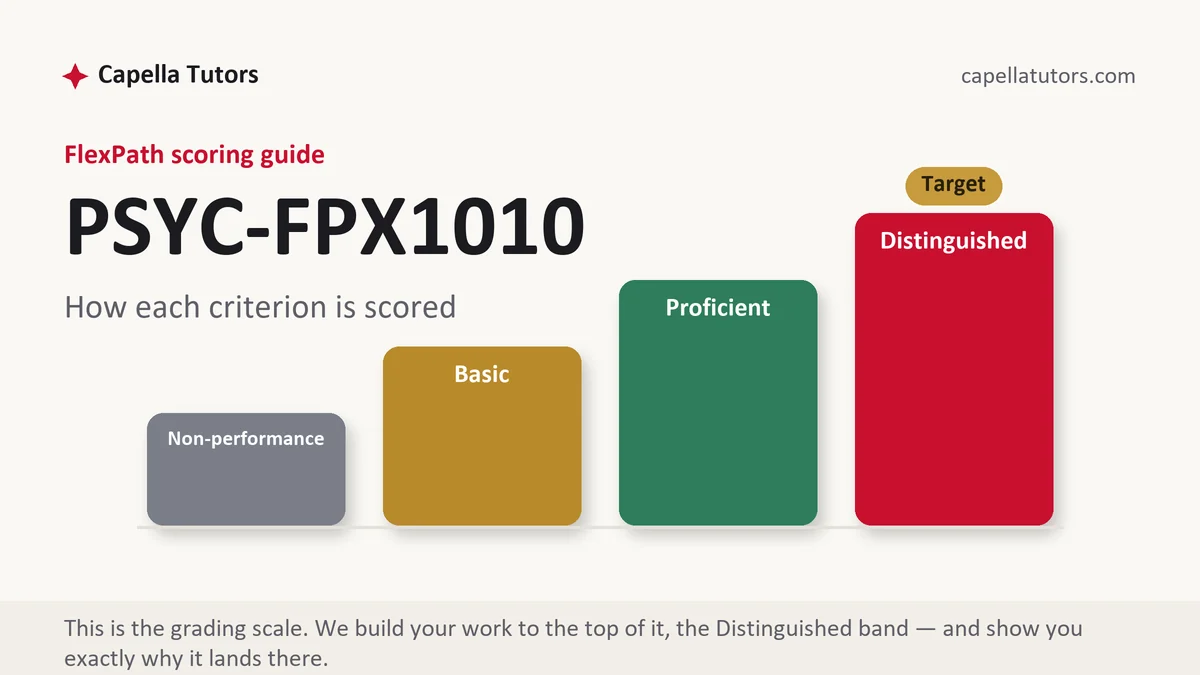
What PSYC FPX 1010 actually grades
A survey course is not graded on how many terms you can recall. It is graded on whether a term does any work in a sentence about a real person. The deliverables here tend to hand you a behavior, a short scenario or a slice of your own experience, then ask which account of psychology explains it. The lenses the course sets up are the familiar ones, biological, behavioral, cognitive, humanistic, psychodynamic and sociocultural, and naming the right one is only the entry fee. What the criterion rewards is whether the mechanism you describe underneath that name belongs to it rather than to one of the others.
Take a student who checks a phone every few minutes while trying to read. A behavioral account is about the schedule of the payoff, since rewards that arrive unpredictably sustain a habit far better than rewards that arrive on time, which is why the checking survives a hundred empty screens. A cognitive account is about attention and expectancy, because the anticipated message occupies working memory whether or not it ever arrives. A biological account talks about reward signaling and about what a week of five-hour nights does to sustained attention. A sociocultural account points at a norm regarding how quickly a friend expects an answer. Every one of those is defensible. The paragraph that gestures at all four and concludes that behavior has many causes is the one that lands in the Basic column, because it has named no mechanism at all.
The second thing this course grades is early method literacy, and it is graded more strictly than a first course suggests. You will be asked to tell an experiment from a correlational study and to say which variable is which. One habit settles most of it. Before writing a word about a study, write a plain sentence in this shape: the researchers measured this, in these people, and compared it against that. The independent variable is whatever the researchers manipulated or the grouping they compared, and the dependent variable is what they measured afterward. If nothing was manipulated, no sentence you write about that study is allowed to contain the word because.
The third strand is the writing itself, which carries a criterion of its own. This is where APA starts for most psychology students, and the communication line on the guide is scored as seriously as the content lines above it. Discussion posts run the same logic at smaller scale: a claim, a source that actually supports it, and a reply that adds a mechanism rather than agreement. Because FlexPath lets you carry two courses at once, a 1.5 point course like this one usually sits alongside something heavier, and the discussion cadence is the first thing to slide when that happens.
How we help in this course
Work on 1010 starts from your own materials rather than from a generic outline. Tell us which textbook edition your section uses and which chapter the assessment points at, and the sample comes back in that book's vocabulary instead of a synonym your evaluator has never met. Where an idea belongs to a named researcher we attribute it to that researcher and cite the original study, a habit the upper-division courses in this program will demand and this one quietly rewards.
Everything else runs on the studio's standard terms. Every deliverable is a premium original sample, delivered inside 24 to 48 hours, drafted against the Distinguished descriptors in your own scoring guide, then run through the eight-person pipeline with both quality passes, one for subject accuracy and one for APA and originality. Revisions stay free until the criterion is met, and anything faculty send back re-enters that same cycle without a new charge. Faculty have two business days to evaluate an attempt, so a returned attempt costs you momentum rather than money, and preventing that return is what the second pass is for.
The assessments, one by one
Assessment 1
The opening deliverable in Introductory Psychology usually hands you a behavior or a short scenario, then asks which account of psychology explains it and why that account rather than a neighboring one. Read the full Assessment 1 manual.
How to actually write PSYC FPX 1010: where to begin
The scoring guide comes first and the instructions come second, because the guide is the thing being marked and the instructions only supply the setting. Turn each criterion into a heading in a blank document and paste the Distinguished wording underneath it in a color you will delete later. Then obey the verb. Describe asks for features. Explain asks for a mechanism. Compare asks for at least one stated similarity and one stated difference. Apply asks you to attach the idea to the specific case in front of you. Each criterion is scored on its own line at one of four levels, Non-performance, Basic, Proficient or Distinguished, so a paragraph that answers no criterion earns nothing however well it reads.
Then build every applied paragraph in the same four moves, since in a first course that structure is most of the distance between the columns. Name the concept and whose work it came from. State the mechanism in one sentence, meaning what the idea says causes what. Apply it using the details the scenario actually gave you rather than details you invented. Then bound the claim by saying what the account does not explain. Here is the contrast, in classical conditioning. The Basic version defines the terms correctly and asserts that the child has been conditioned to fear the clinic. The stronger version identifies the injection as the unconditioned stimulus, tracks the waiting room from neutral to conditioned, predicts that several visits without an injection would weaken the response, and then notes that conditioning does not account for the older sibling who described the visit in advance. Same theory, same length, two different scores.
| Section | What goes in it | What Distinguished looks like |
|---|---|---|
| Introduction | The behavior or concept under discussion, the perspective you will use, and the question the paper answers. | A question narrow enough to answer in the space you have, with the perspective named in the first paragraph. |
| The concept explained | The definition in your own words, where it came from, and the mechanism it proposes. | Attribution to the researcher who proposed it, and a mechanism written as cause and effect rather than as a label. |
| The evidence | The study your reading supplies, with its design and participants stated before its findings. | Design named, sample described, and the finding hedged to match what that design can support. |
| Application to the case | The scenario details mapped onto the concept one at a time. | Specific scenario details doing the work, plus a prediction about what would change if one detail changed. |
| Limits and alternatives | What your account does not explain, and which other perspective would explain that part better. | A named alternative perspective and a stated reason you did not choose it. |
| References | Current APA, every in-text citation matched to an entry and every entry cited. | Sources that were genuinely read, with the original cited wherever a framework has a named author. |
Developing the synthesis
Synthesis in a first course is not a literature review. It is the smaller move of holding two accounts beside each other and saying something about the relationship between them. If your reading offers a biological account of aggression while your scenario shows the aggression appearing in one setting and nowhere else, the useful sentence is the one that reconciles those facts, that a disposition can raise the odds of a behavior while a situation decides whether it appears at all. Write that relationship out loud. Never leave two ideas in neighboring sentences without stating how one bears on the other, because an evaluator reading for synthesis is reading for exactly those connective sentences and will not supply them for you. Then close by naming what your explanation cannot settle, since marking the edge of your own claim is usually the extra move the top column is describing.
Citations that survive faculty review
A paper at this level draws on three kinds of source, and each one answers a different question. The assigned textbook is legitimate and citable and it is the right source for a definition, but it is a secondhand account of everyone's research, so a claim resting on one study should point at that study instead. Peer-reviewed psychology journals through the Capella library are the second kind, and one or two are usually enough here, chosen because they say something the textbook only summarizes. The third kind is the public and professional record, the American Psychological Association for its ethics code and its style rules, and federal statistical sources such as the National Center for Health Statistics when a paper needs a prevalence figure. Where a framework has an author, cite the author, so operant principles point at Skinner and observational learning points at Bandura rather than at a page in a survey text. Before submitting, read the reference list beside your citations and confirm that each side accounts for the other, which takes two minutes and prevents the correction faculty write most often.
The mistakes that land Basic instead of Distinguished
- Defining instead of applying. A correct definition with no case attached answers the vocabulary question the course did not ask.
- Perspectives blended into mush. Listing four explanations without committing to one leaves the mechanism criterion unanswered.
- The word because attached to a correlation. Two things measured at the same moment cannot support a causal verb, and graders in psychology look for this first.
- Quotation where a paraphrase belongs. A quoted sentence shows you found the page while a paraphrase shows you understood the paragraph, and the rubric pays for the second.
- A reference list of one textbook. One outside peer-reviewed source, doing a job the textbook cannot do, moves the source criterion up a column by itself.
PSYC FPX 1010 questions students actually ask
Can I use the course textbook as a source?
Yes, and you should, as long as it is doing work a textbook can do. Cite it for a definition, for the accepted outline of a theory, and for the vocabulary your evaluator expects to see. Do not cite it for a specific research finding you intend to build an argument on, because the textbook is reporting somebody else's study in two sentences and those two sentences will have dropped the sample, the design and the size of the effect. Find the study through the library and cite it directly. Your reference list should also show at least one source you chose yourself, since a list containing only the assigned reading tells an evaluator nothing about your source skills.
How long should the paper be, and how many sources does it need?
Your scoring guide decides both and it often names neither. When no length is given, the working rule is that each criterion needs two or three developed paragraphs, so the paper grows from the number of criteria rather than from a page target you picked. Sources follow the same logic. Two or three, each with a stated job, beats six listed in a row, because an evaluator can see which sources are doing work and which are decoration. If a length is named, treat it as a ceiling as well as a floor, since padding is visible and reads as a writer with nothing left to say.
Is a website ever an acceptable source in this course?
Some are, and the test is who is accountable for the page. A federal statistical agency, a professional association publishing its own code, or a university hosting a research summary can all be cited, and in some papers one of them is the correct source. Consumer health pages, essay mills, tutoring blogs and encyclopedia entries are not. Wikipedia in particular is a reasonable place to find search terms and a poor place to find a citation. Trace the claim back to whoever generated it, cite that, and you have done the source lesson the course is quietly teaching.
Introductory Psychology paper due?
Send the prompt, the criteria and the chapter it points at. The sample comes back written to your own scoring guide. First premium sample free.