This manual is for PSYC FPX 1010 Assessment 2, start to submission. The second deliverable in Introductory Psychology usually stops asking what psychology explains and starts asking how anyone knows: you are handed a study, or sent to find one, and the criteria want its design named, its variables identified, and its result reported at the size that design can carry. Reading a finding correctly is the whole skill here. Below is the method our tutors use, a structure built out of the criteria, and an annotated excerpt. If you would rather not write it twice, a premium original sample for your exact prompt lands inside 24 to 48 hours and is revised free until each criterion clears. Capella's catalog lists the course as PSYC-FPX1010, and some courserooms print PSYC1010; both point to this same Assessment 2.
One honesty note before the manual: Capella revises courses and scoring guides over time, so always write to the exact scoring guide attached to your assessment in the courseroom. The course identity above is verified on capella.edu; the method and structure below are our tutors' approach to it, not Capella's official rubric text.
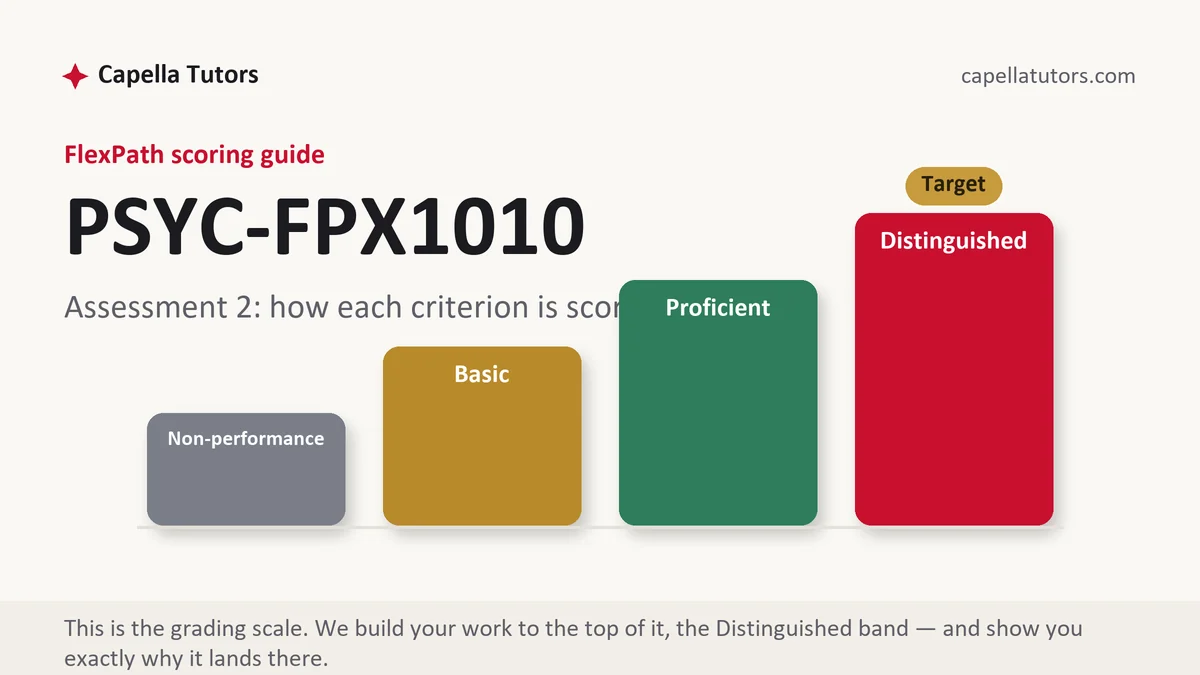
How PSYC FPX 1010 Assessment 2 is scored
Nothing on a FlexPath assessment is averaged into a letter. Each criterion receives one of four levels, and the wording inside those levels is the instruction you are really writing to:
| Level | What it means on a study critique |
|---|---|
| Distinguished | The design is named before any finding, the variables are identified in the study's own terms, every verb matches what that design can license, and the numbers arrive with a scale and a spread. The criterion names one further act; locate it and perform it. |
| Proficient | The study is represented accurately and judged against standards you stated. Correct work, one act short of the column above. |
| Basic | A summary wearing an evaluation's clothes, or an appraisal that turns out to be agreement with the authors. Where most first attempts land. |
| Non-performance | Something the criterion required is not on the page, usually the design description or the limitation. Absent outranks thin as a reason for the floor. |
A general education course is the least intimidating place in this degree to learn what a design can and cannot license, and the vocabulary you settle here is used without explanation in every course that follows. Evaluators read the verbs closely, and one causal verb on a study that only measured things costs a criterion however clean the prose around it.
The PSYC FPX 1010 Assessment 2 method, step by step
-
Let the criteria decide your section list
Paste each criterion into a blank document as a heading, drop its top-level wording underneath, and underline the verb. Summarize, evaluate, compare and critique want four different paragraphs, and answering the wrong verb is a scored mistake rather than a stylistic one.
-
Go to the method section before you have an opinion
Read the abstract once for the question, then skip the results and settle three things in writing: who took part, what was done to them or compared between them, and how the outcome was measured. A finding means something different depending on all three, which is why this order saves an afternoon.
-
Name the varied thing and the measured thing
Write one sentence in this shape: the researchers varied ___ and measured ___. If nothing was varied, the study either compared groups that already differed or recorded two things at once, and you are holding a correlational design. That sentence licenses or forbids every causal verb in the paper, so keep it where you can see it.
-
Turn the numbers into a sentence before you quote them
An average is a location and says nothing about scatter. Two groups whose means sit three points apart can overlap almost entirely if individual scores range across twenty, so find the standard deviation, the sample size and any effect size, then write the plain version first: most people improved a little, or a few improved a great deal. The figures follow that sentence rather than replacing it.
-
Evaluate against standards you stated in advance
Put your appraisal standards on the page before any verdict. Was the sample right for the question, was the measure a fair stand-in for the thing of interest, was the comparison group treated identically otherwise, and does the conclusion travel further than the evidence. A standard behind a verdict makes it appraisal; a verdict without one is a preference.
-
Mark your own copy, then submit early
Print the guide, take one criterion at a time, and write N, B, P or D beside each line in your own hand. Anything under D earns one more pass before you upload. An attempt can sit with faculty for up to two business days, so a Friday submission often means a Tuesday answer.
A structure that maps to the criteria
Treat the targets below as a tutor's planning arithmetic for a short undergraduate critique. They are ours rather than Capella's, and any row your own guide leans on should get more.
| Section | What it must do | Guide word target |
|---|---|---|
| Introduction | Name the study and its question, then say what your critique concludes about the weight it can carry. | ~120 words |
| The study described | Participants, procedure and measure in the order a reader needs them, with the citation inside the sentence about what the researchers did. | ~220 words |
| Design and variables | The design named, the varied variable identified, the measured outcome identified, and the reason that label fits. | ~250 words |
| The findings, read plainly | The result in ordinary English first, then the figures with their scale, their spread and any effect size. | ~250 words |
| Appraisal and limits | Your stated standards applied one at a time, plus one alternative explanation the design leaves open. | ~280 words |
| References | Current APA, the study cited to itself rather than to a summary of it, entries and citations accounting for each other. | as needed |
Annotated sample excerpt
Our own model paragraph, here for its moves instead of its content. Run the moves on the study you were assigned.
Forty-eight students in an introductory course were sorted by coin flip into two study conditions, and that sorting is what makes this an experiment rather than a survey of how people prefer to study.1 Both groups read the same 1,200 word passage once; one group then reread it twice more, the other answered three recall questions from memory with the passage closed, and both were tested seven days later on the same thirty idea units.2 The recall group averaged 11.4 units against 8.1 for the rereading group, and with standard deviations near 4 in each group the two distributions overlap heavily, so the honest sentence is that practising retrieval helped most of these students somewhat rather than transforming any of them.3
- 1Random assignment is named as the warrant for the word experiment, in the same breath as the design. A reader looking for method literacy has the answer in the first clause.
- 2What each participant did is visible, which is what makes the comparison checkable. The varied thing and the measured thing are both here, in the study's own terms.
- 3The figures get a scale and a spread, then a plain English reading. Reporting the overlap, not just the gap, is usually the extra act the top column describes.
The full premium sample for your exact assessment, written fresh to your scoring guide and issue, is free to request. Study it, revise it into your own voice, and submit work you understand.
The five mistakes that cost Distinguished
- The summary in evaluation's clothing. Three accurate paragraphs about what the authors did, with no standard applied to any of it, answer the description criterion twice and the appraisal criterion never.
- Agreement standing in for a standard. Whether a conclusion sounds right to you is not a criterion; whether the sample, the measure and the comparison support it is.
- A mean with nothing beside it. An average with no spread, sample size or scale hides whether the difference matters, and it is the first thing a psychology evaluator asks for.
- A percentage with no base. Recall improved by forty percent says nothing until the sentence supplies from what, to what, and in how many people.
- The variables swapped. Calling the outcome the independent variable is a small slip that reads as a misunderstanding of the design, and it usually costs the criterion.
Pre-submission checklist
- One labeled section per criterion, answering the verb that criterion used
- Participants, procedure and measure all appear before the first result
- A written sentence names what was varied and what was measured, with the design labeled from it
- Every figure carries its scale, and every average carries a spread
- Appraisal standards written down before any verdict, plus one alternative explanation named
- In-text citations and reference entries match both ways, APA current, every criterion self-scored D
Handed a study you cannot read yet?
Send the prompt, the scoring guide and the article your section assigned. A team of eight, including a research analyst and two QA reviewers, returns a premium original sample written to the Distinguished column in 24 to 48 hours, with the design paragraph and the numbers handled as this course wants, revised free until the criteria clear.