This manual is for PSYC FPX 1010 Assessment 1, start to submission. The opening deliverable in Introductory Psychology usually hands you a behavior or a short scenario, then asks which account of psychology explains it and why that account rather than a neighboring one. Naming the perspective is the entry fee; the criteria pay for the mechanism underneath the name, working on details the case actually supplied. Below is the method our tutors use, a structure assembled from the criteria, and an annotated excerpt. Would you rather hand it over? A premium original sample for your exact prompt returns in 24 to 48 hours, revised free until every criterion clears. Capella's catalog lists the course as PSYC-FPX1010, and some courserooms print PSYC1010; both point to this same Assessment 1.
One honesty note before the manual: Capella revises courses and scoring guides over time, so always write to the exact scoring guide attached to your assessment in the courseroom. The course identity above is verified on capella.edu; the method and structure below are our tutors' approach to it, not Capella's official rubric text.
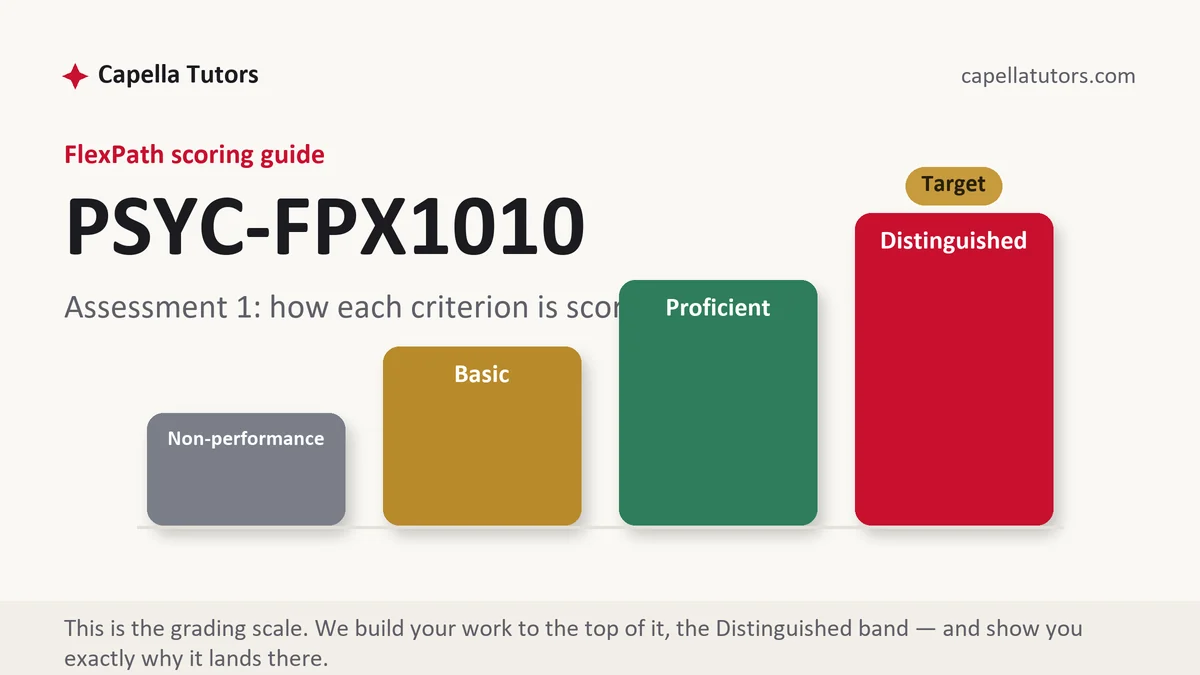
How PSYC FPX 1010 Assessment 1 is scored
FlexPath issues no letter grades. Every criterion on your scoring guide is marked at one of four levels, and the wording of those levels is the brief you are writing toward:
| Level | What it means on a perspectives analysis |
|---|---|
| Distinguished | One perspective is chosen on purpose, its mechanism is written as cause and effect, the case details do the applying, and the paper says what that account cannot reach. The extra act is spelled out in the criterion; find it and perform it. |
| Proficient | The perspective is named and correctly applied with support behind it. Accurate work, one move short of the column above. |
| Basic | A correct definition sitting beside a case it never touches, or four perspectives listed with none chosen. The usual landing place for a first attempt here. |
| Non-performance | A required element is absent, most often the application or the stated limit. Missing rather than thin drops a criterion to the floor. |
Worth 1.5 program points, this general education requirement is easy to treat as a warm-up, and treating it that way is expensive. The habits it marks are the ones later courses in the BS in Psychology assume you arrived with, and they do not teach the lesson twice.
The PSYC FPX 1010 Assessment 1 method, step by step
-
Build the outline out of the criteria, not the prompt
The prompt supplies the setting; the guide supplies the marks. Paste each criterion into a blank document as a heading, drop its Distinguished wording underneath, then underline the verb. Describe wants features, explain wants a mechanism, compare wants one similarity and one difference, and apply wants the idea fastened to the case in front of you.
-
Shrink the behavior until one paragraph can hold it
Procrastination is a subject. Reading one chapter once, on the night before it is due, is a behavior. Give the thing you are explaining a time, a setting and a count, because a specific behavior has a mechanism attached while a broad one only has opinions attached. Where the prompt supplies the scenario, mine it for those particulars rather than inventing your own.
-
Pick one perspective and write its mechanism in a single sentence
Finish this sentence before you draft anything: this account says that ___ produces ___ under ___. The biological, behavioral, cognitive, humanistic, psychodynamic and sociocultural lenses fill those blanks differently, and a lens you cannot fill them for is a label rather than an account. Name the researcher behind the idea while you are there.
-
Put every study's design in front of its finding
Before reporting what researchers found, write one plain sentence naming who was studied, what was manipulated or compared, and how the outcome was measured. That sentence decides your verb. A design that manipulated something can carry caused; a design that only measured two things at one moment carries associated with and nothing stronger.
-
Apply detail by detail, then make one prediction
Walk through the case a particular at a time and say what your mechanism expects of each one. Then add the sentence most first drafts leave out: if one detail changed, what would the account predict? A prediction can be wrong, which is why an evaluator reads it as understanding rather than recall.
-
Hire the rival account, then score yourself
Name the perspective you rejected, state what it would say, and give your reason for passing on it. Then read the draft against the guide one criterion at a time, mark each N, B, P or D honestly, and give anything under D one more pass. Faculty have two business days to evaluate an attempt, so submit early in the week.
A structure that maps to the criteria
These word targets are planning numbers our tutors use for a short undergraduate analysis, not Capella rules; stretch any row your own scoring guide asks more of.
| Section | What it must do | Guide word target |
|---|---|---|
| Introduction | State the behavior in one concrete sentence, name the perspective you will use, and give the question the paper answers. | ~120 words |
| The behavior described | What happens, when, how often, and in what setting, written from observation rather than from adjectives. | ~200 words |
| The perspective and its mechanism | The account named and attributed, then what it says causes what, in cause and effect order. | ~300 words |
| The application | Case particulars mapped onto the mechanism one at a time, closing with a prediction about what would change if one particular changed. | ~350 words |
| The rival account and the limits | The perspective you did not choose, stated fairly, plus what one case cannot establish. | ~230 words |
| References | Current APA, citations and entries accounting for each other, with frameworks cited to their authors. | as needed |
Annotated sample excerpt
An original model opening from our team, written at the register the top of the guide describes. Treat it as study material: take the moves, then build your own version.
Across four weeks I read each assigned chapter exactly once, on the evening before the deliverable was due, and twice found I could not reconstruct its argument two days later.1 A cognitive account explains that better than effort does: one pass builds a memory that is easy to recognize and hard to retrieve, so a highlighted page rewards recognition while an assessment demands retrieval.2 This analysis explains that pattern through the cognitive perspective, weighs it against a behavioral account of when I actually sit down, and marks what four weeks of one student's notes cannot establish.3
- 1The behavior arrives dated, counted and located, with no definition and no throat-clearing. An evaluator can picture the thing being explained by the end of the first clause.
- 2The mechanism is stated as cause and effect, recognition against retrieval, rather than named as a term. This sentence is the difference between the two middle columns.
- 3One perspective is committed to, the rival is announced so it cannot look like an afterthought, and the claim is bounded in the same breath.
The full premium sample for your exact assessment, written fresh to your scoring guide and issue, is free to request. Study it, revise it into your own voice, and submit work you understand.
The five mistakes that cost Distinguished
- The glossary paragraph. A flawless definition with no case attached answers the vocabulary question this course did not ask.
- Every perspective, no choice. Four accounts listed and a closing line about behavior having many causes leaves the mechanism criterion untouched.
- A causal verb on a measured relationship. Two things counted at the same moment cannot carry caused or because, and psychology evaluators check that verb first.
- Invented case details. Applying the idea to particulars the scenario never supplied reads as a paper about a different case, and the criterion is scored against the case you were handed.
- The textbook as the only source. One outside peer-reviewed article, chosen because it says something the survey text only summarizes, lifts the source criterion by itself.
Pre-submission checklist
- Each criterion has its own labeled section, and its verb is answered
- The behavior carries a time, a setting and a count before any theory arrives
- One perspective chosen, attributed, mechanism written as cause and effect
- Every study gives design and sample before finding, verb matched to design
- One prediction and one stated limit appear in the paper, not just in your head
- Citations and reference entries account for each other, current APA, self-scored D throughout
Want the first psychology paper done with backup?
Send the prompt, the scoring guide and the chapter your section was assigned. A team of eight, including a research analyst and two QA reviewers, returns a premium original sample written to the Distinguished column in 24 to 48 hours, in your textbook's vocabulary rather than a synonym for it, revised free until the criteria clear.