This manual is for PSYC FPX 1010 Assessment 3, start to submission. The closing deliverable in Introductory Psychology usually asks for more than one explanation held at once: two accounts of the same behavior, the relationship between them written out, and a claim kept inside what a single case can establish. Listing both accounts is not synthesis; saying how one bears on the other is, and that sentence is what the criterion pays for. What follows is the method our tutors run on this deliverable, a structure taken from the criteria, and an annotated excerpt. Tight on time? Send the prompt and a premium original sample comes back within 24 to 48 hours, revised at no charge until the criteria clear. Capella's catalog lists the course as PSYC-FPX1010, and some courserooms print PSYC1010; both point to this same Assessment 3.
One honesty note before the manual: Capella revises courses and scoring guides over time, so always write to the exact scoring guide attached to your assessment in the courseroom. The course identity above is verified on capella.edu; the method and structure below are our tutors' approach to it, not Capella's official rubric text.
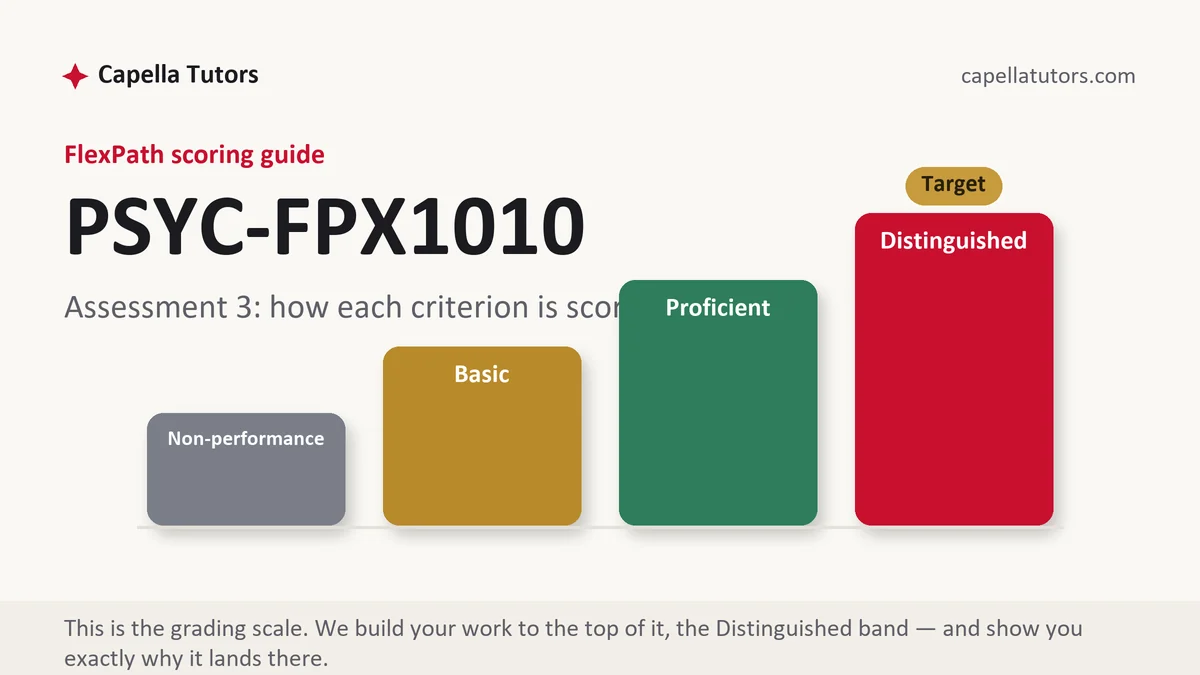
How PSYC FPX 1010 Assessment 3 is scored
There is no letter grade to hide inside. Every criterion lands on one of four levels, and the level wording usually tells you which sentence is missing:
| Level | What it means on a two-account synthesis |
|---|---|
| Distinguished | Both accounts are stated accurately, the sentence connecting them is written rather than implied, the pairing produces a prediction or a decision, and the writer marks what a single case cannot settle. The extra act sits in the criterion wording; perform it on purpose. |
| Proficient | Both accounts are accurate and both reach the case. Complete work, still missing the connective sentence the column above is paying for. |
| Basic | Two correct paragraphs sitting side by side, closing on the observation that behavior has many causes. The usual shape of a first attempt at synthesis. |
| Non-performance | One of the required parts is not present, most often the second account, the application, or the limitation. |
Synthesis at this level is a small move rather than a literature review, and the small move is the one that transfers. Research-facing courses later in the degree open with two findings that do not obviously agree, and the sentence you learn to write here is the sentence those courses keep asking for.
The PSYC FPX 1010 Assessment 3 method, step by step
-
Read the criteria for the connective verb
Reconcile, integrate, relate and compare all point at the same missing sentence, and it is never the one students forget to research. It is the one they forget to write. Copy each criterion into your outline, then mark the ones that no paragraph about a single account could ever satisfy.
-
Fix the case before you fix the theory
Write the behavior down with numbers and a setting, drawn from the scenario you were handed rather than from memory. Two accounts can only be compared against a case specific enough to disagree about. A vague case lets both explanations be right at once, which is exactly how a paper arrives at Basic with nothing obviously wrong in it.
-
Give each account its own mechanism sentence
For both explanations, finish this sentence: this account says ___ produces ___ under ___. If the two sentences come out the same, you have chosen one account twice. If you cannot finish one of them, you are holding a label rather than an explanation. Attribute each account to the researcher or tradition it came from while you are there.
-
Write the relationship, in one of four shapes
Accounts relate in a small number of ways. They operate at different distances from the behavior, one supplies a condition the other needs, they compete and could be told apart by a test, or each covers a part of the case the other leaves alone. Choose the shape that fits, name it, and put the sentence in the paper, because that sentence is the criterion.
-
Let the pairing earn a prediction
Two accounts held together should forecast something neither forecasts alone. Say what you would expect to change if one feature of the case changed, and keep the forecast small enough to be wrong. Being capable of wrongness is the evidence that you understood a mechanism instead of a vocabulary list.
-
Bound the claim, then letter your own draft
One case, however carefully described, cannot establish a pattern, and saying so in your own words costs a sentence and buys a criterion. Then read the draft beside the guide line by line, put a letter against each criterion honestly, and rewrite anything short of the top column before the upload rather than after the feedback.
A structure that maps to the criteria
Planning numbers again, ours rather than the school's, sized for a short undergraduate synthesis. Where your guide names a section this table does not, the guide wins.
| Section | What it must do | Guide word target |
|---|---|---|
| Introduction | The behavior in one concrete sentence, both accounts named, and the question this paper answers about them. | ~130 words |
| The case in detail | What happens, how often, where, and across what stretch of time, taken from the scenario exactly as given. | ~200 words |
| The first account | Its mechanism written as cause and effect, attributed, then applied to named details of the case. | ~280 words |
| The second account | The same treatment for the rival explanation, including the case details the first account left untouched. | ~280 words |
| The relationship, stated | The sentence joining the two, the shape of that relationship, and the prediction the pairing produces. | ~250 words |
| Limits and references | What one case cannot settle and what would settle it, then current APA with frameworks cited to their authors. | ~180 words |
Annotated sample excerpt
One model paragraph of ours, showing where the connective sentence goes and how much work it does when it gets there. Borrow the shape, not the case.
On four untimed practice sets the student scored between 82 and 88 percent; on the two timed exams that followed she scored 61 and 64, and she describes reading the first question three times without taking in the words.1 An arousal account and a working memory account both fit that gap, and they do not so much compete as operate at different distances from it: raised arousal supplies the physical state, while worry occupies the limited capacity the multi-step items need, which is why her scores drop furthest on those items and hold on recognition items.2 Held together the two accounts forecast something neither manages alone, that removing the clock should help her more than calming the physical symptoms would, and one student's score pattern comes nowhere near testing it.3
- 1Numbers, a range and one behavioral detail, all taken from the case as supplied. The reader can see the thing being explained before any theory arrives to explain it.
- 2The connective sentence is written out, and the relationship is named as a difference in distance rather than left for the reader to infer. This is the sentence the synthesis criterion exists to find.
- 3The pairing earns a forecast, and the claim is bounded in the same breath, which keeps the paper honest without spending a separate paragraph on hedging.
The full premium sample for your exact assessment, written fresh to your scoring guide and issue, is free to request. Study it, revise it into your own voice, and submit work you understand.
The five mistakes that cost Distinguished
- The parallel-paragraph paper. One account per paragraph, both accurate, nothing joining them, is an inventory rather than a synthesis, and the criterion can tell.
- The closing line about many causes. Behavior is complicated is true of every behavior anyone has ever studied, which is precisely why it satisfies nothing.
- Two names for one mechanism. If both accounts predict the same thing in the same words, one explanation has been written twice and the comparison criterion has nothing to mark.
- A forecast that cannot be wrong. Something might improve is not a prediction; her score on multi-step items should recover first is.
- Certainty from a single case. One person's pattern can motivate a claim and cannot establish one, and an evaluator will write the limitation in the feedback if you leave it out of the paper.
Pre-submission checklist
- The case carries numbers and a setting before either account appears
- Each account has its own mechanism sentence and its own attribution
- One written sentence states how the accounts relate, and names the shape of that relationship
- The pairing produces a prediction small enough to be wrong
- A stated limit on what one case establishes, plus what would settle the question
- Frameworks cited to their authors, APA current, every criterion self-lettered D
Two explanations and no sentence between them?
Send the scenario, the criteria and the accounts your prompt named. A team of eight, including a research analyst and two QA reviewers, returns a premium original sample in 24 to 48 hours with the connective sentence and the prediction placed where the guide looks for them, revised free until each criterion clears.