Send across the prompt and the scoring guide and the deliverable comes back inside 24 to 48 hours as an original premium sample, written to the Distinguished wording in your own rubric with a second reader on it before it ships. The registrar records PHI FPX 1200, Philosophy of Problem Solving, at 3 points, one of the Humanities choices inside Capella's FlexPath general education menu. That menu totals at least 22.5 points with a floor of 2 points in each of its four categories, so a student assembles it from options rather than working through a set sequence. In Capella's catalog the course code is written PHI-FPX1200.
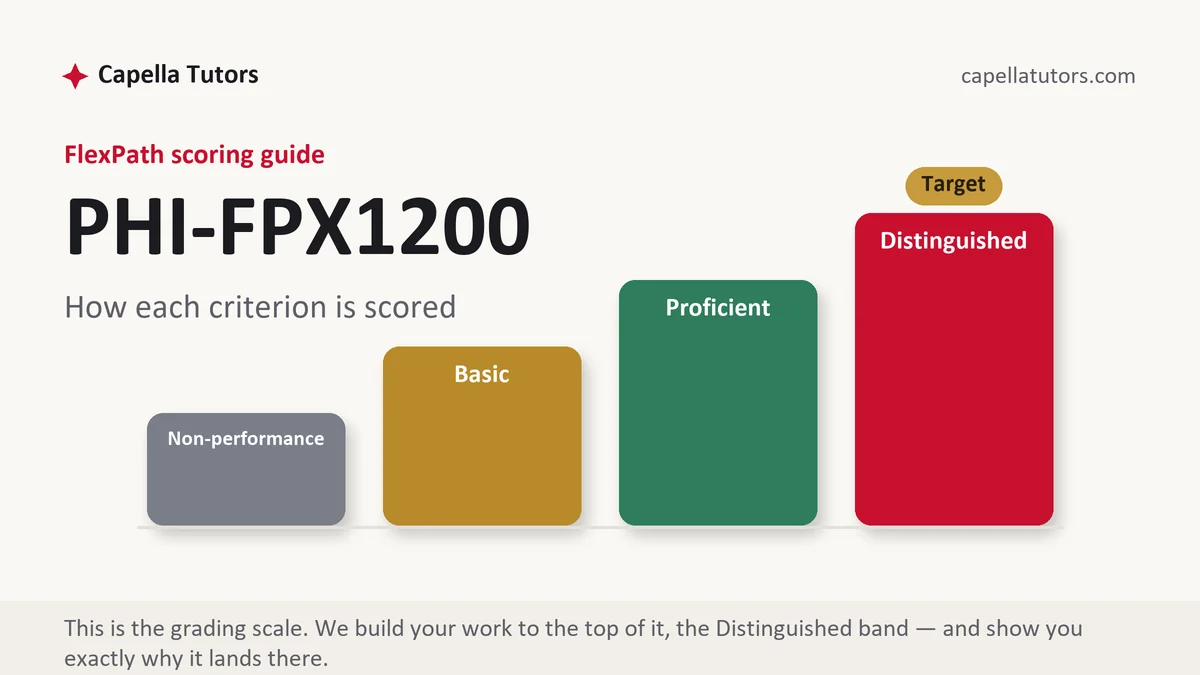
What PHI FPX 1200 actually grades
Philosophy of Problem Solving is a reasoning course wearing a practical name. In current courserooms the assessments turn problem solving on yourself: a personal philosophy of problem solving, a reflection on your skills, goals and accomplishments, a skill development plan, and a professional presence presentation. Two students can recommend opposite actions and score identically, provided both reconstructed the argument fairly, tested the inference, and said what would change their minds. What does not score is a confident opinion with reasons attached afterward, which is what most first drafts turn out to be.
The distinction this course lives on is between an argument being valid and its parts being true, and it costs more marks than anything else on the page. Consider this: every employee who finished the training passed the audit; Dana passed the audit; so Dana finished the training. Every sentence in it may be true and the argument is still broken, because passing the audit could have happened another way. Change the second premise to say Dana finished the training and the conclusion that Dana passed the audit follows with no gap at all. The test is mechanical: can you invent a situation where the premises hold and the conclusion fails? If you can, the form is bad no matter how reasonable the conclusion sounds. Write that test into the paper explicitly, because a criterion asking you to evaluate an argument wants to watch you run it.
The third strand is fallacies and bias, and here the danger runs the other way, too much labeling and not enough explaining. Naming an argument a slippery slope earns nothing; showing that the chain has four steps and that no evidence is offered for the third earns the row. An attack on a person is only an ad hominem when character is offered instead of a reason, and pointing out that a study was funded by the company selling the product is a legitimate question about reliability rather than a fallacy. The same discipline applies to cognitive bias. Confirmation bias, anchoring, availability, and sunk cost each name a specific mechanism, and a paper using the term as a synonym for being wrong has not used it at all.
How we help in this course
Our 1200 samples show the reasoning on the page. Arguments arrive reconstructed in numbered premises with the conclusion stated separately, inferences are tested by counterexample rather than declared strong, fallacy claims come with the specific missing step identified, and any problem-solving process runs through to a decision with the criteria set before the options were compared. Send the case, the article, or the workplace problem your prompt names and the sample works on that material rather than on a textbook illustration.
Everything else is the studio standard. Turnaround is 24 to 48 hours, the target is the Distinguished column, and eight people work the file: a researcher who reads your guide before anything else, a subject writer, a reviewer who grades the draft against every row, an APA and originality pass in both directions, and an editor at the end. You do not pay for revisions, and faculty feedback re-enters the same queue for free.
The assessments, one by one
Assessment 1: Personal Philosophy of Problem Solving
Describe how you approach problems, the steps and habits you rely on, an example from your life or work, and how you want your approach to grow. Read the full Assessment 1 manual.
Assessment 2: Reflecting on Your Skills, Goals, and Accomplishments
Describe your goals, strengths and areas for growth, your problem-solving skills, and write accomplishment statements that show results. Read the full Assessment 2 manual.
Assessment 3: Skill Development Plan
Choose target skills such as communication, technology and problem solving, assess your strengths and gaps in each, set development actions. Read the full Assessment 3 manual.
How to actually write PHI FPX 1200: where to begin
Start by turning the scoring guide into headings and the prompt into a list of verbs. Reasoning criteria are unusually literal: if a row says identify, explain, and evaluate, three things are owed and an evaluator will look for all three underneath that heading. Students in this course lose more marks to unanswered instructions than to bad reasoning, because the reasoning feels like the hard part and the instructions feel obvious enough to skim.
Then put the argument into standard form before you say anything about it. Strip the rhetoric, number the premises, state the conclusion last, and add the premise the author left unstated, which in ordinary writing is almost always the interesting one. An argument that a policy should be adopted because it saves money is relying on an unstated premise that saving money is what should decide the matter, and once that premise is on the page it can be examined. Do this charitably, meaning you repair small gaps and take the strongest available reading, because a criterion measuring your evaluation of an argument is also measuring whether the argument you evaluated is the one that was made.
Then, if the prompt asks for a solution and not only an analysis, define the problem as a gap. A problem is the distance between what is happening and what should be happening, stated in terms somebody could check, and the commonest failure in submitted work is a problem statement that is a solution in disguise. Saying the problem is a shortage of staff has already chosen the answer. Saying that calls wait an average of eleven minutes against a target of four leaves every solution available, including scheduling changes that cost nothing. Then set your criteria before you list the options, because criteria written afterward are criteria written to select the option you had already picked, and an evaluator reading in order can see which came first.
| Section | What goes in it | What Distinguished looks like |
|---|---|---|
| The problem or claim | The situation or argument, restated neutrally, with the gap or the conclusion identified. | A statement no side would object to, with the current state and the desired state both given. |
| Reconstruction | The premises numbered, the conclusion separated, and any unstated premise supplied. | The strongest available version of the argument, repaired where the original was loose. |
| Evaluation of the inference | Whether the conclusion follows, tested rather than asserted, with the type of reasoning named. | A counterexample attempted, and validity kept apart from the truth of the premises. |
| Evidence and bias | The support offered for each premise, and the reasoning errors present, each one explained. | Fallacies identified by the missing step rather than by label, and bias tied to a mechanism. |
| Options and decision | The alternatives, the criteria set in advance, the choice made, and how it will be checked. | Criteria written before the comparison, a decision reached, and a review measure attached. |
| Sources and format | Logic and critical thinking scholarship, plus evidence for factual premises, in current APA. | Original works cited for concepts, and every factual premise sourced rather than assumed. |
Developing the synthesis
Philosophy does not settle by counting sources, so synthesis here means putting two defensible positions into genuine contact. The classic pairing in problem-solving material sets deliberate analysis against expert intuition. One tradition, running through the work on heuristics and biases associated with Kahneman and Tversky, shows that fast judgment goes wrong in predictable ways and concludes that structured analysis should override it. Another, associated with Klein's studies of firefighters and other experts working under time pressure, shows that experienced practitioners recognize patterns accurately in seconds and that forcing them into a formal process makes them slower without making them better. Both are supported. The interesting move is to say what determines which one applies, and the answer the literature converges on is the quality of feedback in the environment: where the same situation recurs and the outcome is visible quickly, intuition trains itself, and where outcomes are delayed or noisy, it does not. Reaching that distinction and applying it to the problem in your prompt is what a synthesis row is describing.
Citations that survive faculty review
Two different jobs need two different kinds of source here, and the reference list should show both. Concepts belong to the people who developed them, so cite the original where you can: Toulmin for the structure of an argument in ordinary language, Kahneman and Tversky for the biases, Dewey for the reflective account of how a problem gets defined, and a standard logic text for the formal apparatus. Citing a study guide's summary of Toulmin is the reference-list equivalent of describing a painting from a postcard. Factual premises belong to evidence, so anything your argument asserts about the world, a rate, a cost, a trend, a legal requirement, needs its own source from peer-reviewed work or a government or professional body, and the commonest failure here is a beautifully structured argument whose second premise is simply asserted. One further habit protects the whole paper: when you quote an argument you intend to attack, quote it accurately and at enough length that the reader can see you have not trimmed it into something easier.
The mistakes that land Basic instead of Distinguished
- Treating a valid argument as a true one. Form and content are graded separately, and a paper that runs them together loses both rows.
- Fallacy labels with no explanation. The name is a claim, and the claim needs the missing step spelled out underneath it.
- A problem statement containing its own solution. Once the answer is inside the problem, the option comparison is theater.
- Criteria invented after the options. Any evaluator who reads in order can see which one came first.
- An argument reconstructed at its weakest. Defeating a version nobody defended answers no criterion and reads as evasion.
PHI FPX 1200 questions students actually ask
What is the difference between a valid argument and a true one?
Validity is about the connection, truth is about the content, and an argument can have either without the other. If all metals conduct electricity and copper is a metal, then copper conducts electricity, and that is valid because the conclusion cannot fail while the premises hold. Replace the first premise with something false and the argument stays valid while becoming useless. An argument that is valid and built from true premises is called sound, and sound is what you are usually aiming for. The distinction is graded heavily because most real disagreements are about premises while most bad reasoning is about form, and a writer who cannot separate the two ends up arguing about the wrong thing.
How do I name a fallacy without getting it wrong?
Describe the defect before you reach for the name, and use the name only if it still fits. Write out what the author concluded, what they offered in support, and precisely what is missing between the two, in your own words. Then check the label against that description rather than against your impression of the passage. Most misnamings come from three pairs: an attack on a person that is actually a relevant challenge to reliability, a causal chain with evidence that is being called a slippery slope, and an appeal to a genuine expert in the right field that is being called an appeal to authority. If the description and the label disagree, keep the description, because the description is what the criterion scores.
Does a problem-solving paper have to end with a decision?
Almost always, and the ones that do not are usually the ones that lost the final criterion. A row asking you to apply a problem-solving process wants the whole process, and a process that stops at analysis has not been applied. State the option you chose, state why it beats the runner-up on the criteria you set, then add the part that separates the columns: what you would accept as evidence that the choice was wrong, and when you would look for it. If the honest answer is that the available information does not support a decision yet, say so and name the specific thing you would need to find out, which is itself a decision and is scored as one.
Reasoning assessment due?
Send the prompt, the criteria, and the argument or problem you were handed. The sample comes back with the premises numbered and every inference tested. Your opening premium sample is not billed.