This manual is for PHI FPX 1200 Assessment 3, start to submission. The Skill Development Plan asks you to choose target skills, often communication, technology and problem solving, assess your current strengths and areas for improvement in each, plan specific actions and resources to develop them, and explain how the changes will benefit your personal, academic and career goals. The grade turns on a plan you could follow. Actions with resources and dates score above intentions to improve. Below is the method our tutors use, a structure that maps to the criteria, and an annotated sample excerpt. Prefer to hand it off? A premium original sample for this exact assessment comes back in 24 to 48 hours, revised free until it meets the guide. Capella's catalog lists the course as PHI-FPX1200, and some courserooms print PHI1200; both point to this same Assessment 3. In current courserooms this assessment typically appears as "Skill Development Plan".
One honesty note before the manual: Capella revises courses and scoring guides over time, so always write to the exact scoring guide attached to your assessment in the courseroom. The course identity above is verified on capella.edu; the method and structure below are our tutors' approach to it, not Capella's official rubric text.
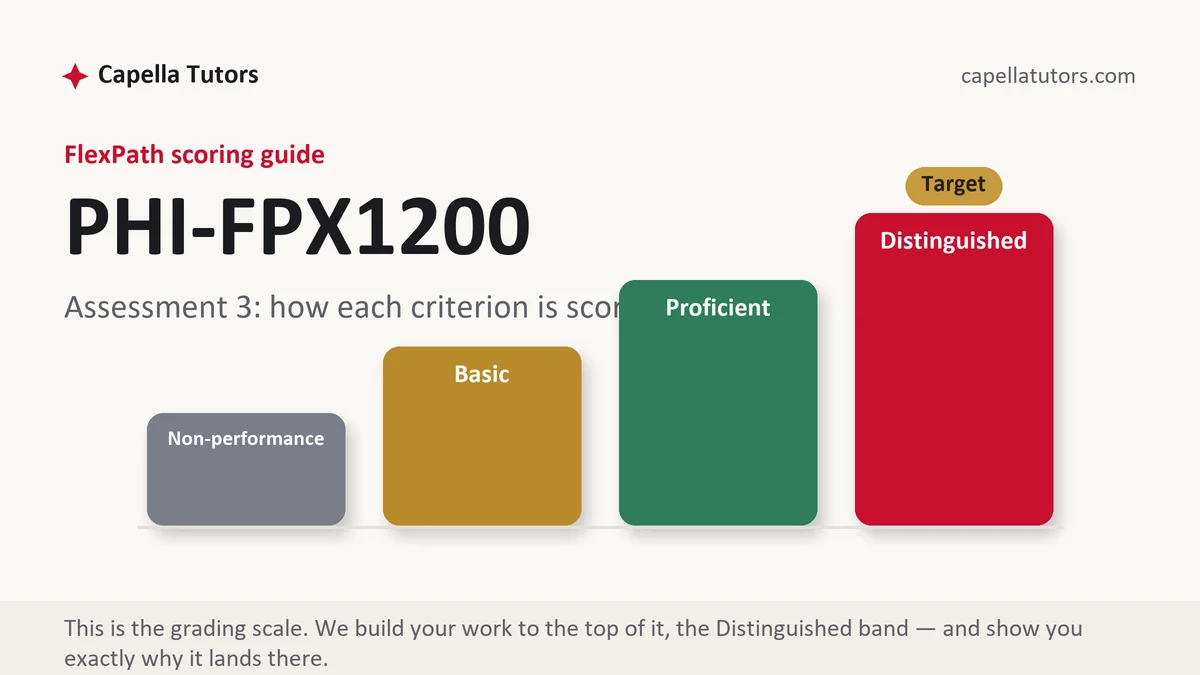
How PHI FPX 1200 Assessment 3 is scored
FlexPath does not use letter grades. Each criterion in the scoring guide lands on one of four levels, and the level descriptions are the real writing brief:
| Level | What it means on a skill development plan |
|---|---|
| Distinguished | Each target skill has an honest assessment of strengths and gaps, specific actions and resources, a timeline and a measure, and the benefits are connected to your goals. |
| Proficient | The plan is complete, but actions or measures are general. |
| Basic | The plan states skills to improve with few concrete actions. |
| Non-performance | A target skill, the actions or the connection to goals is missing. |
Use the template your courseroom provides if there is one, and build on your Assessment 2 reflection.
The PHI FPX 1200 Assessment 3 method, step by step
-
Choose target skills
The skills your guide names or the ones your reflection identified.
-
Assess each skill
Current strengths and areas for improvement.
-
Plan actions
Courses, practice, feedback or mentoring for each skill.
-
Name resources
Capella resources, tools or people who will help.
-
Set timelines and measures
When and how you will know you improved.
-
Connect to goals
How each skill supports your personal, academic and career goals.
A structure that maps to the criteria
Follow the template in your courseroom if there is one; word counts are planning targets our tutors use.
| Section | What it must do | Guide |
|---|---|---|
| Target skill 1 | Strengths, gaps, actions, resources, timeline. | template fields or ~100 words |
| Target skill 2 | Strengths, gaps, actions, resources, timeline. | template fields or ~100 words |
| Target skill 3 | Strengths, gaps, actions, resources, timeline. | template fields or ~100 words |
| Benefits and connections to goals | How the plan serves your goals. | ~150 words |
Annotated sample excerpt
An original model excerpt from our team, written to show the register that reaches the top of the guide. Learn the moves, then write your own version.
Target skill 2, technology: my strength is everyday use of office software, but I struggle with spreadsheets beyond simple lists, which slows me down when reports are due.1 Over the next eight weeks I will complete the free spreadsheet course in the Capella library, practice by rebuilding my department's monthly report with formulas, and ask a colleague to review it.2 I will know I have improved when I can produce that report without help in under an hour, which matters for my goal of moving into a supervisory role.3
- 1Assesses the skill honestly with a specific gap.
- 2Plans concrete actions with resources and a timeline.
- 3Sets a measure and links it to a goal.
The full premium sample for your exact assessment, written fresh to your scoring guide and topic, is free to request. Study it, revise it into your own voice, and submit work you understand.
The five mistakes that cost Distinguished
- Vague actions. Name specific steps and resources.
- No timeline. Set dates.
- No measure. Say how you will know you improved.
- Skipping strengths. Assess what you already do well.
- No link to goals. Connect each skill to your goals.
Pre-submission checklist
- Target skills chosen
- Strengths and gaps assessed
- Specific actions and resources
- Timelines and measures
- Connection to goals
- Template completed if provided
Want the skill development plan written?
Send the scoring guide and any materials from your courseroom. Our team returns a premium original skill development plan in 24 to 48 hours, revised free until it meets the guide.