This manual is for PHI FPX 1200 Assessment 2, start to submission. Reflecting on Your Skills, Goals, and Accomplishments asks you to take stock of yourself: who you are and what you are aiming for, your strengths, your areas for growth, how you solve problems, and two or more accomplishment statements that show what you have achieved, followed by reflection on the experiences behind them. The grade turns on evidence. Strengths and accomplishments backed by specific results score above lists of qualities. Below is the method our tutors use, a structure that maps to the criteria, and an annotated sample excerpt. Prefer to hand it off? A premium original sample for this exact assessment comes back in 24 to 48 hours, revised free until it meets the guide. Capella's catalog lists the course as PHI-FPX1200, and some courserooms print PHI1200; both point to this same Assessment 2. In current courserooms this assessment typically appears as "Reflecting on Your Skills, Goals, and Accomplishments".
One honesty note before the manual: Capella revises courses and scoring guides over time, so always write to the exact scoring guide attached to your assessment in the courseroom. The course identity above is verified on capella.edu; the method and structure below are our tutors' approach to it, not Capella's official rubric text.
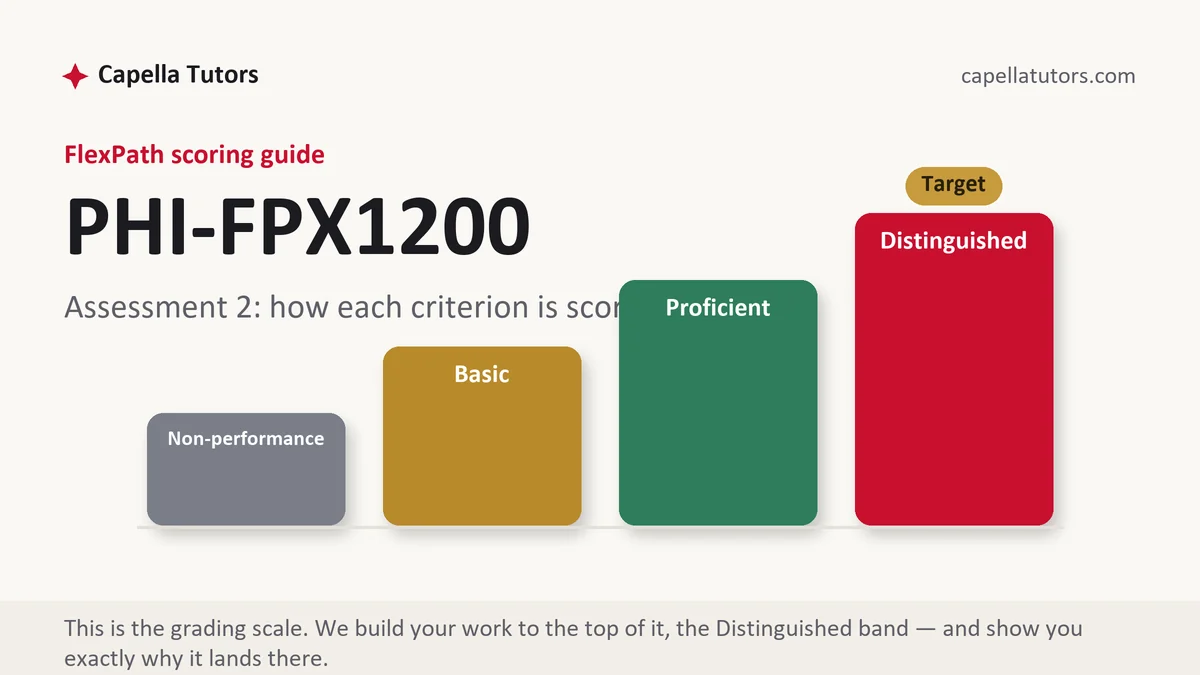
How PHI FPX 1200 Assessment 2 is scored
FlexPath does not use letter grades. Each criterion in the scoring guide lands on one of four levels, and the level descriptions are the real writing brief:
| Level | What it means on a skills and goals reflection |
|---|---|
| Distinguished | Goals are clear, strengths and growth areas are specific and supported by examples, problem-solving is described concretely, accomplishment statements show actions and results, and the reflection shows insight. |
| Proficient | All parts are present, but examples and results are general. |
| Basic | The paper lists qualities with little evidence. |
| Non-performance | The accomplishment statements or the reflection are missing. |
Write accomplishment statements in the action and result form used on resumes: what you did and what changed because of it.
The PHI FPX 1200 Assessment 2 method, step by step
-
Introduce yourself and your goal
Your background and the academic or career goal driving your degree.
-
Name strengths
Two or three, each with an example.
-
Name growth areas
Honest areas to develop and why they matter for your goal.
-
Describe your problem solving
How you approach problems, briefly, with an example.
-
Write accomplishment statements
Action verbs, specific actions and measurable results.
-
Reflect
What those experiences taught you.
A structure that maps to the criteria
Word counts are planning targets our tutors use, not Capella rules; follow the length and format your scoring guide states.
| Section | What it must do | Guide |
|---|---|---|
| About me and my goal | Background and goal. | ~100 words |
| Strengths | With examples. | ~100 words |
| Areas for growth | With reasons. | ~100 words |
| Problem solving | Your approach with an example. | ~75 words |
| Accomplishment statements and reflection | Two or more statements, then reflection. | ~150 words |
Annotated sample excerpt
An original model excerpt from our team, written to show the register that reaches the top of the guide. Learn the moves, then write your own version.
Accomplishment 1: Redesigned the scheduling process for a four-provider clinic, replacing paper sign-up sheets with a shared online calendar, which cut double-booked appointments from about six a week to fewer than one within two months.1 The experience showed me that I am good at seeing where a process breaks down, and that staff accept change more readily when they help test it.2 It also connects to my goal of moving into practice management, where improving processes is a daily part of the job.3
- 1States the action and a measurable result.
- 2Reflects on what the experience revealed.
- 3Links the accomplishment to the stated goal.
The full premium sample for your exact assessment, written fresh to your scoring guide and topic, is free to request. Study it, revise it into your own voice, and submit work you understand.
The five mistakes that cost Distinguished
- Qualities without evidence. Support each with an example.
- Accomplishments without results. Show what changed.
- Avoiding growth areas. Name them honestly.
- No link to goals. Connect each part to your goal.
- Missing reflection. Say what the experiences taught you.
Pre-submission checklist
- Goal stated
- Strengths with examples
- Growth areas named
- Problem-solving approach
- Accomplishment statements with results
- Reflection
Want the skills and goals reflection written?
Send the scoring guide and any materials from your courseroom. Our team returns a premium original skills and goals reflection in 24 to 48 hours, revised free until it meets the guide.